Why You Need a Source of Truth for Product Information
Key takeaways
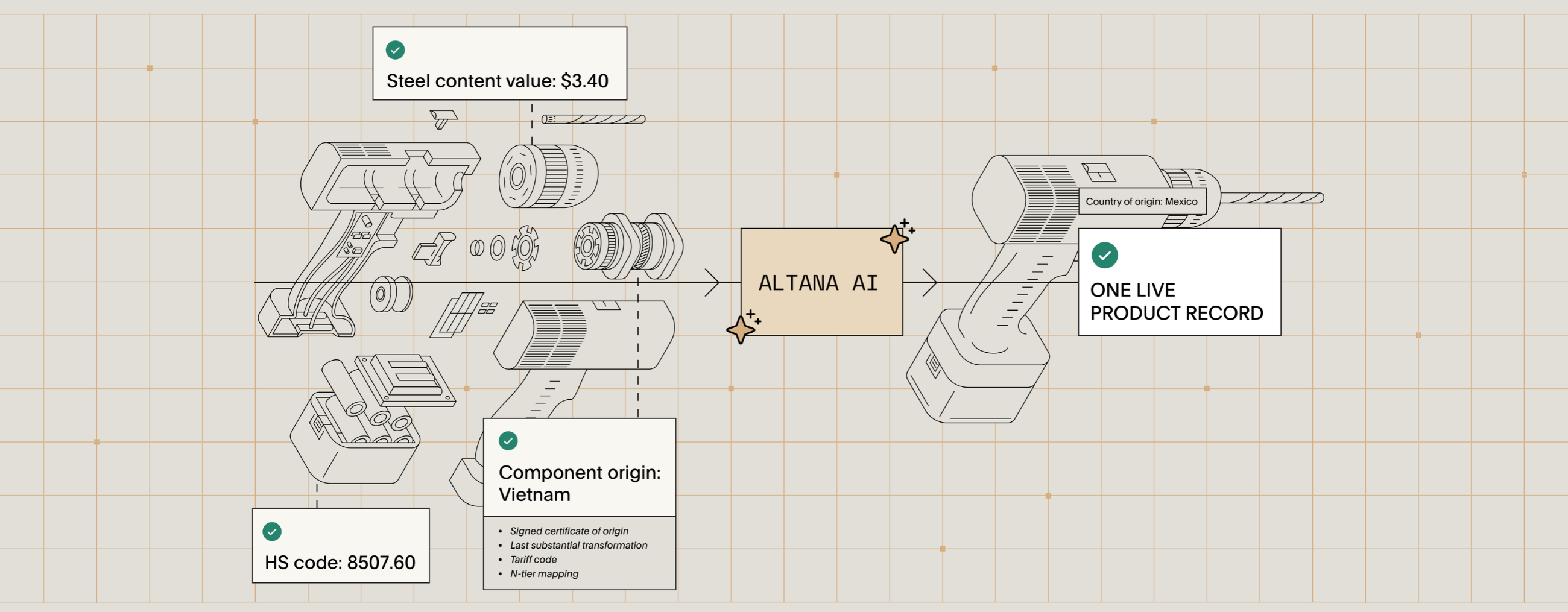
Most enterprises treat product data as a disconnected record: created once in a PLM or ERP, reasoned differently through the lens of purchasing, manufacturing, sales and logistics while the rules around it modernize. In reality, fragmented product information is a hidden cost across your business: detained shipments and overpaid tariffs, fragmented spend on the same parts, ESG claims that can’t be traced to a product, and plans built on an outdated picture of supply. An intelligent product catalog replaces those silos with one dynamic product record, connected to the customers, suppliers, logistics providers, and regulators across your value chain.
✓An intelligent product catalog encodes tribal knowledge in software, eliminating key-person dependencies and bringing functions across your business together on one source of value chain truth.
✓Siloed product data across trade, procurement, ESG, planning, and risk teams creates blind spots that show up as border seizures, tariff overpayments, untracked part-level spend, and sustainability claims no one can verify.
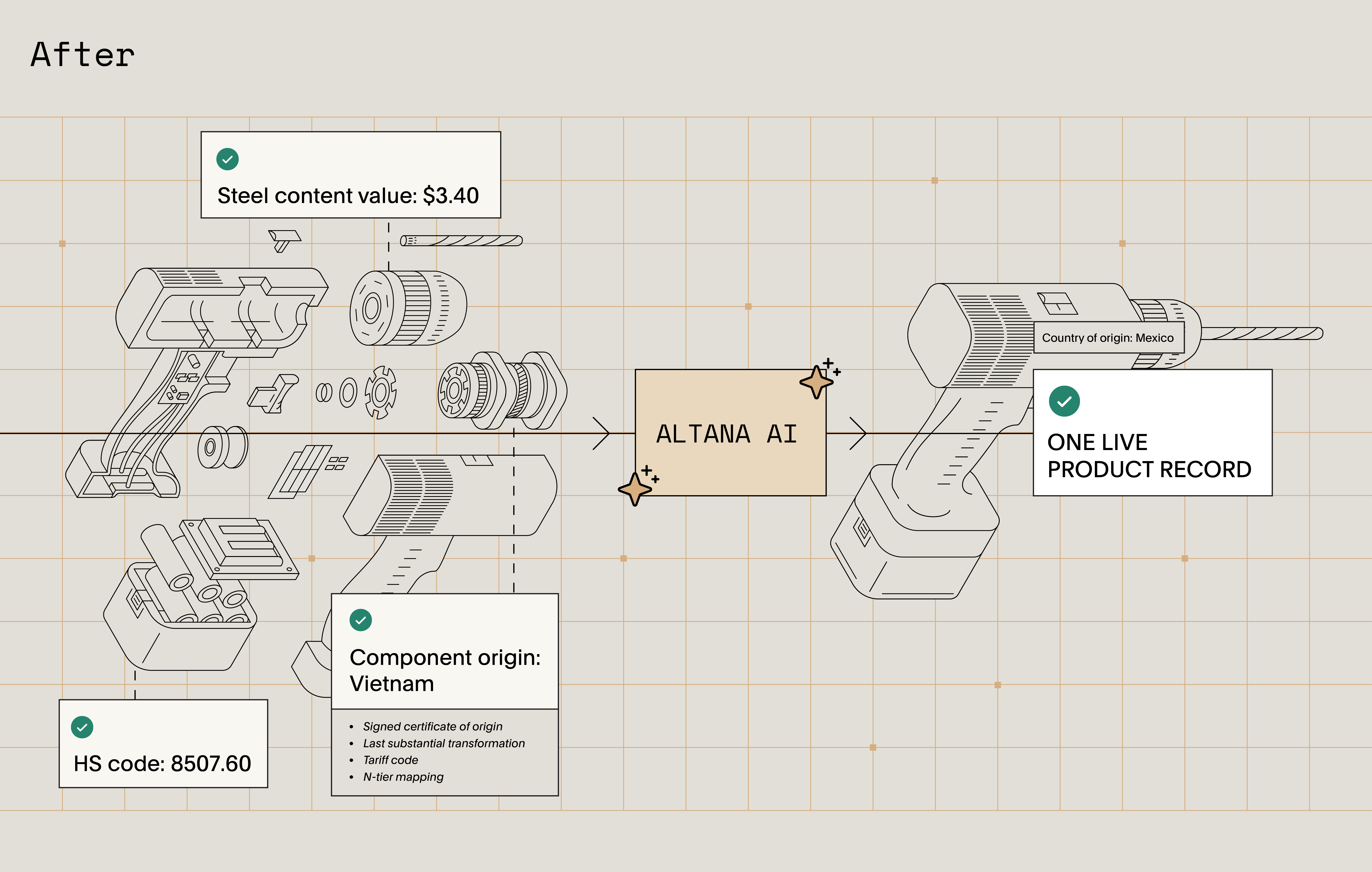
✓Altana’s intelligent product catalog brings the BOM, value chain traceability, product safety, trade compliance, risk, ESG, spend, and revenue into one dynamic view, kept current as suppliers, brokers, and regulators contribute across the Altana network.
Your product data is everywhere. Your product truth is nowhere.
Ask five teams at the same company what's in a product, and you may get five differing answers.
Products are often created in a PLM, but that data quickly goes stale because the other teams that interact with a product as it’s manufactured, transported, and sold will alter the ground truth, while recording that information across different systems — or not at all. What’s more, the core enterprise systems that product data flows through are built around general ledgers, leaving no room in their data models for a rich, multi-dimensional view of the product to serve various business functions from a single source of truth.
Here’s what this looks like in real life. Let’s follow a single product, say a cordless drill, from idea to checkout.
1. Design. Engineers build the drill in a PLM. They think about specs, materials, and performance: the motor, the gearbox, the lithium-ion battery pack, and the bill of materials that ties them together. Country of origin and tariff exposure rarely make it into the record.
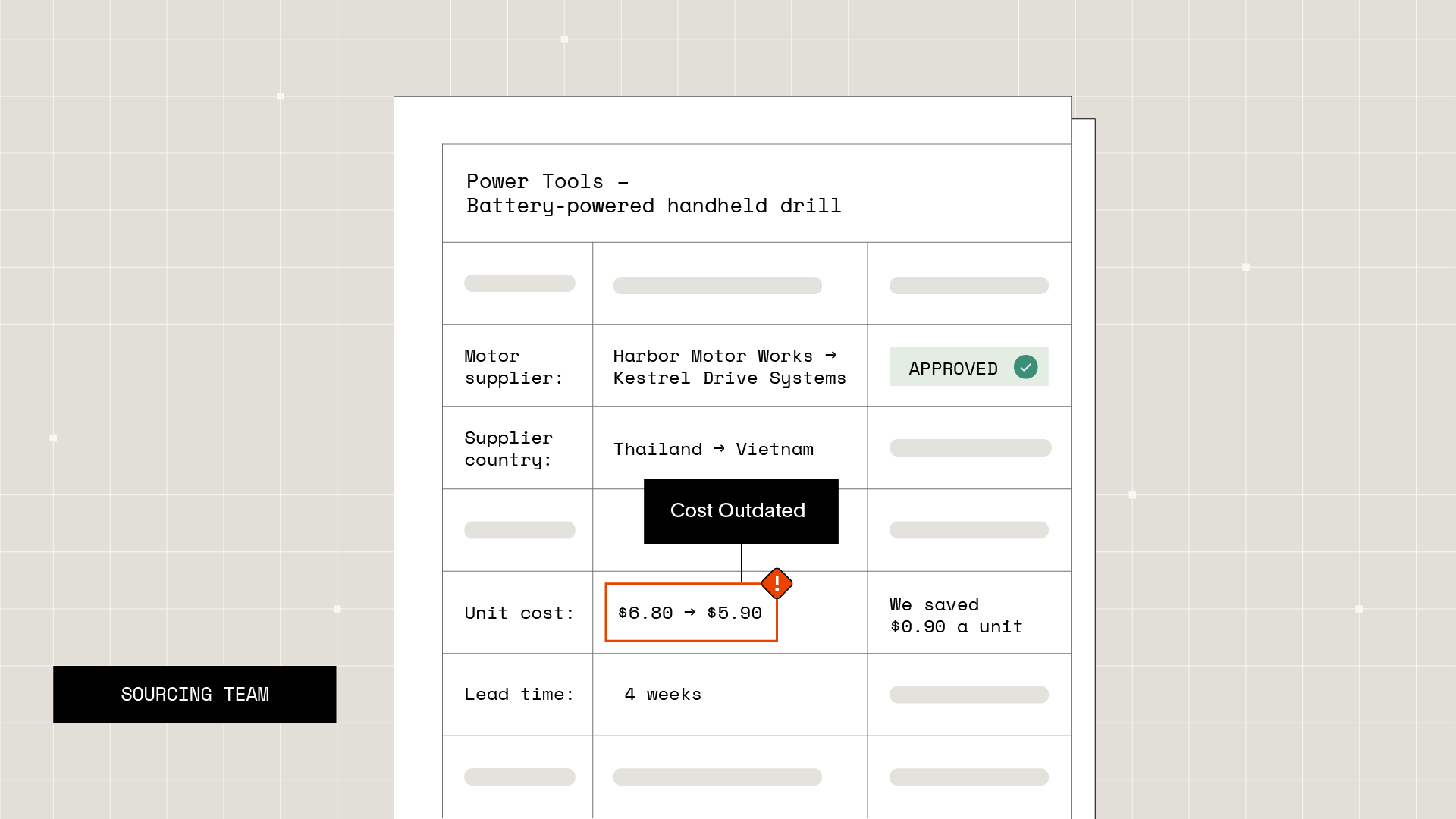
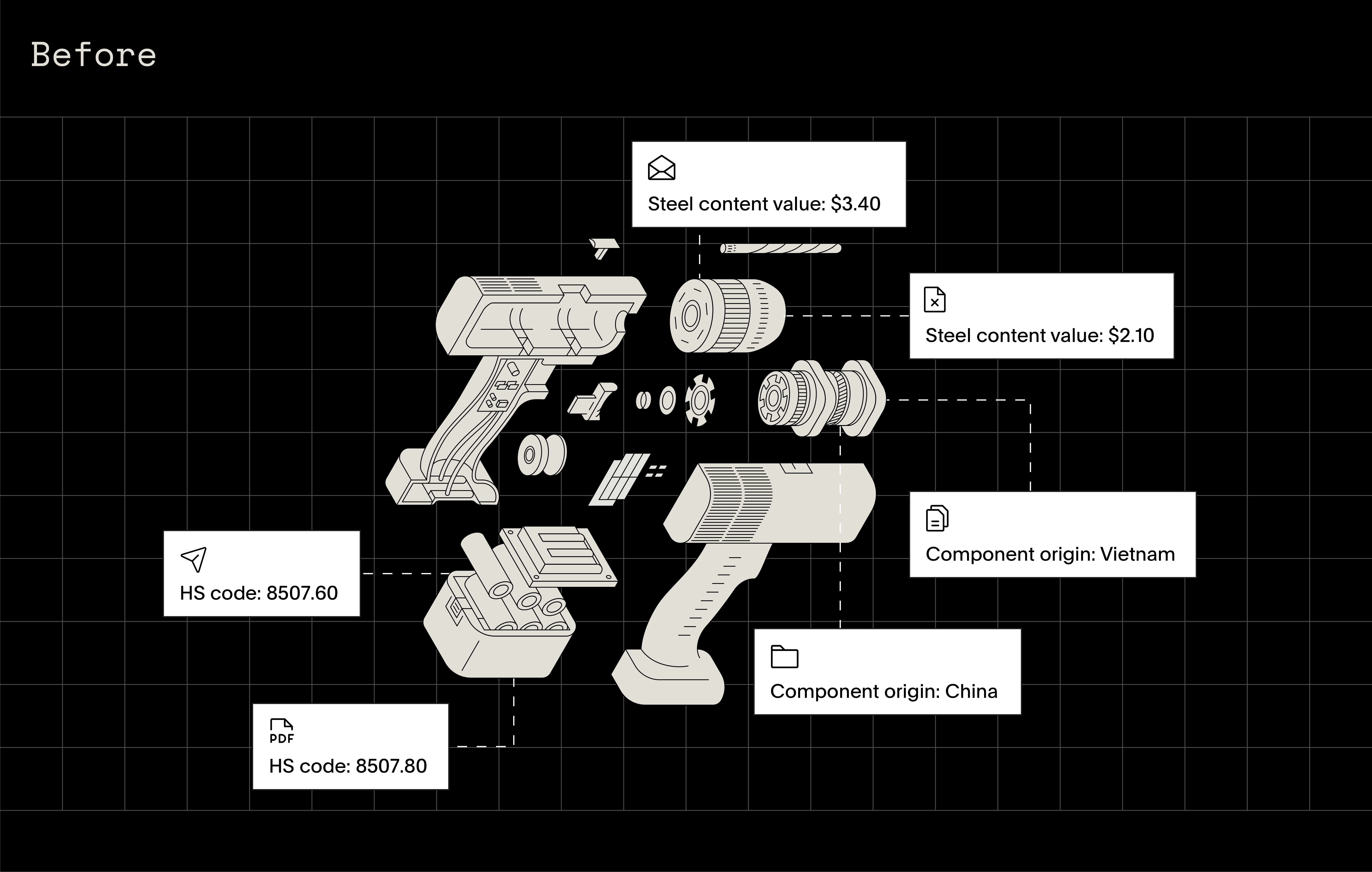
2. Sourcing and procurement. Buyers choose a supplier for each component based on cost, quality, capacity, and lead time, and record supplier names, part numbers, and prices in the ERP. When the battery supplier in one country is swapped for a cheaper one in another, the PLM never records it. And because the same battery cell is bought by three business units under three part numbers, no one sees total spend on it.
Why Your Supply Chain Risk Management Plan Will Fail
3. Planning. Demand planners forecast how many drills will sell and set orders and inventory to match. The plan lives in a planning tool that can’t see which of the drill’s parts are single-sourced, delayed, or facing new tariffs.
4. Manufacturing. The contract manufacturer assembles the drill and buys many of its own sub-components. It thinks about yield, substitutions, and keeping the line running. Which smelter supplied the cobalt in the battery cells, or which mill made the steel in the chuck, are value chain details its systems don’t record.
5. Sustainability. The ESG team needs the drill’s carbon footprint and proof that its battery minerals and the rubber in its grip aren’t linked to forced labor or deforestation. It sends suppliers a company-level questionnaire with no connection to the drill or its bill of materials, then waits weeks for answers it can’t verify.
6. Trade compliance. Before the drill can ship, trade teams need its HS classification, country of origin, FTA eligibility, duty rate, and evidence that no component ties back to a restricted party. To get there, they piece together a bill of materials pulled last spring and supplier declarations buried in email.
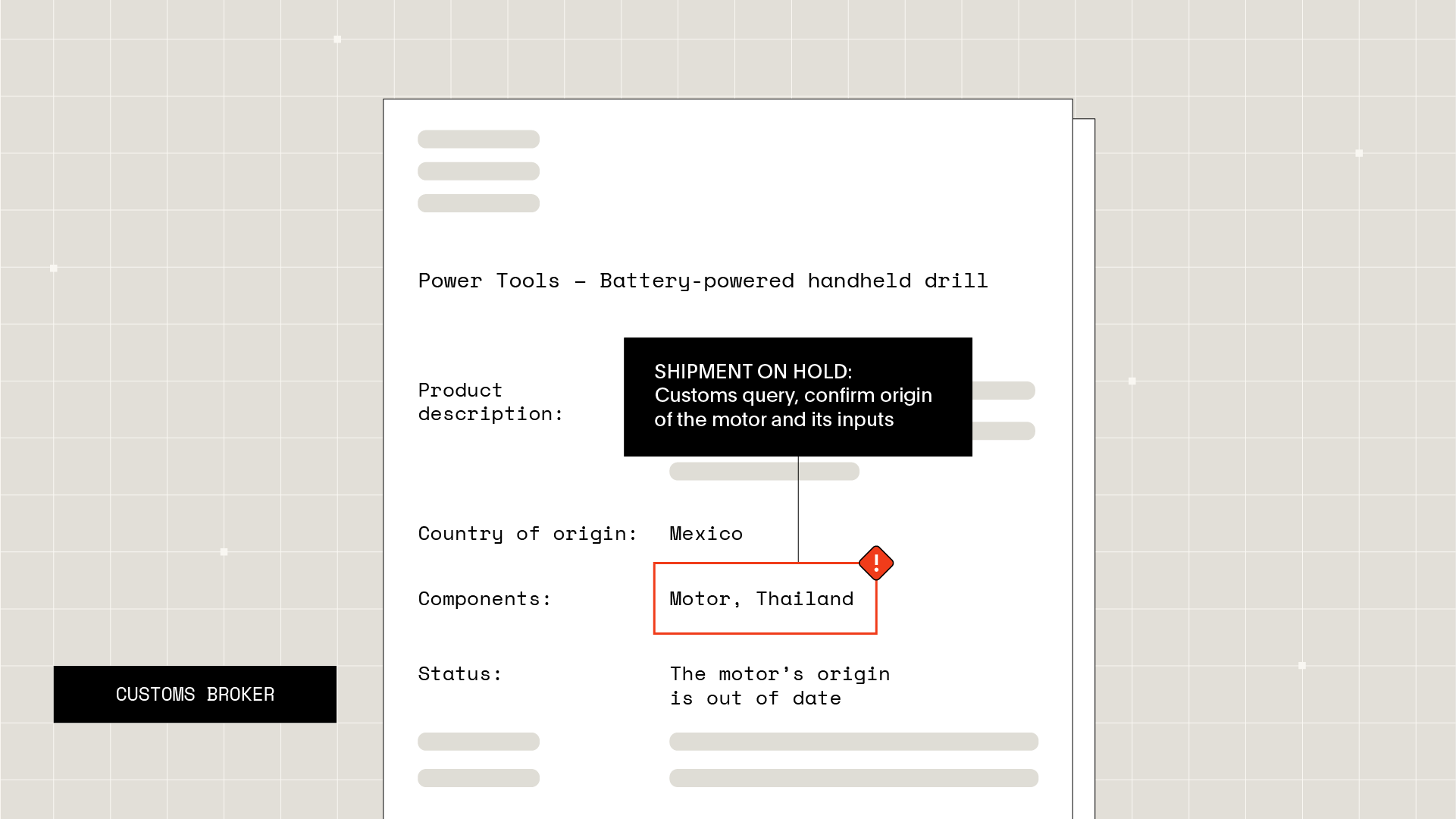
7. Transport and clearance. Freight forwarders, carriers, and customs brokers need a product description, HS code, value, and origin for every entry, plus supporting documents if Customs asks. They file from whatever specs they were sent weeks or months ago.
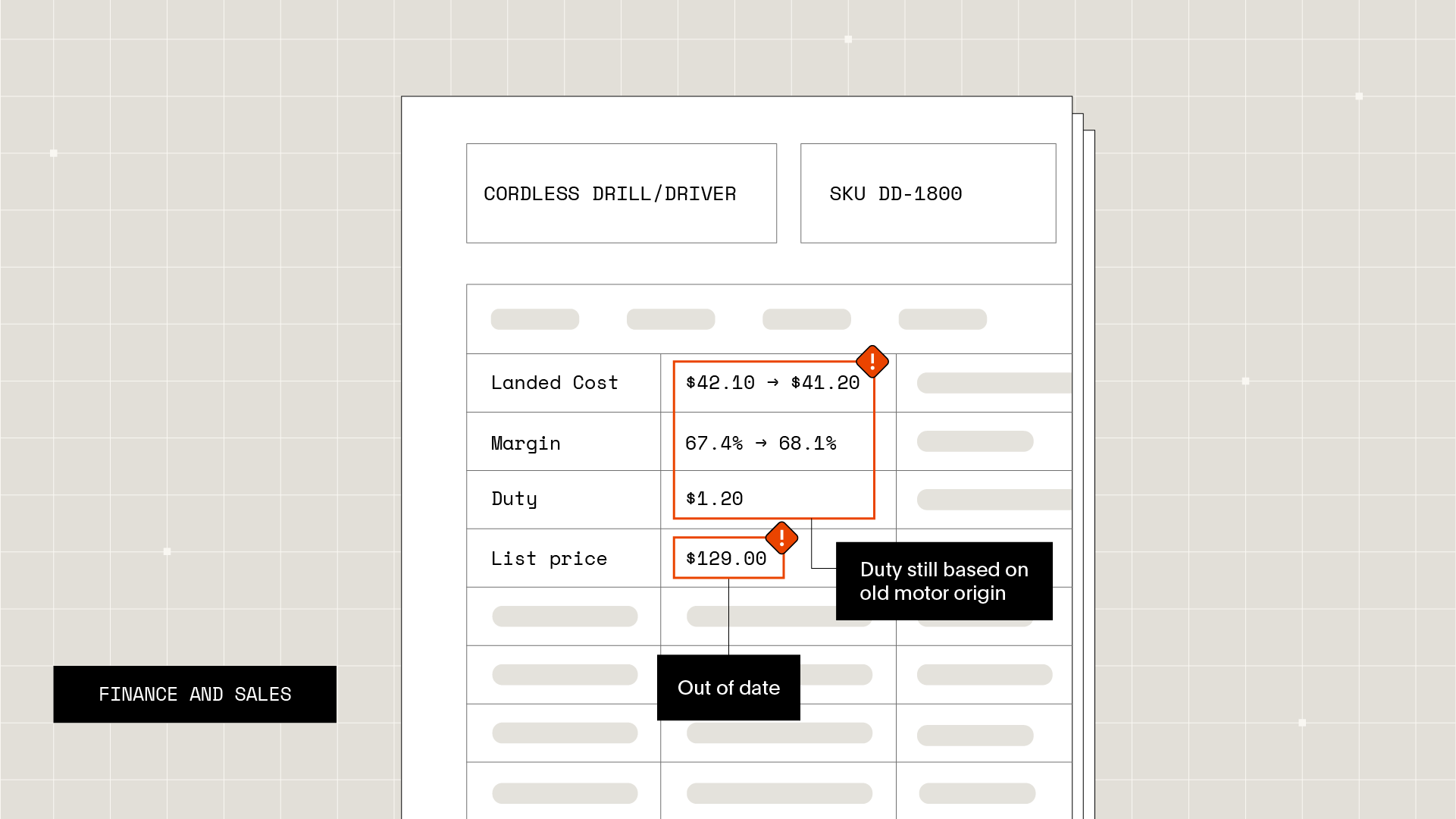
8. Sale. By the time the drill reaches a store shelf or an online cart, it’s a SKU in the ERP’s general ledger: a price, a cost, a margin. Finance tracks landed cost and sales tracks demand. Neither sees that a supplier change three tiers upstream just impacted the duty rate, the carbon footprint, and the margin.
Every one of these records was accurate for the team that wrote it, at the moment it was written. But products don’t stand still. Each time a supplier, component, or regulation changes, every version drifts a little further from the full product truth.
This used to be only an inefficiency. Now it's a liability that hits the bottom line. Component-based tariffs, product-level compliance rules, and parts shortages that interrupt assembly lines mean product information has to be right, current, and provable — across every team that touches it and every partner who needs it. That takes a single, intelligent source of product truth.
The gap is already showing. According to The State of Enterprise Trade & Customs Organizations, maintaining a centralized record of products is the #1 responsibility of a trade professional. Yet 76% of respondents could not produce full information about a product within a day if Customs or a broker asked.
"Fragmented trade data slows decisions and makes it hard to trust the numbers."
C-suite executive,
Industrial Manufacturing
C-suite executive,
Industrial Manufacturing
"When sourcing patterns change, it affects all the trade information about a product that we need to ensure our filings and attestations to CBP stay accurate and compliant — country of origin, HS codes, supplier compliance details."
Sr. Manager, Trade Compliance,
Pharmaceuticals
Sr. Manager, Trade Compliance,
Pharmaceuticals
"We manually review and update product data across multiple systems and spreadsheets which takes time and can create delays."
Sr. Manager, Trade Compliance,
Electronics & Semiconductors
Sr. Manager, Trade Compliance,
Electronics & Semiconductors
10 reasons you need an intelligent product catalog
Here’s what changes when every team and partner works from one intelligent product record.
1. Product, trade, and business data come together in one master record.
Trade decisions usually sit apart from general product and business data, even though they directly depend on each other. Classifications depend on physical product composition, while sourcing decisions rely on import tariff costs. Unifying trade and business data within a single catalog enables trade compliance to actively inform strategic sourcing and product decisions rather than reacting to them after the fact. The same applies well beyond trade: the BOM, value chain traceability, product safety, risk, ESG, spend, and revenue all describe the same product, so they belong in one unified view that updates as products and suppliers change.
2. Buyers negotiate with the full cost picture, not the supplier’s version of it.
When tariffs hit, Tier 1 suppliers pass the increase along, and buyers rarely have the data to push back. A 25% duty on a sub-component that makes up a small share of a part’s cost shouldn’t turn into a 15% price increase on the whole part. Because an intelligent product catalog maps each part’s bill of materials to its upstream value chain, buyers can see which Tier 2 inputs are actually exposed to new duties, where they come from, and how much of the part’s cost they represent. That gives procurement a fact-based should-cost position before the price conversation starts. It also lets them compare alternative suppliers, sites, and lanes by their real landed cost and tariff exposure, so sourcing decisions don’t have to wait until the bill arrives.
EQI: Forging the Future of Resilient, Compliant Supply Chains
3. Modern trade policy demands product-level value chain visibility.
Regulations like UFLPA, Section 232 tariffs, EUDR, and CBAM care about the value chain behind the goods, not just the end product or the company making them. With an intelligent, networked product catalog, you have the value chain evidence to prove compliance before goods ship, and it stays current as the rules change.
Reveal Your Products' DNA With Product Value Chains
4. Alignment across teams prevents costly compliance gaps and keeps delivery and costs predictable.
Today, trade compliance, sourcing, procurement, ESG, planning, and risk management often conduct separate traceability and supplier research. Bringing everyone onto a single platform ensures teams draw from and contribute to the same record rather than starting from scratch or working off conflicting data. When views diverge, errors ripple outward: an inaccurate understanding of a product's composition or origin leads to wrong HS codes, incorrect duty rates, overpaid tariffs, or compliance exposures.
5. Adjusting to regulatory or sourcing changes is easier when the information lives in one place.
Much of the pain in trade workflows is spending hours retrieving and cleaning data scattered across emails and spreadsheets. Because spreadsheets are static snapshots, they quickly go stale due to regulatory updates (like new tariffs or reclassification rules) and sourcing shifts (like new suppliers or country-of-origin changes). Centralizing product data in a catalog — connected directly to enterprise systems like your ERP — keeps information live, usable, and consistently up to date.
The State of Enterprise Trade & Customs Organizations
6. Institutional knowledge stays with your business, and every decision is auditable.
Whenever product attributes change or classification decisions occur, a centralized catalog records who made the change, when, and why. This decision log provides complete traceability for internal reviews and customs inquiries. It also ensures critical product knowledge stays in a shared system instead of in people’s heads or on sticky notes, where it can walk out the door when employees leave.
7. ESG data finally connects to the products it describes.
Carbon, deforestation, and forced labor risk are specific to a product’s value chain: which plantation grew the rubber, which smelter refined the cobalt, which mill produced the steel. Supplier surveys ask company-level questions with no link to a product or bill of materials, so answers are slow, generic, and hard to verify. When ESG requests are tied to the parts in a specific BOM, suppliers answer for what they actually provide, and you can calculate product carbon footprints, document EUDR due diligence, and trace forced labor exposure component by component.
8. Plans reflect the supply chain you actually have.
Demand signals only become useful once they’re translated through product value chains. A forecast for 50,000 drills is really a forecast for 50,000 motors, battery packs, and chucks, each with its own suppliers, lead times, and tariff exposure. With product structure and value chain data in one record, planners can turn demand into component-level orders and inventory targets, and see in advance where a single-sourced part or a new duty will constrain supply.
9. A shared product record makes your customs broker relationship more productive.
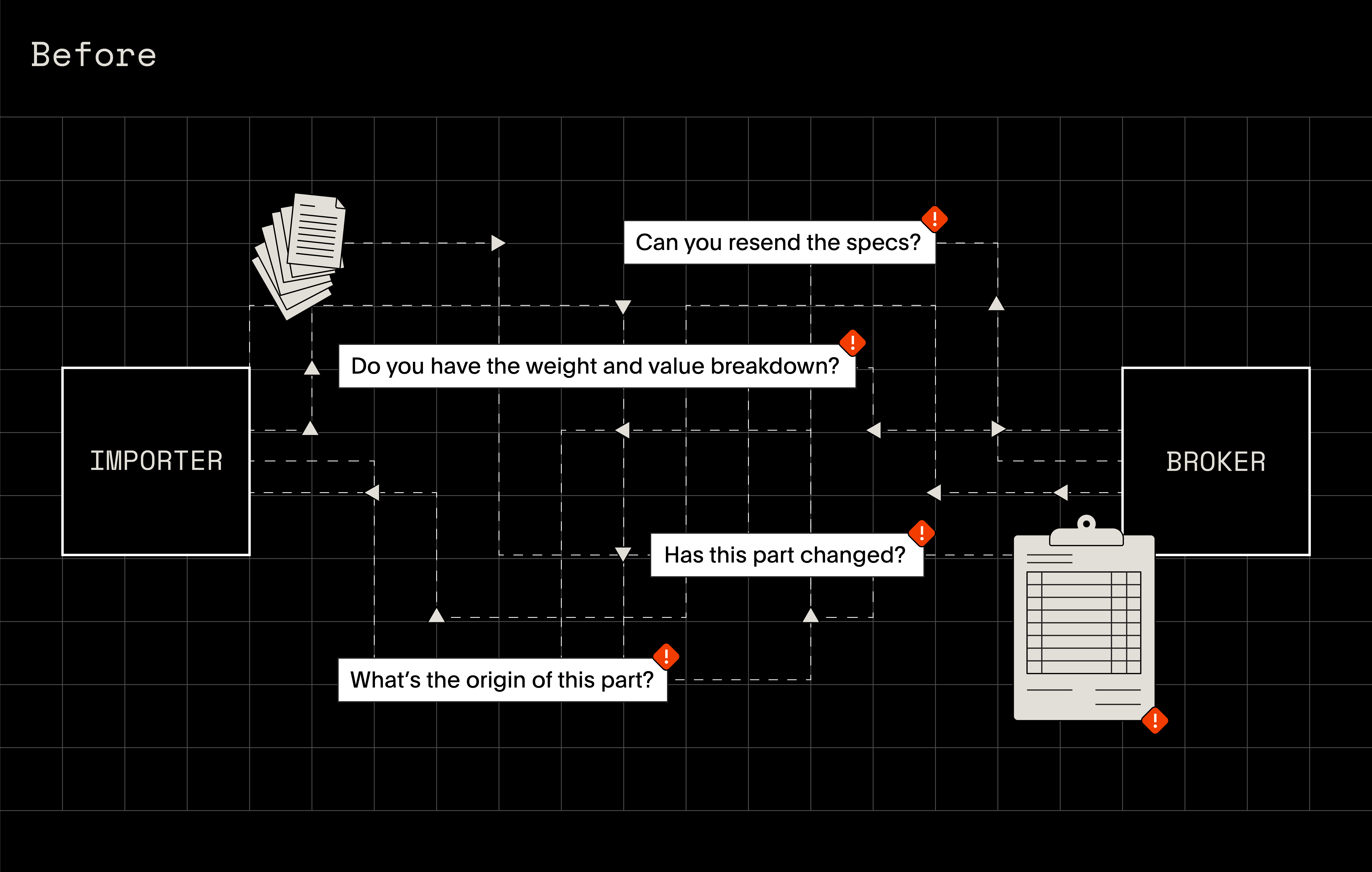
Your brokers’ entries are only as accurate as the product data you hand over. When that data moves through spreadsheets and email threads, the same product gets re-described on every shipment, for every broker. Errors result in corrections, holds, and duty overpayments and underpayments. Discrepancies mean endless back-and-forth and sharing identical product details repeatedly.
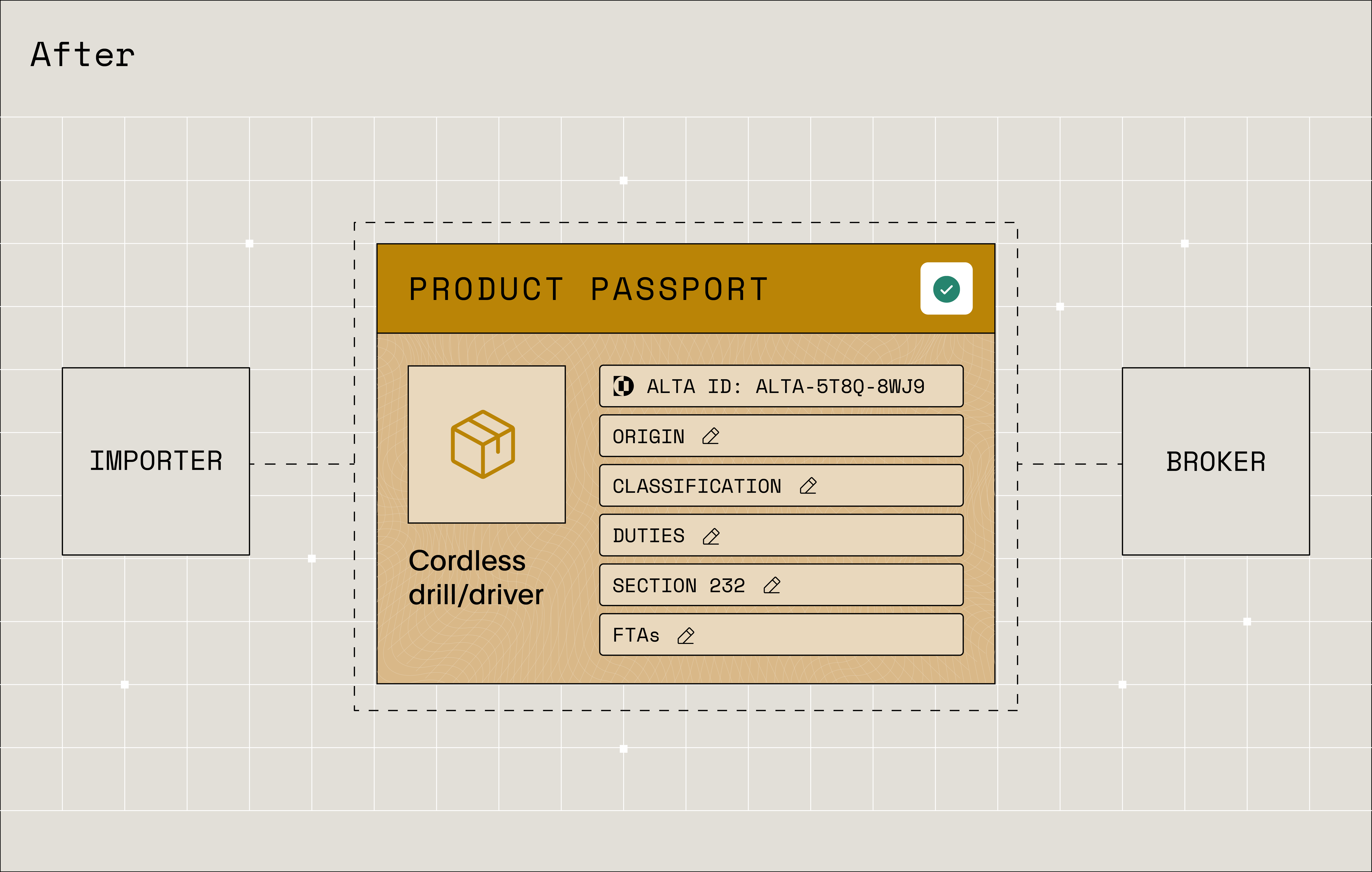
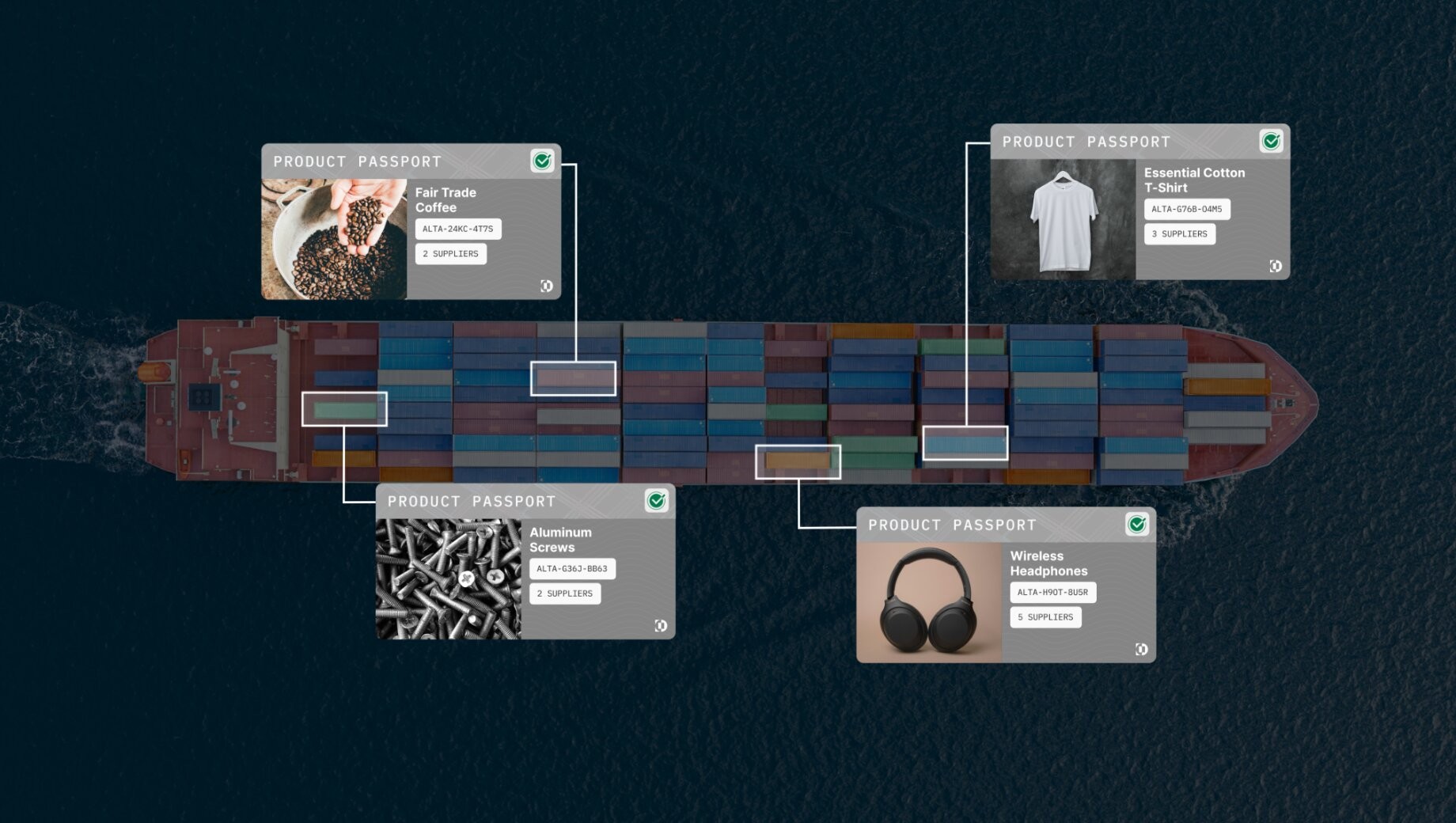
But if you maintain one central, continuously updated product record that is shared with brokers through Product Passports, they file from current, validated data instead of specs that are weeks, months, or years old. Your broker is freed up to focus on the expertise you hire them for: exceptions, regulatory judgment, and keeping goods moving. You deal with fewer requests for more information, and you get a clear view of what was actually filed, which can be checked against the product record you approved.
"The most frustrating part of our broker relationships is that we both lack real-time visibility and consistency around product details, classifications, and documentation."
Director, Trade Compliance,
Industrials
Director, Trade Compliance,
Industrials
"With no shared, real-time product data sync, our brokers rely on outdated component specs we send weeks prior to filing."
Director, Trade Compliance,
Electronics & Semiconductors
Director, Trade Compliance,
Electronics & Semiconductors
"There are just too many back-and-forth requests for our team or our brokers to keep up with. We're all so busy, and there are so many asks for missing product details, classifications, origin information, or documentation."
Sr. Manager, Trade Compliance,
Electronics & Semiconductors
Sr. Manager, Trade Compliance,
Electronics & Semiconductors
"No real-time data sync forces us to repeat sharing identical product details often."
VP, Trade Compliance,
Industrials
VP, Trade Compliance,
Industrials
10. It’s impossible to benefit from AI if your data is all over the place.
Every team that touches the drill is under pressure to use AI to automate workflows, optimize supply chains, streamline classifications, and manage risk. But AI pointed at five conflicting spreadsheets or fragmented systems will produce conflicting answers, creating more noise and manual work for everyone. With one live, verified product record across your organization, AI can effectively reason over your end-to-end value chains—enabling teams to move faster, anticipate disruptions, and achieve true operational efficiency. That’s why Altana’s AI works on your product record and the Supply Chain Graph together: a foundation of verified, product-level data that no generic, publicly trained AI can replicate.
"I want us to get our product data ducks in a row so that we can effectively utilize artificial intelligence. My fear is that we just throw AI tools into the messy mix we have now, and that messy mix gets even messier."
Director, Trade Compliance,
Apparel
Director, Trade Compliance,
Apparel
"If we could use AI to be truly 'trade ready' with a live product record and trusted tools, the business would move faster with fewer delays, penalties, and compliance surprises. For me, it would mean spending less time chasing data and firefighting and more time proactively managing risk and getting medicines to patients on time."
VP, Trade Compliance,
Pharmaceuticals
VP, Trade Compliance,
Pharmaceuticals
"Before I trust AI with our supply chain, it has to be proven accurate on OUR data. It has to predict OUR landed cost within 3% and OUR container ETAs within 2 days, using our actual POs, freight bills, and 3PL data - not a demo dataset."
Chief Supply Chain Officer,
Industrials
Chief Supply Chain Officer,
Industrials
"The root problem for AI usage is data fragmentation. AI needs one reliable source that everyone works from, instead of chasing spreadsheets and emails."
CTO,
Industrials
CTO,
Industrials
What makes a product catalog intelligent and networked
Most product catalogs only store what someone typed into them. Altana's product catalog is an intelligent, networked system of record: a collaborative master data layer for products, their input parts, and their extended value chain networks. It integrates with the enterprise systems you already run.
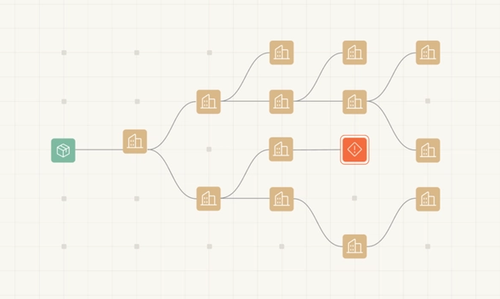
The catalog uses AI to integrate, clean, deduplicate, and enrich product master data, bills of materials, and upstream value chain traceability, and it consolidates product attributes across safety and compliance, sustainability, trade, product images and drawings all into one unified record. It maps every product with the manufacturing and distribution sites for those goods, and maps each bill of materials with its value chain — the suppliers, sites, and transportation lanes associated with each input to the bill of materials through each tier of production. Finally, it associates products to their customers and revenue data, and input parts — and their upstream components — to spend data. Now, each product record contains a full view of its value chain, the various product attributes needed by each function of your business, and a consolidated view of revenue and spend in each product line, mapped to the upstream value chain network and downstream customers.
With this data foundation in place, AI can go to work to enrich, audit, and do work on your product master data. Each product, part, site, and company in the catalog is connected to the world’s most comprehensive supply chain knowledge graph to power your business with additional visibility and context. Altana’s Supply Chain Graph covers nearly every company on Earth and the ownership connections between them. It also encompasses nearly every facility on Earth and its function. Most importantly, it maps the physical movement and transformation of goods across these facilities, providing a bottom-up view of the global physical economy. In all, the graph covers more than 50% of global trade.
AI models generate suggested multi-tier value chain connections based on the products, parts, and the vendors and sites known to your business. Your purchasing teams curate these value chain networks, and the models learn. AI agents apply each enterprise's own SOP to every product, reassess as data changes, and keep the reasoning, so the team's expertise builds up in the platform, and AI works as your team works, not from a generic rulebook. Agents also generate — or audit — your trade and compliance attributes to make them trade-ready, eliminating endless back-and-forth with your customs brokers on product specs and runaway spend on third-party professional services firms, and making your trade teams more productive. Agents then identify bottleneck facilities in your upstream value chains, monitor real-time events that might lead to a business interruption, and simulate network disruptions to inform planning and supply chain orchestration. Finally, AI helps to identify where the views in the catalog are incomplete in order to direct traceability workflows across the network in Altana.
Product Passports connect parties and their product data across the value chain network. Replacing supplier surveys, Altana Product Passports create a digital bridge for the data, documents, and agents across the network, helping to fill in gaps in value chain traceability and retrieve ground-truth documentation and data where necessary. Each Product Passport represents a value chain connection — the part, sites, and supplier associated with each step of the upstream bill of materials.
Data flows into your catalog from the upstream value chain. And you can share data through Product Passports with your customers, your logistics providers, and even with your regulators, like US Customs and Border Protection, all from your networked catalog. Sharing is managed according to strict field-level permissioning, and data is recorded into your product catalog only when your authorized users review and approve data flowing to you. In short, as your network changes, as your products change, and as markets and regulations change — so does your product catalog. And every function of your business that relies on your product data benefits accordingly.
Altana Product Passports: A Digital Pass for Trusted Trade
Rethinking product truth: Networked intelligence vs. static databases
Most product databases are places where internal data goes to sit. Altana's intelligent product catalog is different because it's powered by the Altana network: the suppliers who make your components, the logistics providers and brokers who move and clear your goods, and the regulators who decide whether they cross the border.
Here’s what that means for the drill. When the battery supplier moves cell production to a new plant, that supplier can update its part of the value chain directly in Altana, and the change flows into your catalog. Trade compliance sees the new country of origin and the duty impact. The ESG team sees the new carbon figure. Planners see a new lead time. Procurement sees the cost change against total spend on that cell. Your broker files the next entry from the updated record. Nobody had to send a survey or chase an email to find out.
A federated data model keeps your sensitive data and IP private, while letting you share what each partner needs. The catalog takes information in and shares it out. That has two effects:
A more accurate, more current picture. What suppliers verify, what your own systems know, and what Altana's Supply Chain Graph suggests all feed the same product record — so you see your products and supply chains as they actually are today.
Less friction in shared workflows. Supplier collaboration, brokerage, and customs clearance all run on the same product data, instead of on emails, questionnaires, and re-keyed spreadsheets.
Turning product truth into a competitive advantage
Every team keeping its own fragmented view of product data is accepting risk, inefficiency, and avoidable border delays. Continuing to rely on memory, scattered spreadsheets, and siloed research puts your company’s compliance, resilience, time, and bottom line at risk.
The question isn't whether you can afford an intelligent product catalog. The question is how many more detained shipments, overpaid tariffs, and wasted hours your team will tolerate before you build a single source of truth.
When your suppliers, logistics providers, and regulators contribute to one networked record, trade readiness, spend analysis, ESG reporting, and planning stop being scrambled and start running on the same current product truth. And when you’re on Altana, your product data can be shared with ERPs, in a Product Passport, or on an invoice as a unique Altana ID that serves as the product’s always-current canonical dataset.
An intelligent product catalog is a centralized system of record for your products: what they're made of, where their parts come from, who supplies them, and how they're classified for trade. In Altana, it combines data from your own systems, AI suggestions from Altana's Supply Chain Graph, and supplier-verified information into full product value chains that keep updating as value chain partners across the network contribute. On top of that record, AI agents automate classification, origin determination, duty calculation, and FTA qualification, and keep tariffs and risk screening current as rules change.
Spreadsheets are snapshots in time. They go stale as regulations and sourcing change, multiply into competing versions across teams, and don't record who changed what or why. An intelligent product catalog stays current and keeps an audit trail of every change and decision.
When teams work from different views of a product, errors spread. A wrong view of a product's composition or origin leads to a wrong HS code and a wrong duty rate. One shared record keeps classification, origin, and duty decisions grounded in the same, current product facts.
It connects to the suppliers, logistics providers, and regulators involved in your products through Product Passports. It takes verified information in and shares it out, so your product picture stays accurate and collaboration happens on real products instead of disconnected emails and surveys.
Importers can share verified product and value chain information with Customs before goods ship. Customs pre-validates trusted goods, and AI monitors them for change. Future entries for those products become simple record-keeping events instead of repeat reviews.
Those systems are built for the whole business, not only for trade. Holding trade records in them often means painful custom extensions, and they can't capture the granular detail trade work requires, such as component origin, classification rationale, and supplier evidence. When rules or sourcing change, teams update the same data by hand across several systems. An intelligent product catalog connects to your ERP and MDM rather than replacing them, adding the product value chain layer they lack while staying current.
Your broker has the product data you've sent, which is usually a snapshot that's re-sent shipment by shipment and may be weeks old by the time they file. That's why trade teams and brokers so often exchange emails to re-establish product details that were already settled for an earlier shipment. With Altana, you share Product Passports from your catalog directly with your brokers, so they file from the same current, validated record your team maintains. You decide what each broker sees, and you can check what was filed against the record you approved.