U.S. Customs selects Altana to modernize enforcement and border clearance

Learn more

Altana

February 12, 2026

Altana in Action

How Product Value Chains in Altana Reveal Your Products’ DNA — and Why Component Truth is a Requirement for Modern Trade Work

value chains dna altana

Subscribe to get the latest in Altana News & Learnings.

Modern trade work now depends on knowing a product’s DNA. Remediating compliance risks, calculating tariff exposure, establishing supply chain resilience — all depend on having a complete, traceable record of a product’s component and material inputs, the countries these inputs come from, and the manufacturing steps, suppliers, and facilities that transformed them into a finished product.
Knowing a product’s DNA is necessary because from tariffs to forced labor enforcement to sustainability laws, trade enforcement has shifted upstream. Compliance with regulations and assessed duties hinge on what’s inside a product, not just what crosses the border. At the same time, general threats to product-line resilience — single-sourced suppliers, adversarial dependence, chokepoints, and more — are typically buried tiers deep in supply chains, where 85% of trade and procurement teams lack visibility.
These challenges mean that modern trade work must be built on product value chains. Value chains are a structural, visual map of how a product is formed, charting the parts and components that funnel into a product, how these inputs flow across the supply chain between different facilities during their journey, and how they change and transform along the way.
electronics usmca linkout
See How One Manufacturer Accessed Component Truth and Identified $615M in USMCA Savings
Learn More
Just as modern trade work must be grounded in product value chains, product value chains are only as strong as the component truth within them. Component truth is the defensible integrity of the product story — where materials originate, how they are transformed, and whether these determinations hold up under enforcement scrutiny.
Establishing component truth and producing product value chains that enable high-impact trade work is possible with Altana. Read and watch to learn:
  • How your Altana catalog centralizes product data that often lives in fragmented systems and spreadsheets
  • The three sources of data that Altana uses to build value chains for every product in your catalog
  • How Altana’s AI models and collaboration with suppliers via Product Passports establish component truth, flesh out accurate, up-to-date value chains, and allow trade teams to navigate a changing enforcement landscape

A central catalog for your product master data — including multi-tier value chains for every product

Trade and procurement teams often manage product information across unwieldy spreadsheets or a series of PIMs, PLMs, ERPs, and other siloed systems. Your product catalog in Altana centralizes information from these fragmented sources into a central repository of information about your products, their specifications and attributes, and the manufacturing that went into their production. This way, every product decision — compliance, tariffs, and sourcing, in addition to shared work with finance, legal, design, and other departments — is grounded in the same product truth.
Each entry in the catalog allows you to aggregate product master data into a product profile. This profile includes a product’s name, image, ID, and description, as well as trade and tariff codes, financial information such as purchase orders, specifications such as bills of materials, relevant documentation, and more.
The centerpiece of a product profile in your Altana catalog is a product value chain — the visual map of how a product is sourced, manufactured, and moved around the world.
From left-to-right, a product value chain extends from the product to Tier 1 suppliers to Tier 2 suppliers to Tier 3 suppliers and beyond. Traveling backwards in the value chain takes you from a product to parts to components to sub-components and eventually to raw materials, enabling accurate origin determination and identification of upstream compliance violations, such as a supplier linked to forced labor. Traveling forward in the value chain charts the flow of raw materials to a finished good, making it possible for your team to model and mitigate tariffs, simulate disruptions, and identify sourcing alternatives.

Mapping value chains from three sources — including AI suggestions drawn from the largest map of the global supply chain

Altana creates product value chains that are a dynamic system of record by drawing information from three sources. The first source is what you already know about your products. This information could be uploaded in bulk into your Altana catalog, or piped into the catalog via an API connection to your other product data management tools. In some cases, you will only know information about your product and its Tier 1 suppliers. In others, some mapping further into the sub-tier has taken place. Either way, you bring the information you have, don’t lose any completed traceability work, and preserve institutional knowledge that would otherwise be recreated shipment-by-shipment.
The second source of information is suggestions by Altana’s AI, which draws from the largest map of the global supply chain — Altana’s Knowledge Graph. The Knowledge Graph is made up of publicly available data, such as bills of lading and customs declarations; commercial data from partners such as Moody’s; and proprietary transaction-level data courtesy of our partnership with Maersk and other leading logistics providers.
AI identifies likely upstream relationships based on transaction evidence in the Knowledge Graph and uses it to suggest which suppliers, components, and facilities exist in a given product’s value chain. Information about the specific transactions that cause Altana’s AI to suggest that a supplier or component is upstream in a product value chain — including rich data such as HS codes and transaction dates — are provided as evidence. If you agree with the AI suggestions, you can add them to the catalog, where they will be reflected in the product value chain.
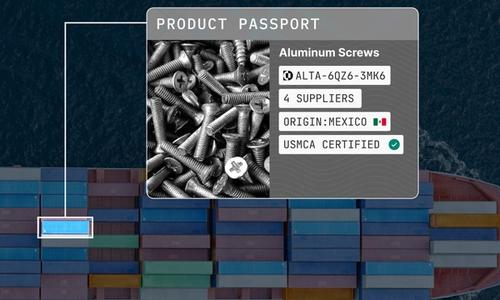
The third source of value chain information comes from what you learn by collaborating with suppliers through Altana Product Passports. You can package up your understanding of a product value chain into a Product Passport, share the Passport with a supplier, and ask the supplier to share with you what they know about a given product. For example, your supplier may have done further upstream mapping into the inputs and suppliers for a specific component within your product. You can update the Passport together, effectively connecting your catalog and your supplier’s catalog for maximum visibility and traceability. Together, you’ve created a shared, documented understanding of product origin and transformation, with neither party being forced into painstakingly rebuilding the product story alone.
If you agree with Altana’s FTA recommendation, you can accept the suggestion. As with every Altana workflow, the option to collect more information from suppliers is still available in a single click.
Together, the three data sources — what you already know about your products, what AI suggests, and what you learn through collaboration with suppliers — give you a living, breathing record of where a product comes from that will evolve even as sourcing and manufacturing changes.

Value chains as the foundation of advanced trade compliance workflows

Product value chains provide a dynamic system of record to navigate component-based trade enforcement and possible threats to product-line resilience that are buried deep in supply chains. This serves as a foundation for faster, more efficient trade workflows that reduce the risk of costly border delays, unlock consistent savings on the most complex tariffs, make it possible to simulate disruptions, and introduce the option to pre-validate shipments with U.S. Customs and Border Protection (CBP) through Altana Product Passports.
The dynamic system of record that product value chains provide also serves as an investment in the future. As enforcement, tariffs, and sourcing strategies continue to shift, product value chains preserve institutional knowledge about how a product came to be so that you and your team can respond to change without slow, painful, and inconsistent recreations of a product’s story and journey.
See the power of value chains for yourself. Schedule an Altana demo today.
  • Case Studies

    From Detention to Pre-Validation: CBP & an Iconic Retailer Leverage Altana Product Passports

  • coo and fta determination with altana

    TradeNerds Academy

    Perform a Complex Country of Origin Determination and Claim FTA Qualification in Minutes With Altana

  • Progressive Filing Webinar

    TradeNerds Academy

    Progressive Filing: Proactive Customs Compliance with CBP

Subscribe to the Altana newsletter

Latest news, announcements and updates direct to your inbox

  • Privacy Policy
  • ©Altana 2025. All Rights Reserved.
  • Altana and the Altana logos are trademarks of Altana Technologies, Inc., in the United States and other countries.

Company Type

  • Platform
  • For Government
  • For Enterprises
  • For Suppliers
  • For Logistics

Use Case

  • Tariffs & Trade Compliance
  • Resilience
  • Counternarcotics

Resources

  • Resources
  • Cookie Preferences
  • Trust Center

About

  • About Us
  • Careers
  • Legal
Altana
  • Privacy Policy
  • ©Altana 2025. All Rights Reserved.
  • Altana and the Altana logos are trademarks of Altana Technologies, Inc., in the United States and other countries.