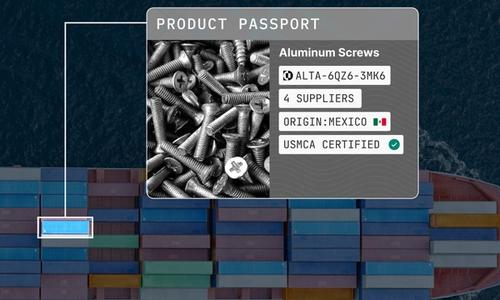
At the center of modern trade compliance work is Country of Origin (COO) — establishing where a product was produced, manufactured, and substantially transformed.
COO importance has been magnified by the fact that it now drives more than duty rates: Origin increasingly determines admissibility, stacked tariff exposure, free trade agreement (FTA) eligibility, and audit risk. This means that COO decisions must be provable and defensible, not merely documented. Such proof lives in every product’s value chain — the component and material inputs in a product, the countries these inputs come from, and the manufacturing steps that transform inputs into a finished product. The challenge is that today’s products are built across multi-tier value chains spanning many suppliers, deep into the supply chain, where many businesses lack visibility. Even when inputs and components are identified, parts and materials frequently originate in multiple countries, and small changes in their sourcing or processing can flip a rules-of-origin outcome — necessitating complex calculations and continuous maintenance, rather than a one-time determination.
The result for trade compliance teams has been a manual marathon. Accurately calculating rules of origin, ensuring compliance with stiffening trade and product regulations, and claiming qualification with free trade agreements (FTAs) has meant sifting through complex Bill of Materials (BOMs), interpreting dense legal text, and chasing down supplier declarations for more and more product lines. Seemingly small mistakes in COO determination compound, with duties, penalties, and missed FTA qualification depressing gross margins by millions of dollars.
Now, with Altana, it’s possible to determine the COO for a complex, multi-tier product and identify qualifications for FTAs such as the United States–Mexico–Canada Agreement (USMCA) in minutes. Watch the four minute demo, and explore the full COO determination and FTA qualification workflow step-by-step.
A central source of product truth meets rule-based logic for lightning-fast COO determinations
With Altana, COO is determined fast and accurately — saving hours and hours of work and elevating trade work to a strategic function that adds to gross margins, rather than a cost center that chews up budget.
These gains are possible because Altana’s AI agent acts as a continuous compliance officer. Your products and their value chains are monitored 24/7, keeping your product catalog accurate and up-to-date. Structured data from this catalog — including HS codes, destination countries, and material inputs — is then parsed and used to apply the relevant rules of origin across the product’s value chain, allowing Altana’s AI to determine the true COO of your products and the components within them — removing the burden of manual interpretation. Throughout the process, you maintain full oversight, auditability, and control. Here’s what it looks like:
For specific products, such as the hydraulic control valve assembly labeled Requires Review, Altana has provided a rules assessment, identified the essential character of the product, and evaluated whether the product is exclusively originating and wholly obtained.
Trade teams can see all material inputs available for review. Because the product contains inputs from the U.S., China, and Canada, Altana has correctly flagged it as not exclusively originating. Because its materials undergo processes from other countries, Altana has identified the hydraulic control valve assembly as not wholly obtained. And while the product was manually identified as having China as the COO, Altana has identified a tariff shift that occurred in Mexico, which could render the product eligible for USMCA.
If you agree with Altana’s AI-driven logic, you can accept Altana's suggestion to update the COO in the product catalog. If you reach a different determination, you can override the suggestion and record your rationale.
USMCA calculator cross-checks COO with FTA rules to claim qualification fast
Having established the COO of the product, Altana’s AI automates the eligibility logic, component qualification, and value content calculations required to claim FTAs. This eliminates the need to manually reconstruct analyses across BOMs, suppliers, and agreements, which has traditionally made claiming FTAs slow and arduous.
USMCA qualification — and qualification for other FTAs — considers country of origin, but is also dependent on the product’s HS code, most recent tariff shift, percentage of regional value content (RVC), and other criteria. Here’s how Altana’s AI cross-checks COO with FTA rules to help you identify FTA qualification and claim it fast:
Within the USMCA calculator, for every relevant product in your catalog, Altana’s AI has analyzed validated origin inputs, component sourcing, and available supplier declarations to determine whether the product qualifies for preferential treatment under USMCA.
Without this analysis, the hydraulic control valve assembly was listed in the product catalog with an undetermined USMCA qualification status — a common outcome when eligibility logic hasn’t been fully evaluated or kept current. Altana’s AI reaches a different conclusion: the product does qualify for USMCA.
This determination isn’t coming from a black box. In the calculator, the specific USMCA rules applied and the product attributes evaluated — such as component origin and qualification logic — are visible, providing you both full transparency into how the AI’s recommendation was reached and the ability to review, accept, or override it.
The two broad rules considered for USMCA qualification are a significant tariff shift having occurred in the region, and a certain percentage of the product’s value (RVC) coming from North American materials and labor. Altana shows that for this product, both rules have been met. The tariff shift came in a USMCA originating country, and RVC meets the appropriate threshold for the specific product.
If you agree with Altana’s FTA recommendation, you can accept the suggestion. As with every Altana workflow, the option to collect more information from suppliers is still available in a single click.
Turbocharge COO determination and FTA qualification — try Altana today
With Altana, COO determination and FTA qualification become decisions your business can rely on. Products approach the border with defensible origin logic, current FTA eligibility, and confidence that tariff benefits are being claimed correctly and consistently. Eligibility stays current as products change, claims are backed by clear logic and evidence, and margin erosion from missed or incorrect qualifications is materially reduced. The result is fewer surprises, predictable landed costs, and defensible, consistent tariff savings.