U.S. Customs selects Altana to modernize enforcement and border clearance

Learn more

Altana

March 25, 2026

Trade Analysis

As Sovereignty Concerns Rise, Governments and Enterprises Turn to a Federated Data Model for Trusted Trade

federated model altanafederated model altana

Subscribe to get the latest in Altana News & Learnings.

A surge of complex, component-based tariffs, the reshoring of critical industries, and the hardening of geopolitical alliances into economic blocs has made fragmentation the understood story of modern trade. Nations are pulling back behind sovereign borders to protect their economies, their industries, and their data.
But fragmentation is not the full story, even amid the ongoing trade war. The same governments building barriers still depend on global value chains to deliver the goods their economies need. Reindustrialization requires raw materials sourced from abroad. Economic security requires visibility into product value chains that cross countries and continents. Enforcement of trade regulations that govern activity far upstream in supply chains requires intelligence that no regulator possesses on its own.
This is the central trade challenge for global governments and enterprises: Sovereign nations need to regulate trade without concern that their data will be improperly accessed or their enforcement coerced by a foreign governments. Enterprises managing multi-tier, global value chains want to keep private their most sensitive information, such as price and trade secrets. But the ability to enforce trade regulations, to improve supply chain resilience, to remediate compliance risk, to calculate complex tariffs and collect duty payments, to have national security and a growing economy — all depend on translating secure trade data and sharing intelligence across jurisdictions.
It is possible to have prosperous global commerce and national security, and to protect data sovereignty while collaborating across the boundaries that have traditionally divided nations, regulators, enterprises, and logistics providers. Learn why data sovereignty goes hand-in-hand with interoperability and collaboration — and how a federated data model serves as a trusted trade translator.
altana trust center
See How Altana Protects Entrusted Data
Visit the Trust Center

Data sovereignty expectations get stronger — and so does the need for interoperability and collaboration
Every nation has its own trade policies, customs systems, and regulatory priorities. And a single product may contain materials and components sourced from dozens of countries, assembled across multiple facilities, and shipped through a complex logistics chain before it ever reaches a port of entry.
The result is a translation problem. Non-standard data formats and enforcement priorities mean a lack of a common trade architecture or language. Information attached during stops along a product’s multi-jurisdictional journey — customs declarations, sanctions screens, tariff classification, origin determination — are inputted in different languages and structures. This makes it hard to move goods efficiently, enforce tariff and compliance frameworks fairly, or catch bad actors operating across jurisdictions.
Centralization will not solve this challenge. A single environment for trade data, housed in one sovereign location, might offer simplicity, but would run afoul of growing global expectations to protect a government’s digital borders and infrastructure and an enterprise’s most private information. Among the most prominent data sovereignty regulations: the EU Data Act, which legally and technically ensures that European government and business entities — not foreign governments or technology providers — maintain control over industrial data.
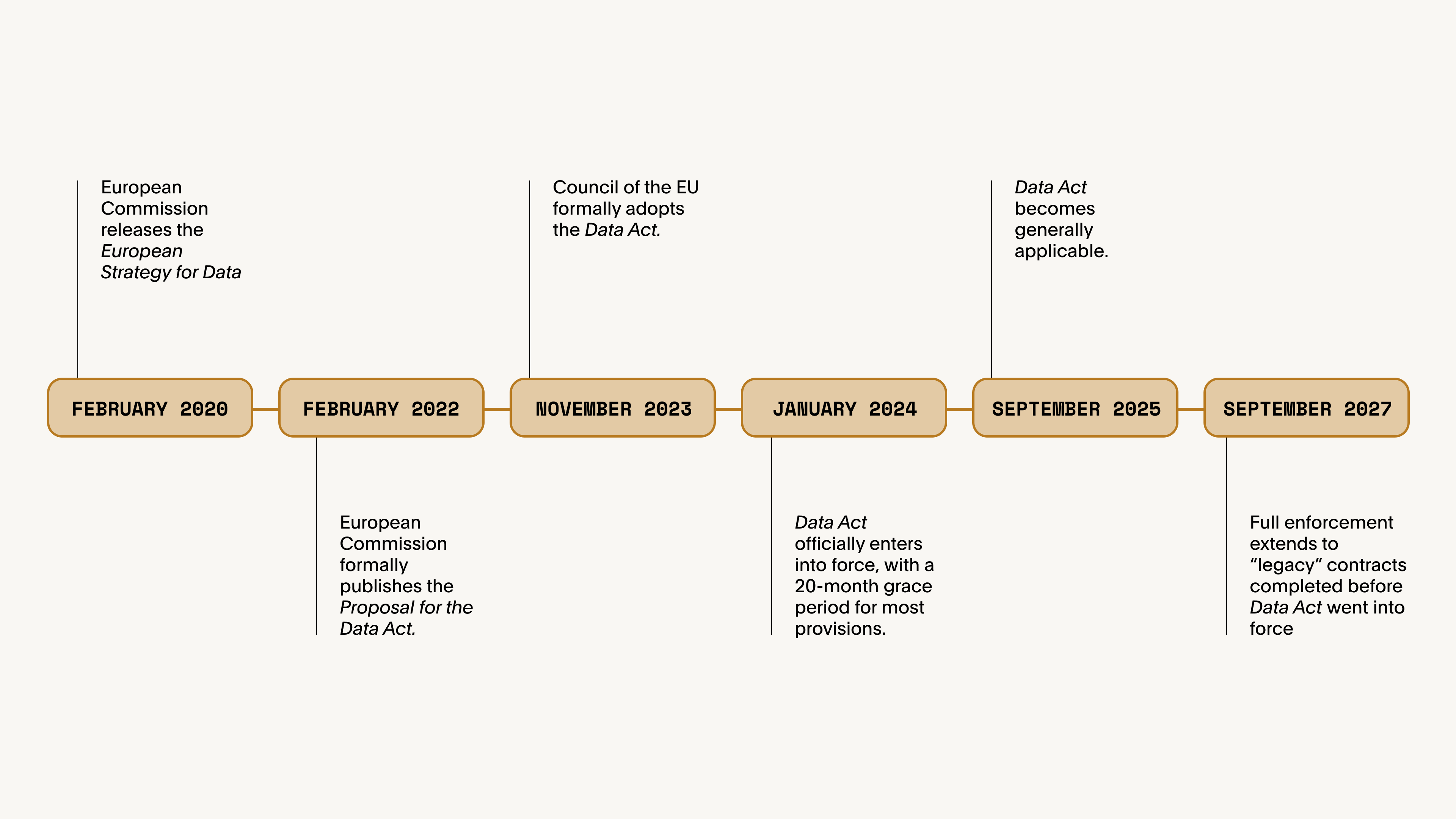
EU Data Act Timeline
Headlines about the EU Data Act emphasize how it strengthens data sovereignty by ensuring that technology providers implement safeguards against illegal third-country data transfers. Less realized is the Data Act’s mandate for interoperability and intelligence sharing, which pushes legacy manufacturers to stop locking insights in proprietary silos by working within secure “data spaces” to share important information with business and government counterparts.
"
…‘interoperability’ means the ability of two or more data spaces or communication networks, systems, connected products, applications, data processing services or components to exchange and use data in order to perform their functions… High-quality and interoperable data from different domains increase competitiveness and innovation and ensure sustainable economic growth.

EU Data Act, Article 2(40); Recital (1)

Just as the EU Data Act codifies data security and interoperability, global trade actors need to preserve sovereignty and enable collaboration by making vital, secure trade information intelligible across borders. This is possible with a federated data model.

A trusted translator: the federated data model
A federated data model is an architecture that allows for trusted, permissioned collaboration between supply chain partners while protecting sovereignty, privacy, and security.
Think of federated data in terms of the way your phone's keyboard learns how you type. The predictive text on your device understands your vocabulary, your patterns, the way you communicate. But your personal data never leaves your phone. The AI model improves by learning from patterns across millions of devices, without any single user's private information being shared with anyone else. You get the intelligence of a broader network while maintaining privacy on your own phone.
evan data sovereignty jon fortt
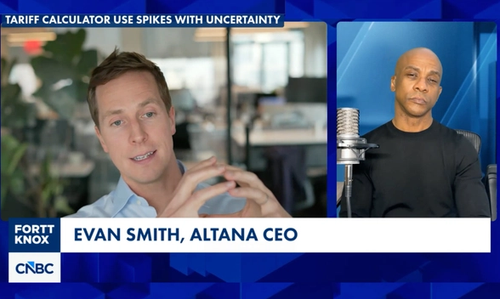
Altana CEO Discusses Data Sovereignty on CNBC
Watch the Interview
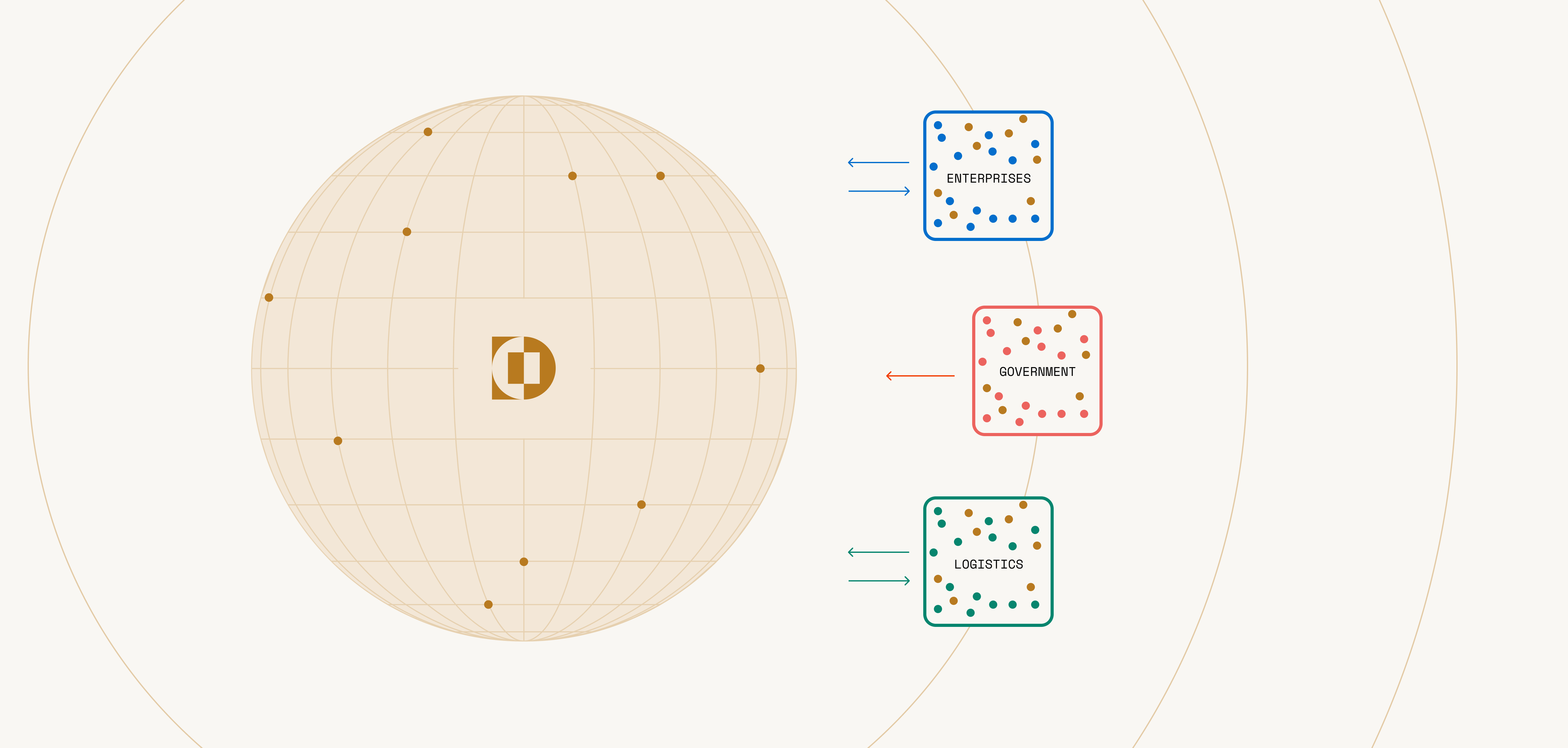
Altana’s federated data model for global trade works on the same principle as your phone, at a much larger scale. Each participant — a sovereign government, a customs authority, an enterprise, a logistics provider — operates within its own secure, isolated environment. Sensitive data, such as trade records, bills of materials, sourcing relationships, pricing, and enforcement intelligence, never leaves that dedicated spoke. It stays on sovereign soil, on sovereign servers, under sovereign control.
What flows across Altana’s product network is not data, but intelligence: Supply chain connections, risk signals, and insights derived from the collective activity of all participants, which include the world’s biggest public and private sector organizations. AI models learn from the broader network's patterns and relationships, then deploy those learnings to each sovereign environment — acting as a trusted translator between systems that would otherwise be unable to speak to one another.

“Federated learning offers a third way, enabling shared information without commingled data or centralisation. This approach allows connection to and learning from sensitive, siloed information across a federated network. While privacy-preserving, federated learning enables extraction of signals from siloed data and facilitates shared intelligence across the participating network.”

"Managing Supply and Value Chains in a New Era of Global Trade: The Promise of Federated Learning", World Customs Journal, 2025

This is not a theoretical concept. For governments, Altana's federated data model is deployed today across sovereign environments in the U.S., UK, and Australia. In each deployment, all data, analysis, and software operate on government-controlled, sovereign infrastructure. Data ingress and egress are monitored and controlled by that sovereign government. The AI learns from the global network. The data never leaves home.
For enterprises and logistics providers, the model works the same way. Each participant gets a private, dedicated environment. Their most sensitive information stays local. But their supply chain connections — the relationships between facilities, products, and companies — contribute to a shared network that benefits everyone. Participants choose what they share and with whom through permissioned collaboration. The network gets smarter. The proprietary data that feeds it never changes hands.
The result is that data sovereignty moves from an obstacle to the foundation of secure information-sharing, collaboration, and trusted trade.

Data sovereignty as the foundation for trusted trade

When sovereign governments, enterprises, and logistics providers can speak to one another through a trusted translation layer, facilitating trusted trade becomes possible.
Customs authorities can screen shipments against a global intelligence network without exposing their enforcement data to adversaries. Enterprises can collaborate with suppliers to trace multi-tier product value chains to N-tier accuracy without revealing vital trade intelligence to competitors. Governments can collaborate with industry on sanctions enforcement, forced labor detection, and scaling production — sharing insights, not data — across allied and non-allied borders alike.
Fragmentation will continue to be a part of the story of global trade, and sovereign nations will continue to advance their own trade policies, but national and economic security can exist alongside prosperous global commerce and economic growth. With a federated data model, governments and businesses can share intelligence, collaborate, and build a more resilient, secure global economy that keeps trusted trade flowing.
Learn more about Altana’s network for trusted trade.
  • TradeNerds Academy

    Altana Product Passports: A Digital Pass for Trusted Trade

  • Component-Based Tariffs Tax the Goods Within the Goods

    Insights

    Component-Based Tariffs Tax the Goods Within the Goods, Complicating Global Trade

  • De Minimis Rollback Reshapes Global Trading System

    Insights

    De Minimis Rollback Reshapes Global Trading System

Subscribe to the Altana newsletter

Latest news, announcements and updates direct to your inbox

  • Privacy Policy
  • ©Altana 2025. All Rights Reserved.
  • Altana and the Altana logos are trademarks of Altana Technologies, Inc., in the United States and other countries.

Company Type

  • Platform
  • For Government
  • For Enterprises
  • For Suppliers
  • For Logistics

Use Case

  • Tariffs & Trade Compliance
  • Resilience
  • Counternarcotics

Resources

  • Resources
  • Cookie Preferences
  • Trust Center

About

  • About Us
  • Careers
  • Legal
Altana
  • Privacy Policy
  • ©Altana 2025. All Rights Reserved.
  • Altana and the Altana logos are trademarks of Altana Technologies, Inc., in the United States and other countries.