Automotive

Risk doesn’t end at Tier 1. Neither should your visibility.

Altana reveals your supply chain beyond Tier 1 and automates the classification, origin, and duty work behind it—so auto and manufacturing teams see what's in every product, recover overpaid duties, and keep goods moving no matter how fast the rules change.

See what changes when an automotive team uses Altana.

  • Meet AIAG forced-labor reporting in days — without surveying your whole supply base.

    Altana pinpoints where forced-labor risk actually sits — down to the suppliers driving exposure — so you target the few that matter instead of surveying thousands. Collect their documentation once through Product Passports, then reuse it to auto-generate AIAG reports for your OEMs and pre-validate goods with CBP before they ship.

  • Know what tariffs really cost you — down to the part.

    Altana’s tariff simulation models duty exposure by supplier, component, and country — across the 22 auto codes that account for $68B in annual exposure. Procurement negotiates from fact, not estimates. Trade compliance qualifies shipments for FTAs and recovers overpayments.

  • Find every point of failure before it stops your line.

    A single missing part upstream can shut down your whole line — and you won't see it coming. Altana maps your full value chain to surface the single-source dependencies and chokepoints hiding upstream, across EV battery minerals, the chips and sensors in today's vehicles, and the steel and aluminum in every part.

asdf

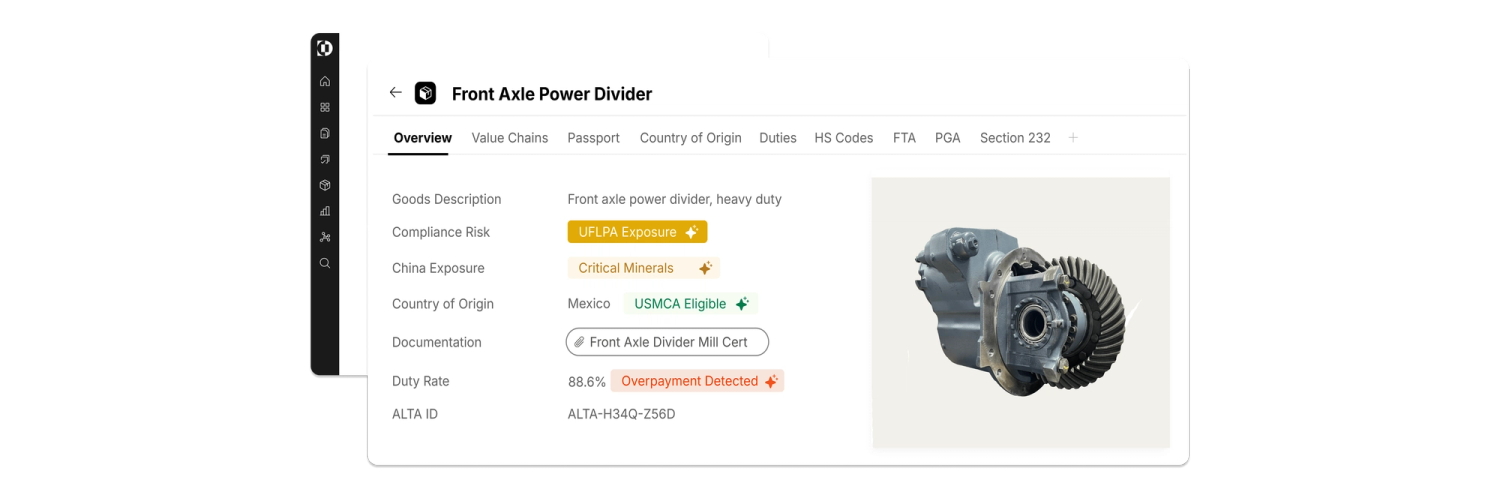
The Altana Product Catalog is the system of record behind every compliance decision. Each part carries its classification, country of origin, duties, and the documentation that backs them—so every position you file is defensible and the work behind it is automated. It's the foundation all workflows run on.

How it works:

  • Onboard

    Bring product data in from your existing systems. No more classification logic trapped in spreadsheets and broker emails.

  • Illuminate

    Altana's AI maps each part's multi-tier value chain back to raw materials—in minutes, without waiting on suppliers—so you can determine origin and surface forced-labor risk.

  • Verify

    AI classifies, calculates stacked duties, and keeps the supporting documentation attached to every record, so each position is audit-ready.

  • Collaborate

    Everyone works from the same record: suppliers contribute documentation, brokers file from one source of truth, and Product Passports let you pre-validate goods with CBP before they ship.

Alt text goes here

The automotive pressure

Forced-labor reporting is here. The visibility you build for it solves more than that.

Altana and AIAG built the industry’s standardized approach to forced-labor due diligence — and the reporting requirement is already in motion. Here’s what every OEM and Tier 1 supplier needs to know. The visibility you build to meet it also answers your tariff, EV-battery, and connected-vehicle questions, from one source of truth.

  • 01

    Auto and aerospace drive most U.S. forced-labor detentions — only ~4% are released.

  • 02

    AIAG’s template went live for select Tier 1s in September 2025; the full rule lands mid-2026.

  • 03

    The real risk sits below Tier 1 — in the smelters and processors surveys can’t reach.

  • 04

    Under UFLPA you’re guilty until proven innocent — enforcement now hits steel, copper, and lithium.

Alt text goes here

Forced labor reporting, in 12 minutes

From the AIAG forced-labor webinar

Four short clips from our forced-labor due-diligence webinar with AIAG and MEMA — from the enforcement reality to a live, end-to-end reporting submission.

Official Press Release

CBP selects Altana's Product Passports to drive next-generation trusted trade

U.S. Customs and Border Protection teams with Altana to create the "Global Entry for Goods," accelerating customs clearance for trusted traders amid increasing trade and tariff compliance complexity.

Key features

Built for automotive teams that span compliance, sourcing, and supply chain.

  • Forced-labor screening

    Identify UFLPA exposure at the supplier level. Collect documentation and respond to detentions with validated evidence. Auto-formats reports to the AIAG-standardized template.

  • Multi-tier mapping & single-source risk

    Map your value chains beyond Tier 1, down to the components and raw materials you’ve never tracked, and surface single-source dependencies before they stop your line.

  • Tariff, origin & FTA qualification

    Model duty impact by supplier, component, and country — including Section 232 material-composition rates. AI determines origin with confidence and checks USMCA and other FTA eligibility across your catalog.

  • Supplier & government collaboration

    Request data from suppliers in-platform through Product Passports, with responses synced to your catalog automatically. Submit those same Passports to CBP to resolve inquiries and clear borders faster.

Quantified Impact

Real-world results, across industries.

Major Manufacturer

30%

Savings via supplier price negotiations

$50M

Realized savings on tariffs

$4.2B

Supplier spend assessed

Chemicals Company

$100M

Indirect (Tier 2 and beyond) China spend re-allocated to trusted suppliers

48 hrs

Time spent verifying a supplier's upstream UFLPA compliance — down from weeks

EQI

64%

Estimated reduction in overall tariff expenses since using Altana

$100M

Remediated compliance risk across international procurement spend in 2025

Answers for OEMs and Tier 1 suppliers.

  • Altana builds N-tier value chains automatically using the world's largest active map of global supply chains — roughly half of it drawn from proprietary, first-party logistics records. You get sub-tier visibility in days, not months, without waiting on supplier survey responses.

  • When new tariffs drop, most teams need weeks to give leadership an exposure number. Altana auto-calculates stacked duties across your entire catalog and re-runs the math within two days of each official rate change. John Deere used this to assess $4.2B in supplier spend, realize $50M in tariff savings, and gain 30% more value in supplier negotiations.


  • Under UFLPA the burden of proof is on the importer: you have 30 days to prove your goods are free of forced labor, or they’re re-exported, destroyed, or abandoned. In automotive and aerospace, only about 4% of detained shipments are released. Altana gives you facility-level value-chain documentation tied to each component, so you respond with verifiable evidence instead of a frantic document chase.

  • Altana maps your multi-tier value chain to the facility level in days, flags forced-labor exposure before you place an order, and lets you collect supplier documentation through Product Passports. It then auto-populates the reporting template your OEM requires—turning a weeks-long document chase into a job of days.