Altana for Trade Compliance
Regulations changed.
Your team size didn’t.
Trade compliance teams are drowning in manual classification, tariff volatility, and forced labor risk. Altana gives you a verified system of record for your products — so you can prep entries faster, avoid detentions, and stop leaving duty savings on the table.
Real-world results
$5M+ Average detention costs avoided
$300M+ Average duty savings identified
8x Faster customs filing
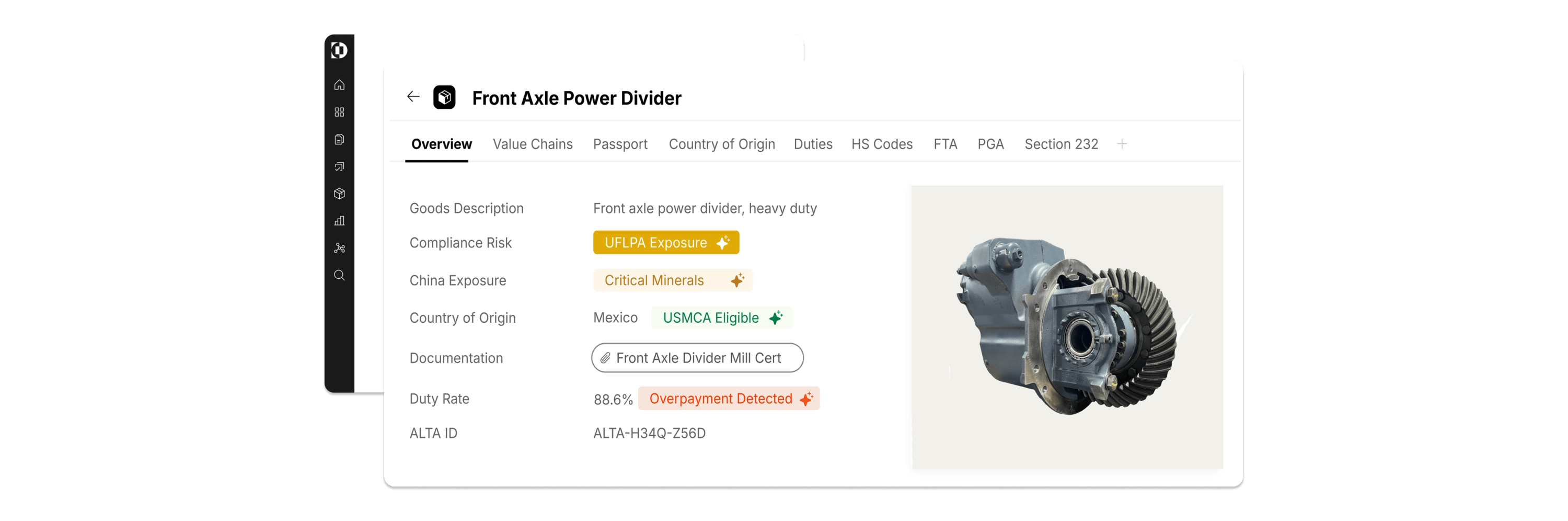
The Product Catalog
Altana organizes your product data into a collaborative catalog where you and your suppliers work together to illuminate multi-tier sourcing paths and keep every team on the same page.
An intelligent system of record for products & multi-tier value chains
See what changes when you use Altana
Automated duty calculation
AI accurately calculates duty rates including complex tariff stacking rules and predicts Section 232 tariffs based on estimated material composition.
HS classification
Faster AI-driven product classification with importer–LSP collaboration.
Country of origin determination
AI maps multi-tier sourcing to determine origin with confidence, supporting USMCA and other preference programs.
FTA qualification and filing
Check trade agreement and preference program qualification and submit claims to regulators through Product Passports.
Forced labor screening
Identify UFLPA exposure at the supplier level. Collect documentation and respond to detentions with validated evidence.
Continuous auditing
Audit existing classifications, origins, and duty rates to calculate duty overpayments or underpayments.
PGA analysis
Automatically flag partner-government agency (PGA) filing requirements and populate attestations from your Product Catalog and parsed documents.
Supplier collaboration
Collaborate directly with suppliers in-platform for traceability and information gathering, using Product Passports to fill in any data gaps which then syncs with your product catalog.
Tariff simulation
Model supplier-level tariff exposure across sourcing scenarios to forecast duty impact by supplier, component, and country.
Government collaboration
Submit Product Passports to regulators, collaborate to address issues, and clear borders quickly.
Case Studies
Real-world results, across industries.
American Retailer
faster classification speed
in total costs from legal fees, storage, and lost sales avoided
days per detention, now eliminated
Agricultural Machinery Company
identified overpayment from July 1 - Sept 9
annual spend at risk from Nexperia exposure
identified overpayment from 3 entries
Fortune 100 Electronics Manufacturer
duty savings identified through USMCA qualification
potential tariff costs across portfolio of sub-tier suppliers newly identified
Testimonials
Hear what the community is saying about Altana

“Compliant value chains don’t exist in isolation. Altana and Maersk ensure our customers can harness the power of trusted supply and distribution networks — no matter where they operate.”
Lars Karlsson,
Global Head of Trade & Customs Consulting, Maersk

Lars Karlsson,
Global Head of Trade & Customs Consulting, Maersk

"Altana helped us rank companies by forced labor exposure, improving UFLPA enforcement and enabling significant targeting of Xinjiang-based companies.”
U.S. Law Enforcement Investigator

U.S. Law Enforcement Investigator

“Altana made our classification workflow 8x faster — shrinking a 25-hour job to 3 hours by handling the straightforward classifications so our team can focus on the ones that require real human review.”
Greg Wallace,
Lead Trade Compliance Analyst at L.L. Bean
Greg Wallace,
Lead Trade Compliance Analyst at L.L. Bean
FAQs
Traditional approaches rely on supplier questionnaires, which break down at Tier-2 and rarely produce useful data beyond it. Altana takes a different approach: we build N-Tier value chains automatically using the world's largest active map of global supply chains, with roughly half of facility-to-facility connections derived from proprietary first-party data.
For every product, Altana combines three layers: what you already know (your BOMs, supplier data, documentation), what AI suggests from the knowledge graph, and what suppliers verify through Product Passports. You get sub-tier visibility on day one, without depending on supplier responses.
Customer result: Customers regularly see 7,000% increases in sub-tier visibility within the first week, replacing what previously took years of manual mapping.
Altana automates HS classification using AI trained on proprietary global trade data, classifying products up to 8x faster than industry standard. The classifier uses goods description, supplier and receiver information, country of origin and destination, material composition, and product category to generate an HS code with a confidence score, generated GRI explanation, and supporting CROSS rulings attached.
For new SKUs with sparse data, Altana enriches product descriptions automatically. High-confidence predictions auto-approve; lower-confidence cases route to human review. Once classified, the decision is stored, versioned, and connected to every downstream workflow.
Customer result: L.L. Bean reduced classification time by 88%, reclaiming 17+ workdays annually.
Altana's data combines public, commercial, and proprietary first-party sources, connected by AI into the most comprehensive map of global supply chains available. Public data includes customs filings, bills of lading, and 60+ sanctions lists. Commercial data includes Moody's BvD ownership records and licensed customs data across 30+ jurisdictions. Roughly 50% of facility-to-facility linkages come from proprietary data contributed by logistics partners and enterprises on the network, including visibility into non-publishing jurisdictions like China.
Every customer operates in a dedicated environment with enterprise-grade security: SOC 2, ISO 27001, IRAP, and Cyber Essentials Plus certifications. Customer data never leaves the customer's environment. Where AI-suggested connections need verification, traceability workflows confirm value chains directly with suppliers.
When new tariffs drop, most teams can't produce an exposure number for leadership in less than several weeks. Altana auto-calculates stacked duties across your entire product catalog and re-runs the math every time tariffs change, typically within 2-5 days of an official rate announcement.
The duty engine layers base tariffs from the HTS schedule, FTA adjustments, special duties (201, 232, 301, IEEPA), Chapter 99 provisions, and value-based allocation across material composition. Each output includes a full duty breakdown per component with justifications and effective dates.
Customer result: John Deere identified $50M in tariff savings and gained 30% additional value in supplier negotiations by analyzing exposure across $4.2B in supplier spend.
Altana is designed to sit alongside your existing ERP, global trade management, and broker systems — not replace them. We act as the connective tissue those systems weren't designed to provide: a shared, product- and value-chain-level source of truth that connects compliance, sourcing, finance, and logistics teams to the same data.
Altana's outputs — HS classifications, country of origin determinations, FTA qualifications, tariff scenario analysis, Section 232 material composition — feed back into your systems of record through APIs and Product Passports, so your filing workflows continue uninterrupted. Product Passports also let you share validated compliance data directly with brokers and regulators, closing a loop that's typically broken between importers, brokers, and CBP today.
The result: you get the automation, visibility, and audit-readiness benefits of Altana without ripping and replacing the systems already running your business.
UFLPA puts the burden of proof on the importer. To clear a detention, you need clear and convincing evidence that your product is free of forced labor across every tier of your supply chain. Detentions are accelerating: in auto and aerospace, detentions rose 1,600% from 2023 to 2024, with 89% of shipments denied entry. The average CBP detention case costs roughly $2 million.
Altana surfaces forced labor exposures across multi-tier value chains, prioritizes them by risk severity and product impact, and lets you investigate, request supplier evidence through Product Passports, and document resolution in a single workflow. Real-time forced labor intelligence flows in through our partnership with Kharon.
Customer result: Customers have reduced supplier UFLPA verification from weeks to 48 hours and reallocated $100M in Tier-2+ China spend to trusted suppliers.
Most importers leave significant FTA savings on the table because qualification is too manual to run at scale. Altana automates the full workflow: country of origin validated from value chain data, HS-specific qualification rules applied automatically (tariff shift at HS6, regional value content, wholly obtained), supplier documentation requested through Product Passports, and FTA attestations submitted to CBP in advance so qualifying shipments clear without disputes.
The same workflow supports USMCA, CAFTA, and other preferential programs. When source data changes, qualifications update automatically.
Customer result: Customers have identified $516M in duty savings through FTA qualification at scale.
Altana provides denied party and restricted party screening with multi-tier supply chain context that standalone screening tools can't match. The platform connects to every major entity list — OFAC, BIS Entity List, DHS UFLPA, EU, UN, UK HMT, and 60+ lists worldwide — and supports custom source lists defined by the customer.
Screening runs in two places: sweep through the entry processing system using any combination of recipient, goods, and sender to trace direct restricted-party exposure, and screen suppliers beyond Tier-1 in real time to surface exposure through the full upstream value chain. Ownership analysis reflects OFAC's 50 Percent Rule, drawing on Moody's BvD corporate registry data.
What sets this apart is the connection to your products. Most screening tools tell you that an entity is sanctioned. Altana tells you which of your products, which suppliers, and how much of your revenue is exposed.
Modern enforcement requires more than a declared origin. CBP wants to see the analysis behind the claim: how the product was made, where value was added, which rules were applied, and what documentation supports the answer.
Altana auto-applies formal rules of origin — wholly-obtained, tariff shift, substantial transformation, regional value content — across U.S. non-preferential rules and trade-agreement contexts. Determinations are based on verified value chain data, with suppliers contributing and validating origin information through Product Passports. Conflicts and missing inputs are flagged before they become audit issues, and every determination is captured with full rationale and version history.
When CBP issues a CF-28 or audits a claim, the supporting analysis, documentation, and decision history are already in place.