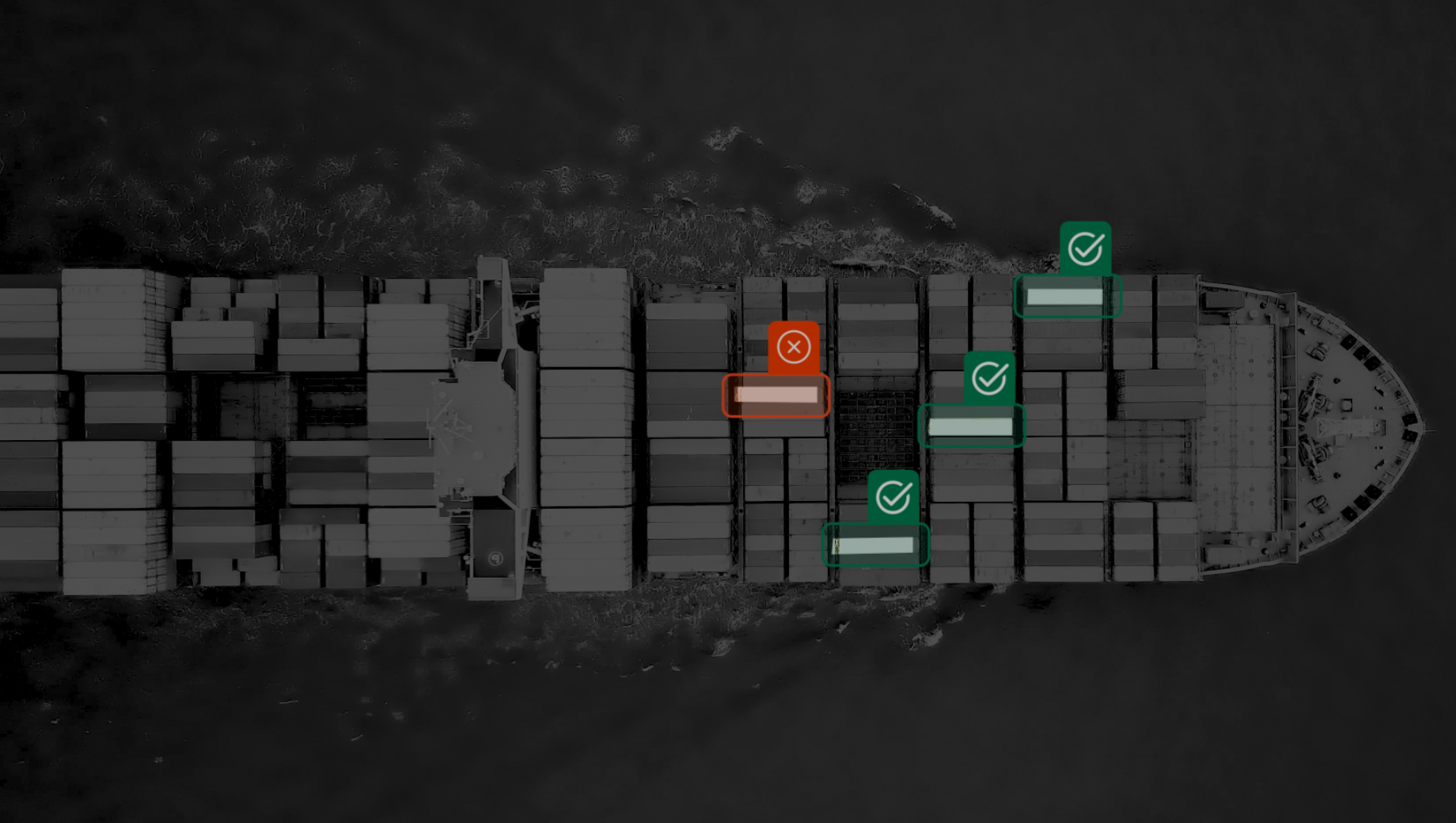
U.S. Customs selects Altana to modernize enforcement and border clearance

Learn more

Altana

April 23, 2026

Future of Trade Forum

USMCA Joint Review & The Future of North American Trade

us canada mexico

At Altana, our vision is a world where global trade is trusted, secure, and resilient.

This conviction informs our Future of Trade Forum, a periodical publication dedicated to exploring the changing global trading system and the forces shaping the global economy.
In this report, we uncover the broad trade flows, sector-specific shifts, and vulnerabilities in North American trade since USMCA ratification in 2020. We also provide insights from trade experts about the successes and failures of the first six years of USMCA, what to expect from USMCA joint review, and the future of North American trade.
ships

View PDF Format

Major Takeaways

01

USMCA has brought supply chain integration to the North American economy. Total goods trade between the United States, Canada, and Mexico has eclipsed $1.6 trillion yearly, and risen 29% since the ratification of USMCA in 2020. Critical sectors, such as automotive, have seen deep supply chain integration, with automotive trade between the three countries rising 38% since ratification.

02

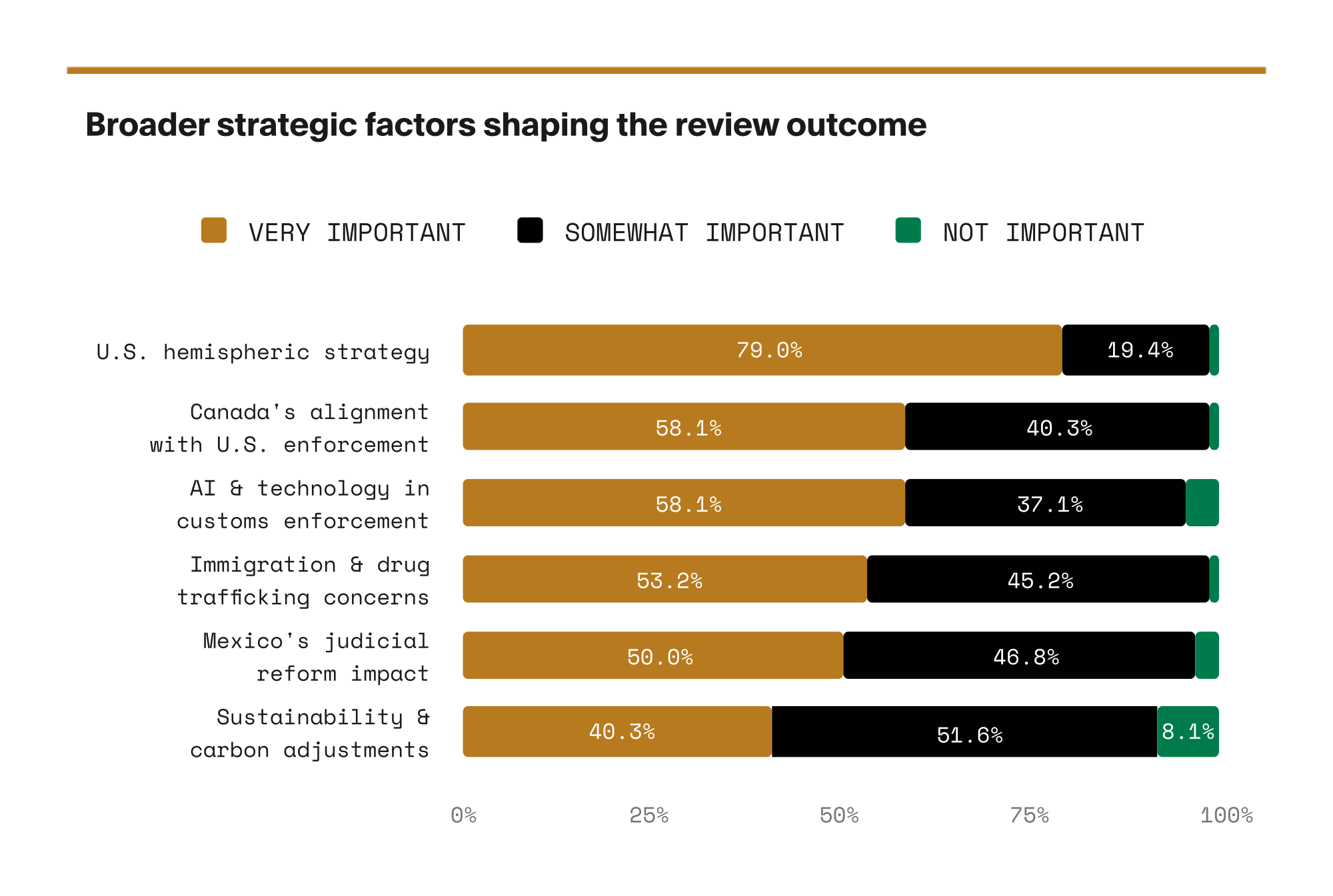
Ahead of USMCA joint review, the majority (62.9%) of a curated group of senior trade, supply chain, and geopolitical experts anticipate a conditional renewal with amendments by the end of 2026. The “Trump Corollary” for hemispheric relations was rated as the most notable strategic factor impacting joint review, with 98.4% of trade leaders ranking it as important.

03

Increased North American forced labor enforcement has still intercepted only a fraction of the exposure flowing into the USMCA trade bloc. At least $86 billion worth of USMCA-bound shipments had upstream product inputs exposed to forced labor in 2024 and 2025, of which only $2 billion was subject to enforcement. Core supply chain inputs, including electrical machinery and semiconductors ($24.4 billion), machinery and computers ($9.6 billion), plastics ($4.9 billion), and vehicles and auto parts ($2.0 billion) were especially exposed.

04

Transshipment vulnerabilities in the USMCA bloc persist, especially amid a strengthened U.S. tariff regime. As U.S. imports from China plummeted in 2025, Chinese goods found possible transshipment and non-transformation routes through southeast Asia into the USMCA bloc. Analysis from Altana’s network found a 76% increase in trade flows on these suspected USMCA transshipment routes in 2025 compared to 2024. In 2025, after Liberation Day, transshipment-flagged shipments entering the U.S. exploded from roughly $5 billion to $25 billion or more per month. Altana estimates that every year, the U.S. loses out on roughly $40 billion tariff revenue from misclassified, mis-valued, and transshipped goods that pass through Mexico and Canada on their way to the U.S.

05

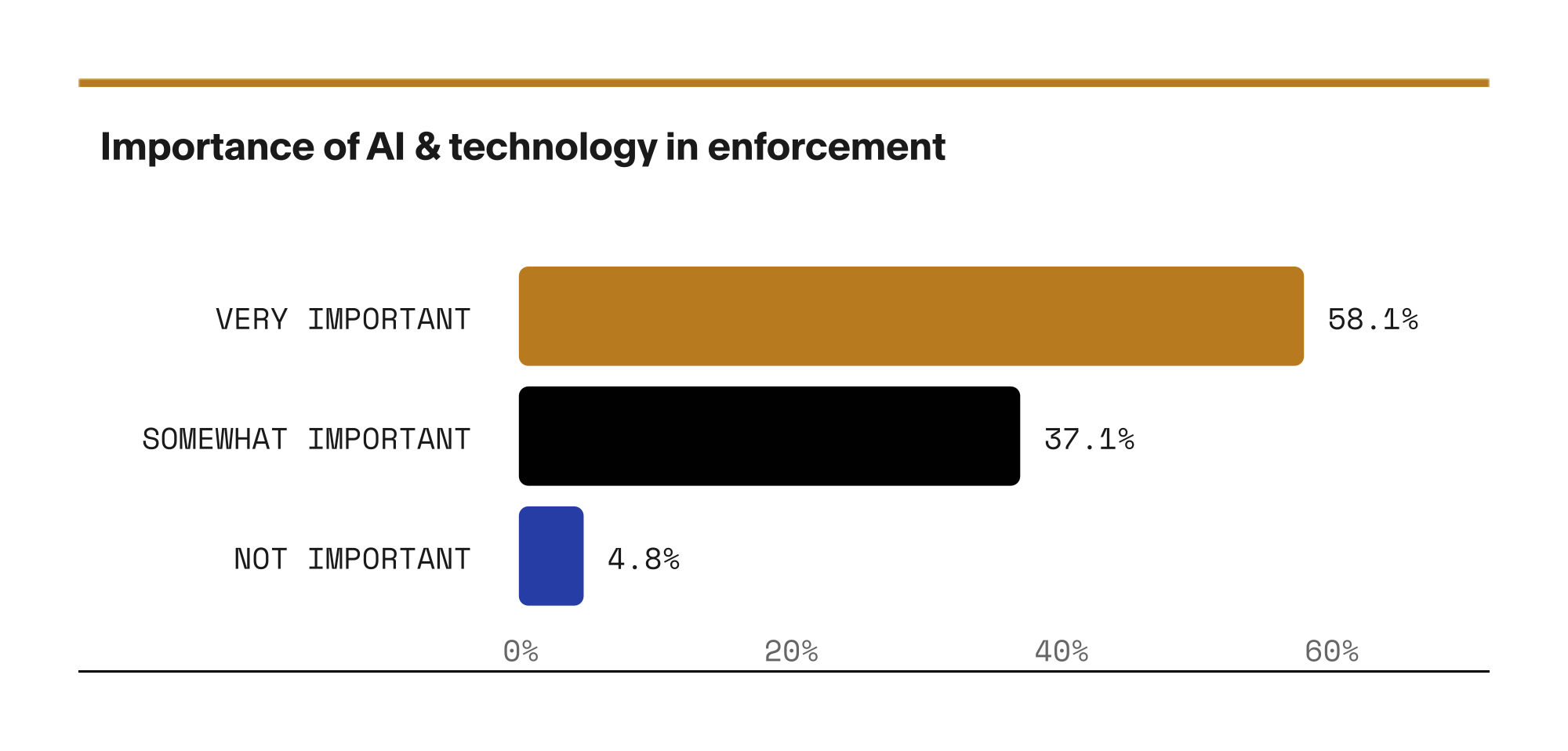
Addressing transshipment was the most likely negotiation to be rated as “critical” by trade leaders, with 56.5% of respondents giving that designation. A striking 87% of trade leaders agree that component-level supply chain visibility — knowing what’s in a product, not just where it ships from — will become the dominant enforcement paradigm in trade agreements. And 95.2% of respondents said that AI & technology would be important to achieving this component-level visibility, improving enforcement, and maintaining the flow of trusted trade.
placeholder

01: Introduction

USMCA integrates North American economy, but vulnerabilities remain
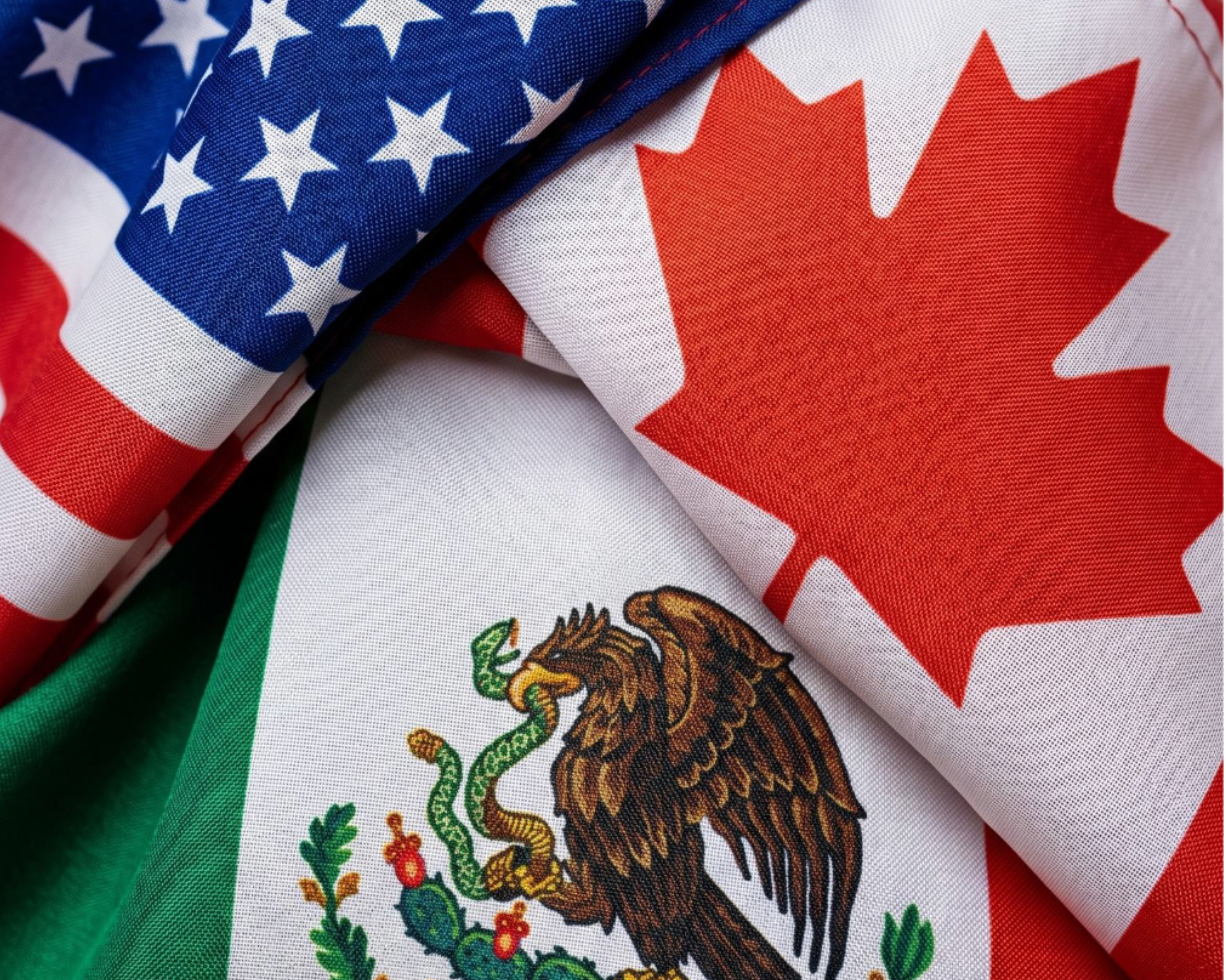
US, Canada, Mexico flags layered togethe
USMCA — and its predecessor, NAFTA — brought prosperity to the North American economy, increasing trade volumes, integrating critical supply chains, and boosting regional investment.
But USMCA was built for a bygone era of stable and open global free trade, and needs modification to meet modern geopolitical, geoeconomic, or enforcement challenges.
The North American free trade project has been a hugely successful economic integration effort. In the three decades since NAFTA took effect, goods trade among the United States, Canada, and Mexico has grown from $343 billion to over $1.6 trillion — a 374% increase that has fundamentally reengineered the continent’s production geography.
The USMCA, which replaced NAFTA in 2020, deepened this integration. Intra-bloc trade has grown 29% since its entry into force, with Mexico surpassing Canada as the largest U.S. trading partner for the first time.
But USMCA joint review is taking place amid the fragmentation of the global trading order and a seismic change in trade enforcement — one that now extends beyond Tier 1 suppliers and location of final product assembly to the components, materials, and inputs within products.
Where a raw material was mined, whether an upstream component was manufactured with forced labor, the location of substantial transformation of each material within a product — all determine tariff rates and whether a good qualifies for border clearance.
For North American governments and businesses, finding a way to harmonize component-level enforcement expectations with the flow of trusted goods is integral to regional prosperity.
This Future of Trade Forum report — featuring a multi-tier supply chain analysis from Altana and unique insights from trade experts — demonstrates that while North American free trade has boosted the flow of goods, the current USMCA framework is not fully addressing the challenges of possible transshipment, adversarial manufacturing reliance, and complex, component-based tariffs.
Read on to learn about the ways USMCA has shaped North American economics and geopolitics, the vulnerabilities and challenges it has yet to address, and the likely outcome of USMCA joint review.
Containers seen from above in a shipping dock

02: General North American Trade

As global trade fractures, North American trade surges

In the face of a fracturing global trade order, intra-North American trade has surged since USMCA came into effect.

Total goods trade among the United States, Canada, and Mexico reached approximately $1.6 trillion in 2024, the last available year with full trade data coverage. This is nearly 30% above 2019, the last full pre-USMCA year, and was the highest level in the three-decade history of North American free trade.
The overall North American trade trajectory is unambiguous. When NAFTA took effect in 1994, total U.S. bilateral goods trade with Canada and Mexico stood at roughly $343 billion. Today it exceeds $1.6 trillion.
North American free trade agreements have not merely lowered tariffs; they have built a continental production network in which components and intermediate goods cross borders multiple times before reaching end consumers.

$1.6T Intra-USMCA goods trade, 2024

+29% Growth since USMCA entry into force, 2020

+374% Growth since NAFTA inception, 1994

Mexican exports to U.S., Canada continue to surge amid tariffs, new trade regulations.

The most consequential macro shift in North American trade in the USMCA era has been Mexico’s emergence as the dominant U.S. trading partner. In 2019, U.S.-Mexico and U.S.-Canada bilateral trade flow was essentially equivalent. Five years later, both had increased, but the U.S.-Mexico relationship accelerated faster, with a 37% increase.
Even the trade and tariff turbulence of 2025 — including Section 232 tariffs on components and materials, like steel and aluminum, in critical supply chains — didn’t halt the U.S.-Mexico trade growth relationship.
An analysis of available trade data from January 2025 to October 2025, compared to the same time period in 2024 and 2019, shows that Mexico and U.S. trade still grew in 2025.
These overall, bilateral increases in trade were driven entirely by a continued increase in Mexican exports to the U.S. and Canada, by 5.8% and 6.2% year-over-year for each.Every other directed flow in the North American trade lane — U.S. to Mexico, U.S. to Canada, Canada to Mexico, Canada to the U.S. — fell in the analyzed portion of 2025 compared to 2024.From 2019 to 2025, the rise in Mexican exports to the U.S. alone surged 51.4% — suggesting deep U.S. reliance on Mexican imports as other trading relationships, such as the one with China, fray under geopolitical pressure.
A truck going through a checkpoint

KEY INSIGHT

Amid a push for onshoring and reshoring, and the rise of more demanding trade regulations, Mexican exports to USMCA trading partners have actually increased, even as other flows within the bloc slow.

03: Sectoral North American Trade

Sectoral trade flows in USMCA bloc raise questions of true North American content, China exposure

Beneath the aggregate growth trends in intra-USMCA trade is significant sectoral-level variation.

Intra-North American trade has boomed for some sectors under USMCA. Others have stagnated. And in several of the industries that matter most to the joint review, the composition of the goods being traded raises questions about the security and resilience of the North American trade bloc.
Sanity Image

Automotive: the backbone of the North American trade — and the flashpoint for what content is really North American.
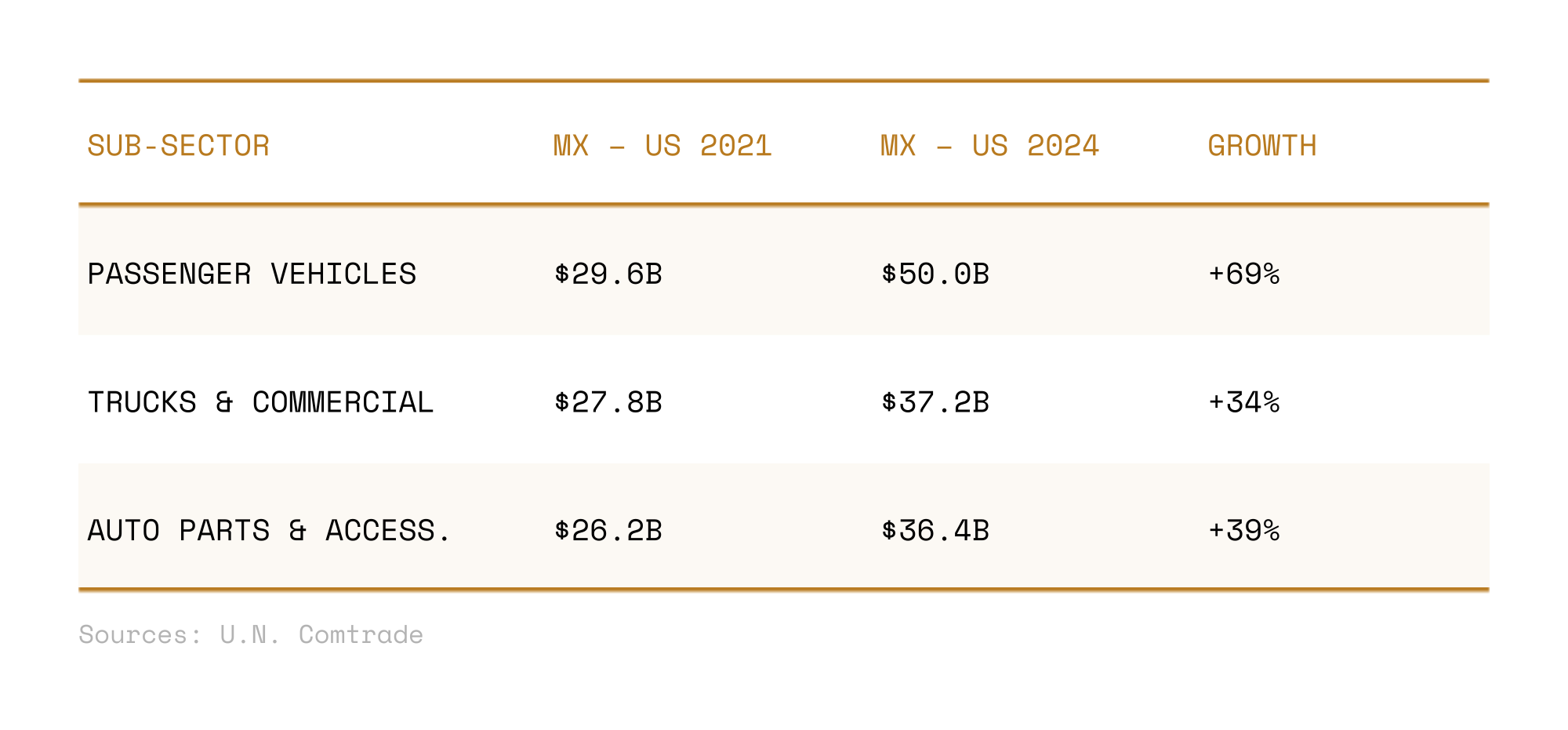
Automotive vehicles and parts is the single largest goods category flowing between the three member states — and its most politically sensitive sector. The growth has been driven overwhelmingly by the Mexico-to-U.S. corridor.
Sub-sector growth table — Passenger vehicles MX→US 2021 $29.6B → 2024 $50.0B (+69%); Trucks & commercial $27.8B → $37.2B (+34%); Auto parts & accessories $26.2B → $36.4B (+39%)

$280B Yearly automotive intra-USMCA trade volume

+38% Increase since 2021 of USMCA automotive trade flows

+69% Increase in Mexico to U.S. trade of passenger vehicles since 2021

Close up of cars in an auto plant

Mexican auto exports to the U.S. now total $137 billion — nearly half of all intra-USMCA automotive trade.

But underneath this growth lies another: Chinese automotive exports to Mexico surged 156% between 2021 and 2024, from $5.3 billion to $13.5 billion. Autos are the single fastest-growing inbound sector for Chinese goods entering the USMCA trade bloc, and as Mexico’s auto exports to the U.S. have risen, the parallel growth in China to Mexico automotive trade defines the central tension of the review.
How much of the content in vehicles and vehicle parts made in North America is genuinely North American? And when Mexican exports to the U.S. and Canada rise, how much has parts, materials, and inputs that trace back to China?

+156% Growth in Chinese auto exports to Mexico, 2021 to 2024

+69% Growth in Mexican auto exports to the U.S., same period

$13.5B Yearly Chinese automotive exports to Mexico

Amid Great Power competition, Chinese exports to Mexico rose in 2025
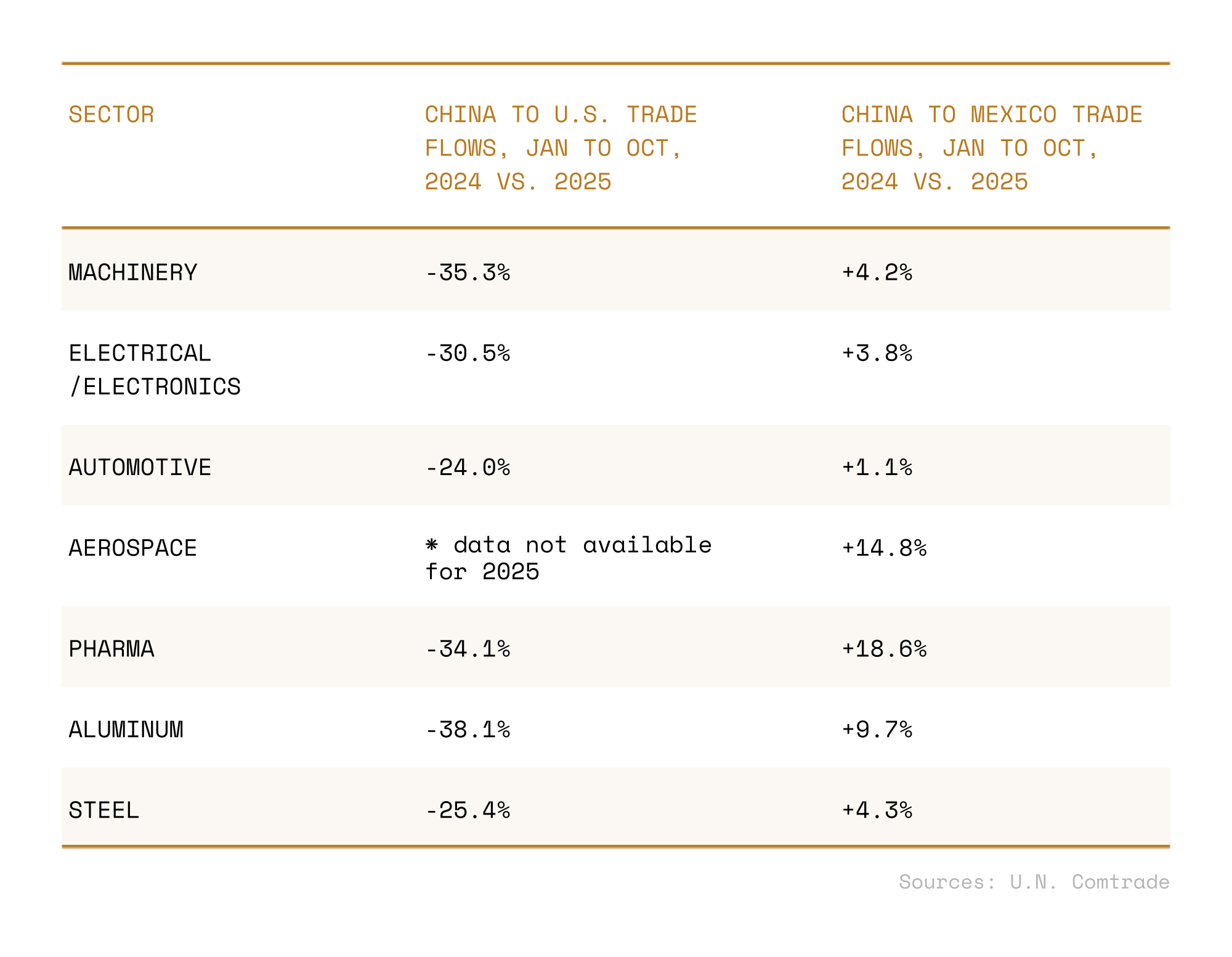
2025 marked a further fracturing of the U.S.-China trade relationship, with major reciprocal and component-based tariffs placed by the U.S. on Chinese goods and Chinese export controls on critical minerals and rare earths. At the same time, Chinese exports to Mexico grew across every major manufacturing sector in the first ten months of 2025, raising questions about USMCA’s success at breaking dependence on adversaries and cracking down on transshipment and non-transformation.
The growth in China to Mexico trade was sharpest in sectors at the center of U.S. trade enforcement. Aluminum and steel, both subject to Section 232 national security tariffs, saw Chinese exports to Mexico rise 9.7% and 4.3% respectively. Aerospace, for which a Section 232 investigation is ongoing, surged 14.8%. The flow of China to Mexico pharmaceuticals — for which China dominates global production of active ingredients, and is also subject to a 232 investigation — grew 18.6%.
While China to Mexico trade surged, China to U.S. trade plummeted in 2025, with drops of around 25% or more for every critical industry analyzed.
Alone, this pattern does not prove that goods are entering Mexico and then subsequently exported northward under USMCA preferences. But it does prove that the new U.S. tariff regime has led to major divergence in the top-level trade patterns of USMCA trade partners. The pattern also raises questions about whether USMCA’s current rules of origin are sufficient to prevent preferential North American tariff treatment from being extended, unknowingly, to goods with substantial Chinese content.
china to u.s. v china to mexico 2025

04: Transshipment

Possible transshipment and non-transformation in the USMCA trade bloc

A plane flies of container ships in the ocean

Goods rerouting and tariff circumvention is an anticipated source of joint review tension. Altana’s analysis indicates that this activity persists in the USMCA bloc, and even accelerated in 2025 amid a new, more robust U.S. tariff regime.

In the first ten months of the year, direct Chinese exports to the U.S. fell. But exports from China to southeast Asian intermediary countries — and then on to Mexico — all jumped.
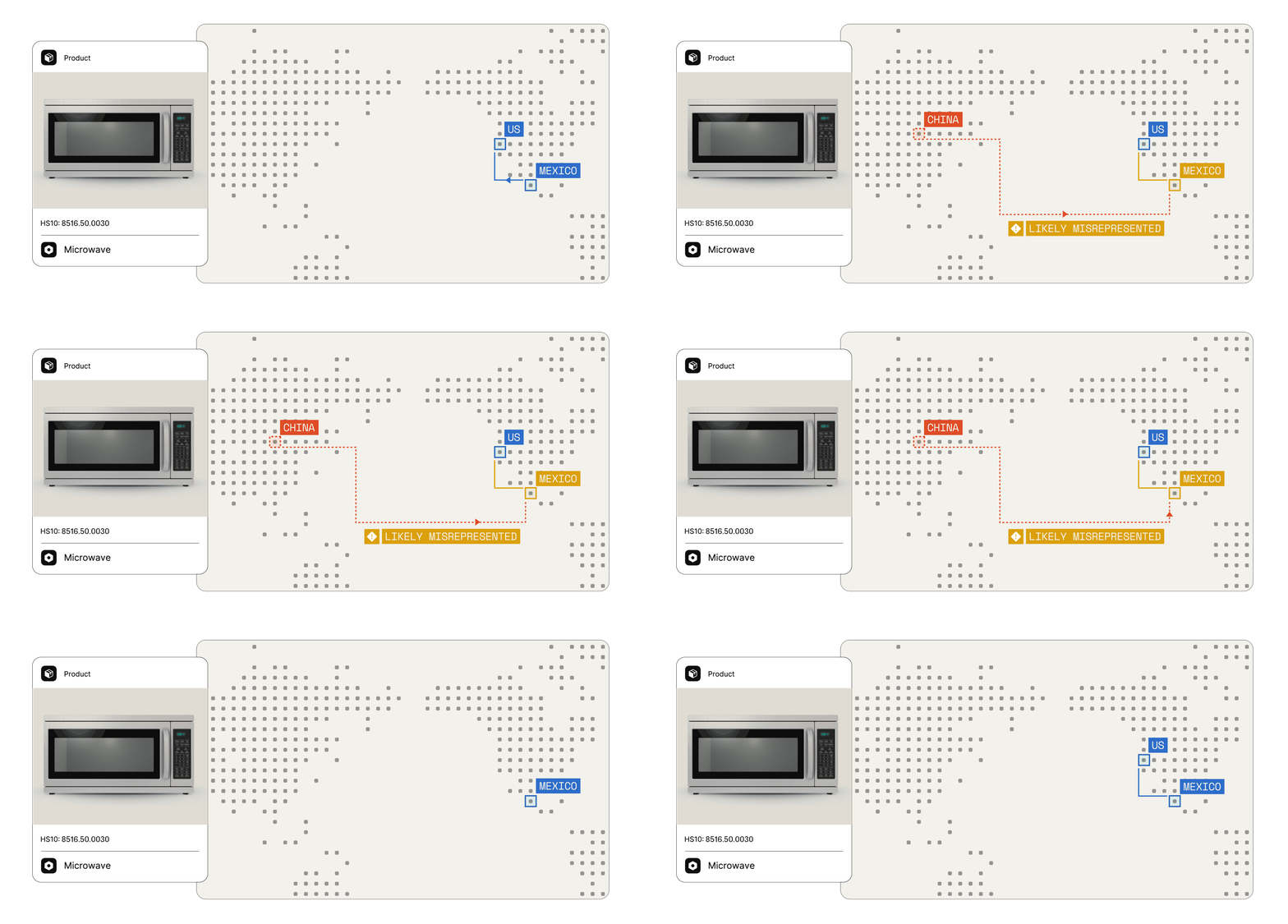
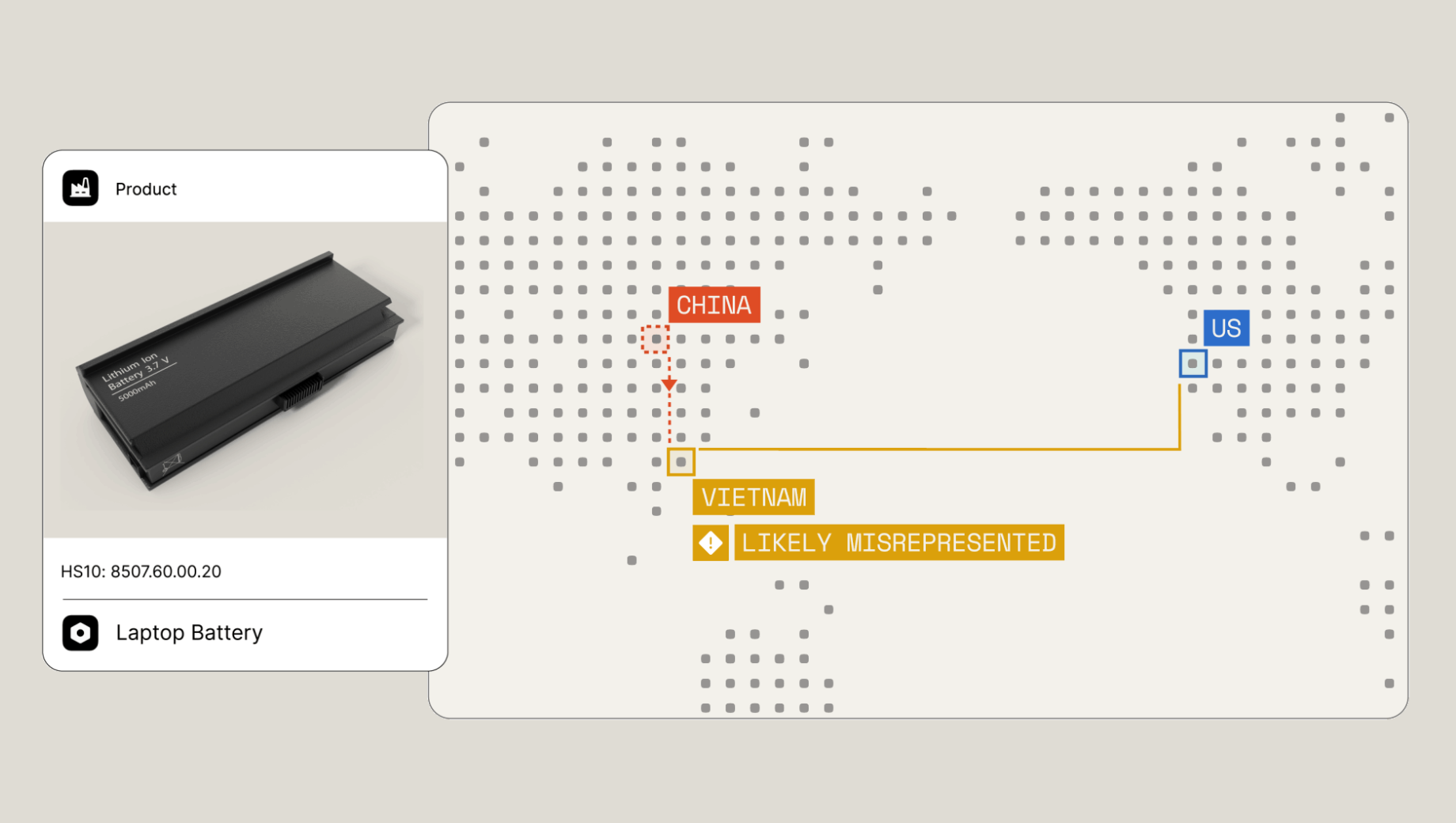
Altana’s transshipment detection algorithm traces facility-level supply chain relationships to identify paths where goods move from an origin to an intermediary to a final destination without evidence of substantial transformation. It indicates that some of this activity was likely illegal transshipment.
Millions of USMCA-bound shipments containing goods with travel consistent with rerouting and tariff circumvention have been registered since the agreement was ratified in 2020.
And month-over-month, the value of suspected U.S.-bound shipments in 2025 consistent with transshipment rose from $21.2 billion in April, when Liberation Day brought high, reciprocal tariff rates, to $31.5 billion in December — a 50% increase.

Trade lanes shifts raise question of Chinese goods entering USMCA through intermediary countries
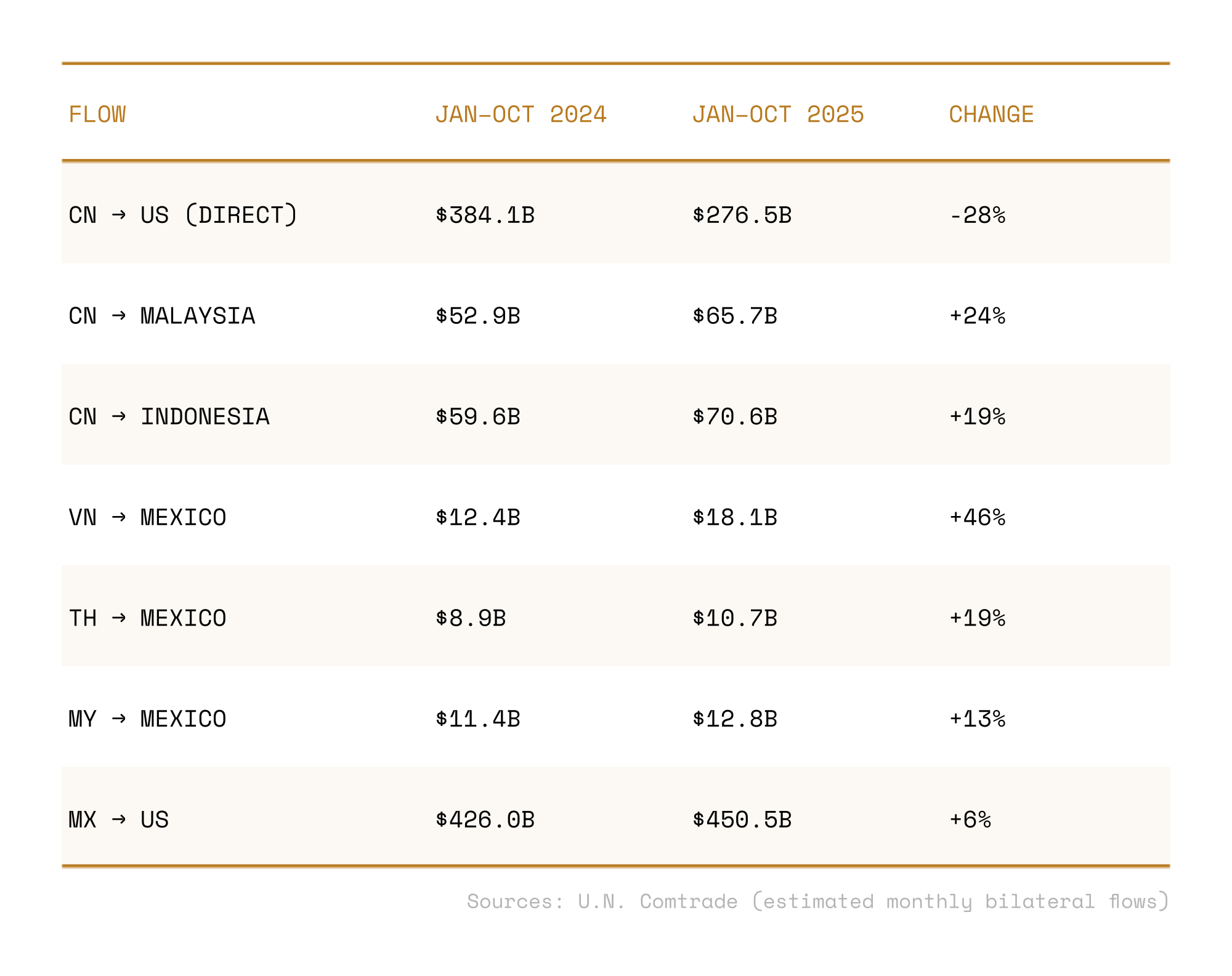
Altana’s analysis shows that in 2025, as U.S. tariff laws became more robust, the flow of global trade shifted, with direct China-to-U.S. trade contracting and trade that involved intermediary channels that fed into the USMCA market all growing.
The divergence between the collapsing China-to-U.S. trade flow and intermediary-to-Mexico flows was stark in the first ten months of 2025: Vietnamese exports to Mexico surged 46%, from $12.4 billion to $18.1 billion. Chinese exports to Malaysia grew 24% and Chinese exports to Indonesia increased 19%. Mexican exports to the U.S. also continued to grow, up 6% to $450.5 billion.
This change in trade flows and surge in rerouting raises the question for USMCA joint review: Did goods undergo enough transformation at each stop to legitimately qualify for preferential treatment under USMCA?
trade lanes shift usmca intermediaries
transship

Existing transshipment pathways are intensifying, not multiplying.

Altana’s transshipment detection capabilities identify supply chain paths — from origin facility to intermediary facility to destination — that are consistent with non-transformation.
Analysis of these established pathways shows that the 2025 tariff escalation intensified activity on pre-existing transshipment routes.
In fact, on pre-existing transshipment routes that end in the USMCA bloc, transactions in the first 10 months of 2025 surged 76% year-over-year, from just over 100 million suspect transactions to 188.5 million.
These findings suggest that rerouting in response to tariffs is not being accomplished by building new, capital-intensive supply chain relationships, but has instead involved more goods rerouting being pumped through established networks of suppliers, facilities, and actors.

Value of suspected U.S.-bound transshipment rose throughout 2025.
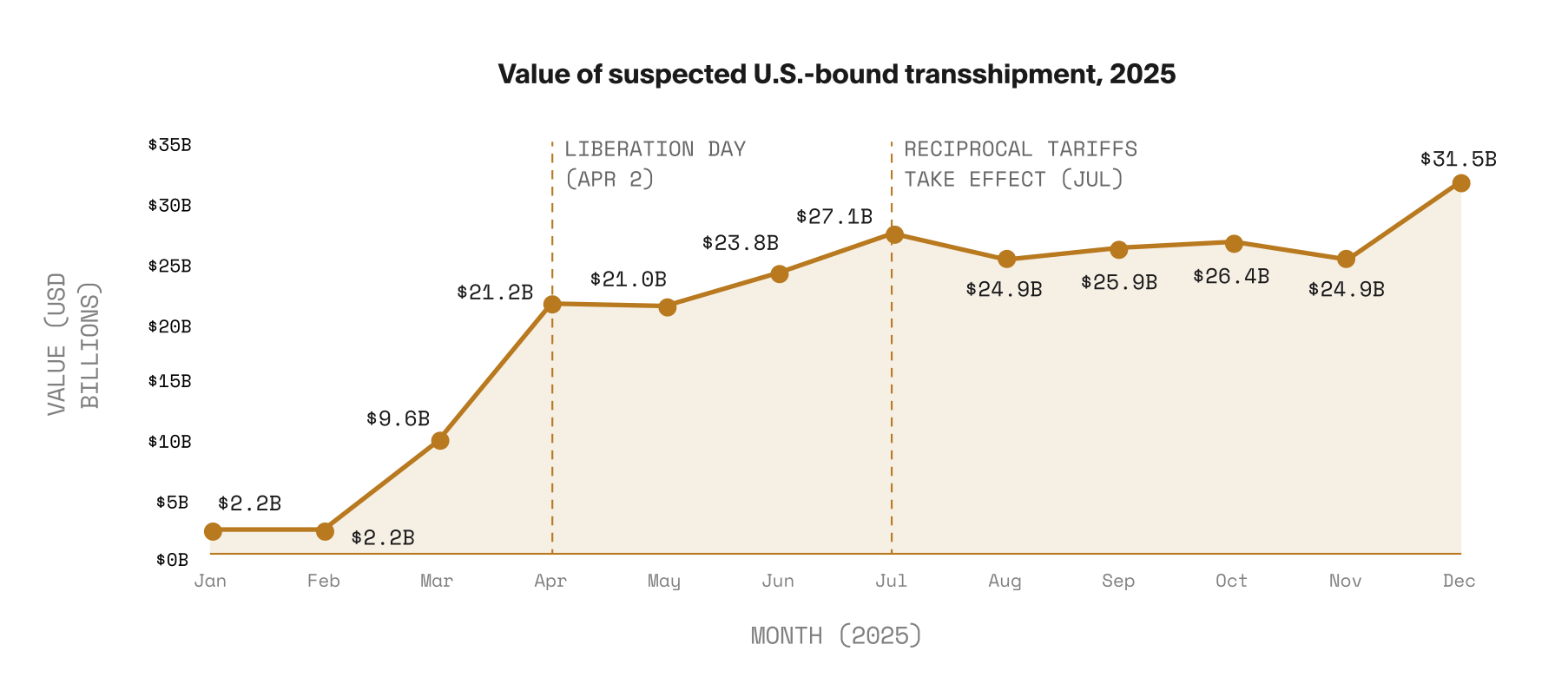
Altana’s analysis indicates that the estimated dollar value of shipments demonstrating patterns consistent with illegal transshipment rose sharply throughout 2025, accelerating at each major tariff escalation. In January and February, Altana identified roughly $2.2 billion per month in suspected transshipment-linked trade entering the U.S. That figure jumped to $9.6 billion in March as anticipation of new tariffs grew, then more than doubled to $21.2 billion in April following Liberation Day. A second surge followed in July when reciprocal tariffs took effect. By December, suspected transshipment had reached $31.5 billion — more than 14 times the January baseline.
The trajectory is telling. Suspected transshipment values did not spike and recede after Liberation Day. Instead, as tariff complexity increased throughout 2025, so did the non-compliant rerouting of goods that are subject to them. The analysis specifically evaluated the flow of goods that were subject to tariffs, suggesting that as new tariff rates took effect and enforcement expanded, the economic incentive to reroute goods through intermediary countries and into the USMCA bloc to qualify for preferential tariff treatment also grew.
transshipment rises in 2025

~$302B Yearly U.S.-bound transshipment

~$40B Lost U.S. tariff revenue due to transshipment

14X Increase in U.S.-bound transshipment, 2025

Suspected non-transformation within the USMCA bloc
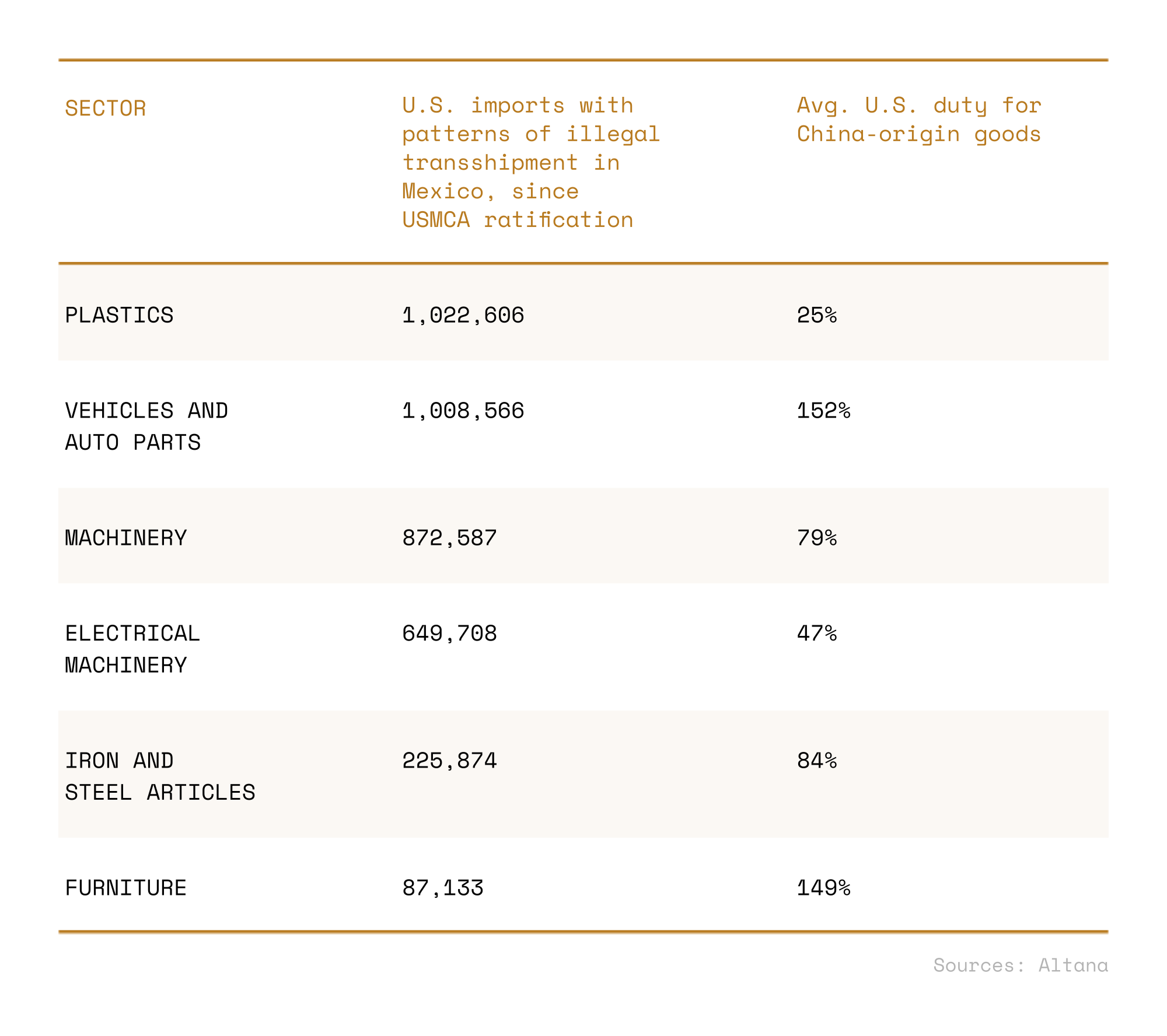
Among suspected non-transformation pathways, the China-to-Mexico-to-United States corridor registers intense activity. Since 2020, Altana has identified 4.6 million shipments on this route, spanning 192,000 distinct supply chain paths and involving 9,100 U.S. importers.
The sectors at the center of the USMCA joint review and sectoral-level tariffs — vehicles, machinery, electronics — are also the sectors most represented on these transshipment journeys.
The duty rates reveal a possible reason for this activity. A Chinese-origin vehicle part facing a 152% duty can be routed through a Mexican facility and potentially enter the United States at USMCA preferential rates — if it qualifies under rules of origin. At question is whether meaningful transformation occurred at the Mexican stop and whether these known transshipment facilities will accurately record regional value content and other upstream, component-level information necessary to calculate and apply complex tariff rates and origin rules.
Suspected transshipment by sector table — U.S. imports with patterns of illegal transshipment in Mexico since USMCA ratification, with avg. U.S. duty for China-origin goods
ships at sea

05: Forced Labor

Forced labor exposure present in North American supply chains

Since the Uyghur Forced Labor Prevention Act (UFLPA) took effect in June 2022, U.S. Customs and Border Protection has reviewed more than 18,000 shipments and taken enforcement action against roughly $3.8 billion of goods with suspected forced labor links.

But analysis from Altana’s Knowledge Graph — the largest map of the global supply chain — reveals that as with transshipment, forced labor enforcement to date has intercepted only a fraction of the exposure flowing into the USMCA trade bloc.
Altana’s analysis reveals that at least $86 billion in goods traced to forced-labor-flagged entities entered the USMCA bloc — $71.6 billion of which entered the U.S. — in 2024 and 2025 alone. This is more than 35 times the total value of goods CBP has enforced under UFLPA in that same time period.

$86B USMCA-bound shipments with upstream exposure to forced labor, 2024-2025

$71.6B Value of U.S.-bound shipments with product inputs exposed to forced labor in 2024 and 2025

$2.03B Value of U.S. CBP UFLPA enforcement, 2024 and 2025
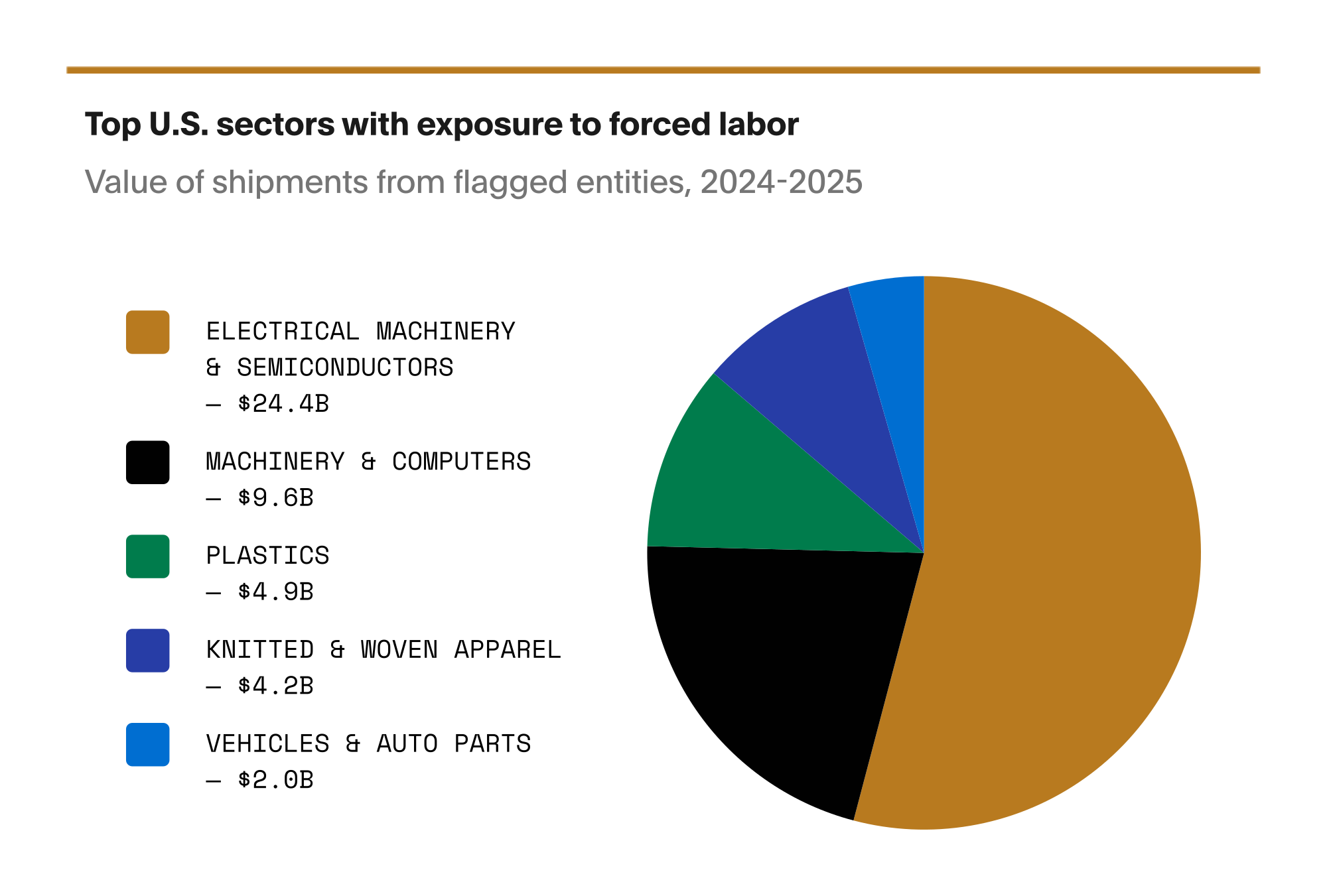
The top sectors flowing to U.S. buyers from flagged entities include electrical machinery and semiconductors ($24.4 billion in 2024–2025), machinery and computers ($9.6 billion), plastics ($4.9 billion), vehicles and auto parts ($2.0 billion), and knitted and woven apparel ($4.2 billion combined). These are not obscure goods, but represent core inputs and components of the North American production network.
Altana’s analysis further reveals that since USMCA ratification, a growing pipeline of goods with links to forced labor production networks have entered Mexico.
u.s. sectors exposure to forced labor
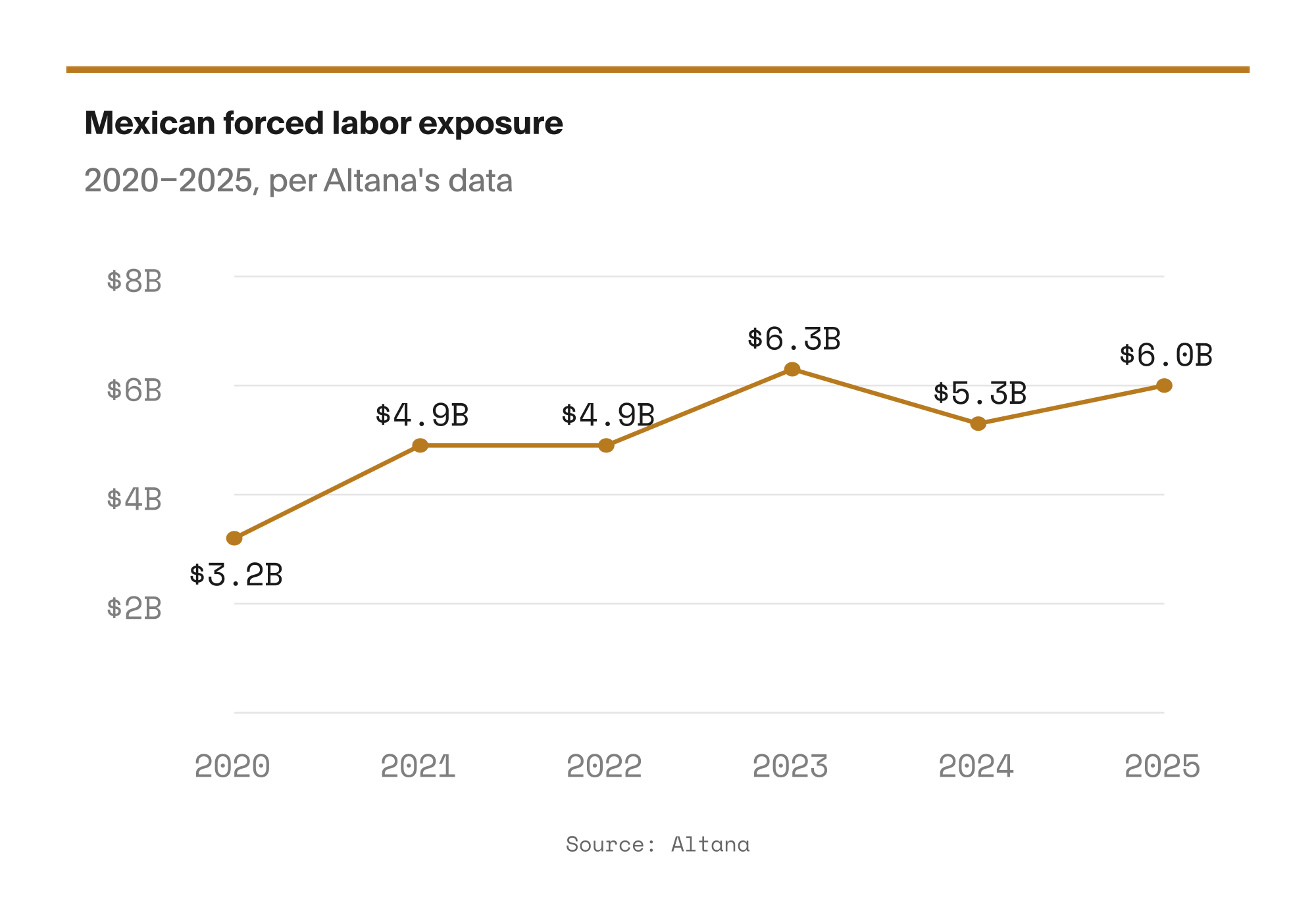
Mexican imports with exposure to forced labor reached $6.0 billion in 2025, nearly double the $3.2 billion in 2020. The growth is concentrated in the same sectors at the center of the joint review: vehicles and auto parts, electrical machinery, and industrial equipment.
It’s possible that the products within these shipments could enter Mexican manufacturing processes, undergo assembly or transformation, and subsequently cross into the United States or Canada under USMCA preferential treatment.
mexican forced labor exposure

Hidden exposure to forced labor present in North American supply chains.
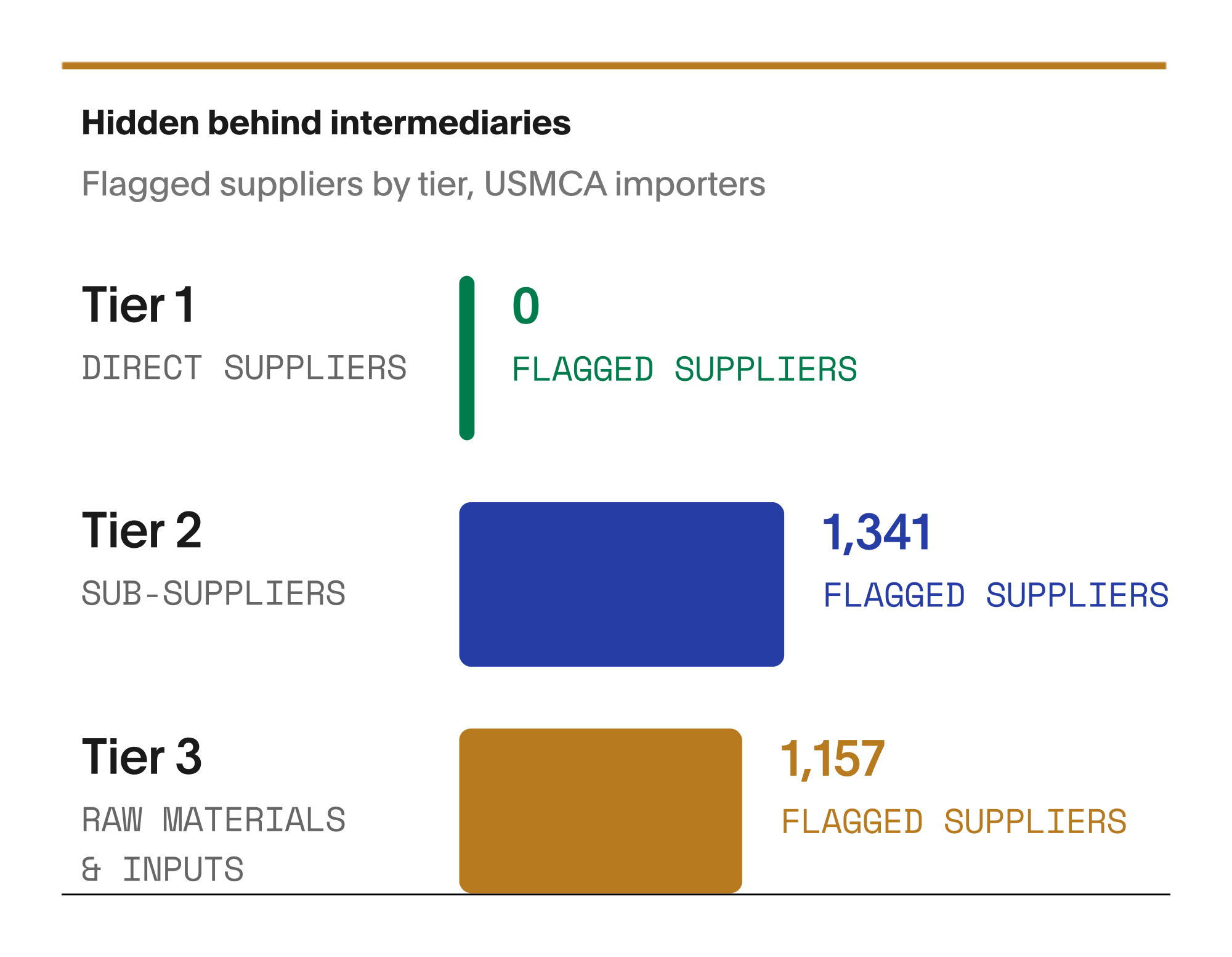
Forced labor content typically enters supply chains further upstream in product value chains, behind multiple tiers of production. And UFLPA’s rebuttable presumption for forced labor if a good’s manufacturing or production is linked to Xinjiang includes parts and inputs across all tiers of production.
To measure this hidden exposure, Altana traced backward through the product value chains of 1,000 major USMCA importers in high-risk sectors — electronics, automotive, textiles, aluminum, steel — that had no known direct trading or supplier relationship with any forced labor-flagged entity in 2024 or 2025. These companies could, if asked by regulators, truthfully say: “we’ve evaluated our Tier 1 suppliers, and none are tied to forced labor.”
Altana’s analysis found significant forced labor exposure lurking further upstream in these product value chains. One level further into production, at Tier 2, 1,341 distinct forced-labor-flagged suppliers were present. At Tier 3, another 1,157 flagged suppliers emerged.
79% percent of these hidden flagged suppliers were based in China. But a significant share operated in intermediary countries — Vietnam, India, Taiwan, Hong Kong — suggesting that the forced labor content is often processed through a third country before reaching the USMCA bloc.
forced labor clal out
Containers seen from above in a shipping dock

06: Trade Experts Survey

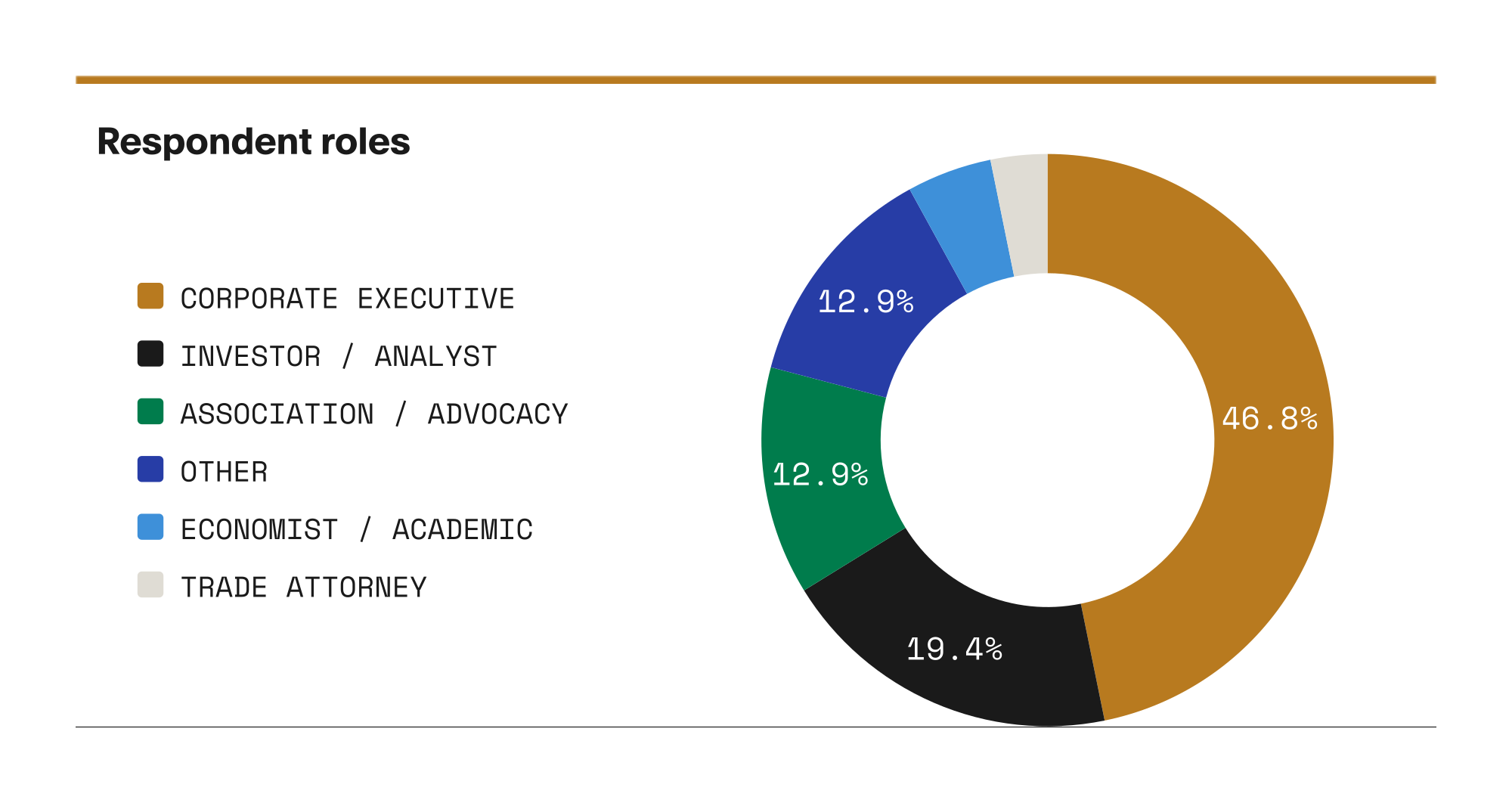
Altana’s Future of Trade Forum engaged in conversation and received perspectives from 91 senior North American trade, supply chain, and geopolitical leaders on the upcoming USMCA joint review.
The participants included former members of the U.S. Congress, current and former members of North American border and customs agencies, academic and think tank members, trade attorneys and consultants, and executives from major North American manufacturers, suppliers, and importers.
These respondents have written and passed trade policy, negotiated trade agreements, enforced trade regulations, and managed the supply chains and trade compliance departments at the most prominent automotive, apparel, defense, electronics, and pharmaceutical companies on the continent.
Sanity Image

Expert takeaways

As the USMCA approaches its first joint review, the trade community is preparing for a pivotal renegotiation — not a rubber stamp.

Altana’s expert survey of 91 senior trade professionals reveals broad consensus: the agreement will survive, but only with significant amendments addressing Chinese supply chain influence, tighter enforcement mechanisms, and a new paradigm built on component-level visibility.
The findings point to an era where knowing what’s in a product matters as much as knowing where it ships from.

63% Expect conditional renewal with significant amendments

89% Agree Chinese transshipment is a significant and growing problem

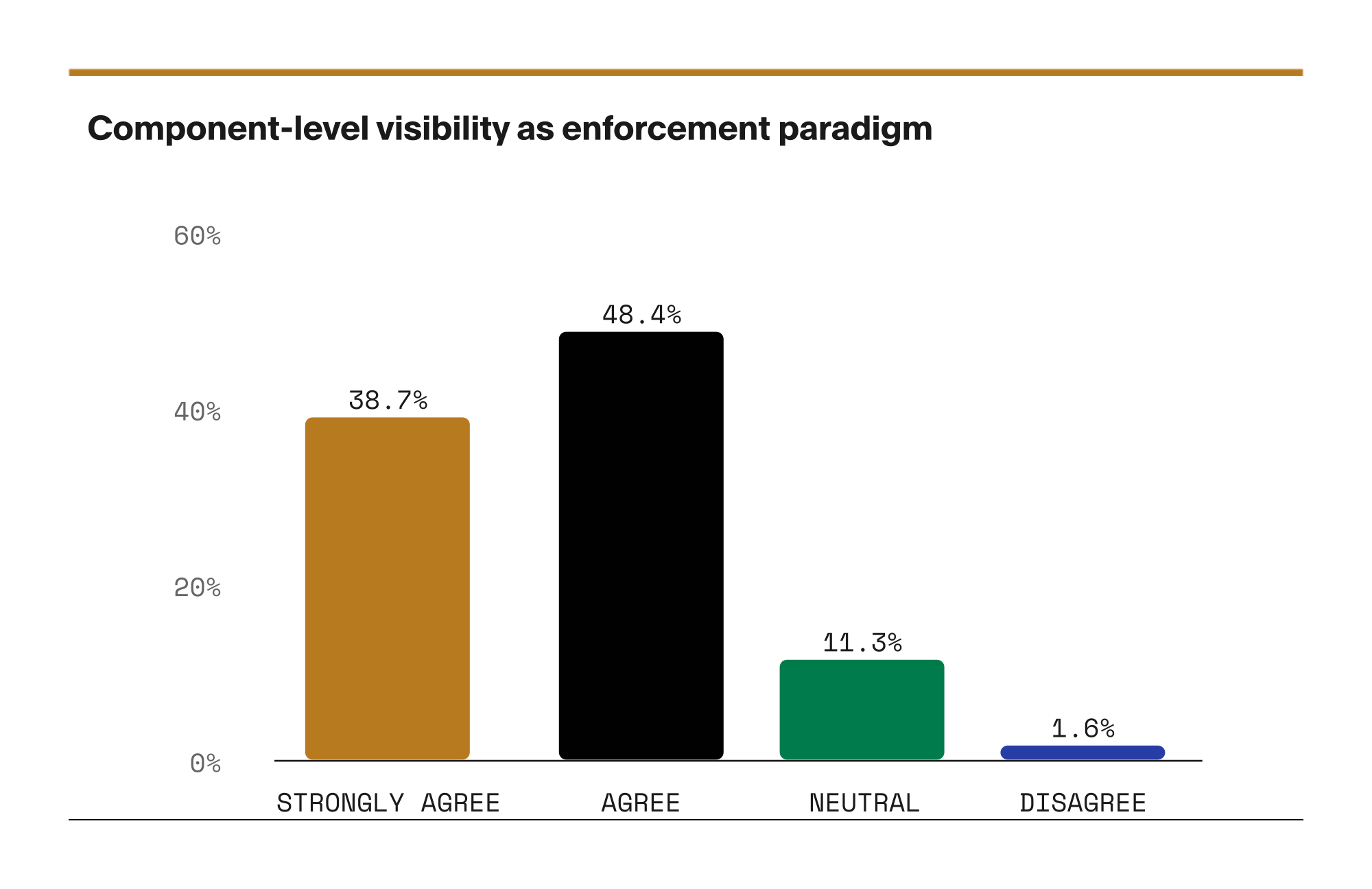
87% Believe component-level visibility will become the dominant enforcement paradigm

The USMCA scorecard: How effective has the agreement been since 2020?

Before looking ahead to the joint review, experts assessed USMCA’s track record across seven core objectives. The verdict: strongest on digital trade modernization and trade volume growth, but weaker on reducing dependence on non-North American inputs and curbing transshipment — precisely the areas now dominating the review agenda.
"
Where USMCA scores lowest — reducing dependence on non-North American inputs (68%) and addressing transshipment (73%) — the pressure for reform is most intense. This explains why China-related enforcement and supply chain visibility have risen to the top of the negotiation agenda.
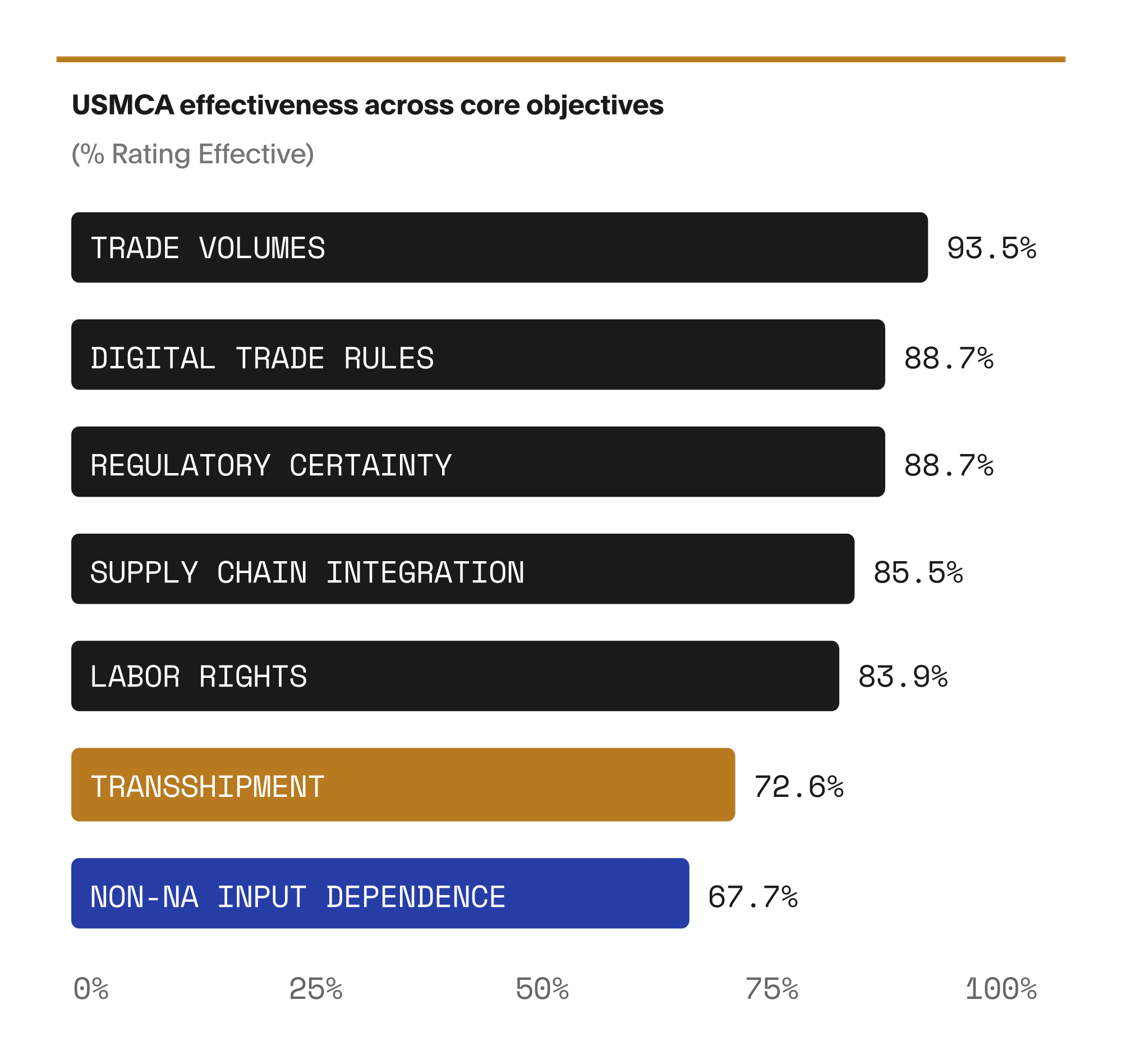
usmca effectiveness
likely outcome of usmca joint review

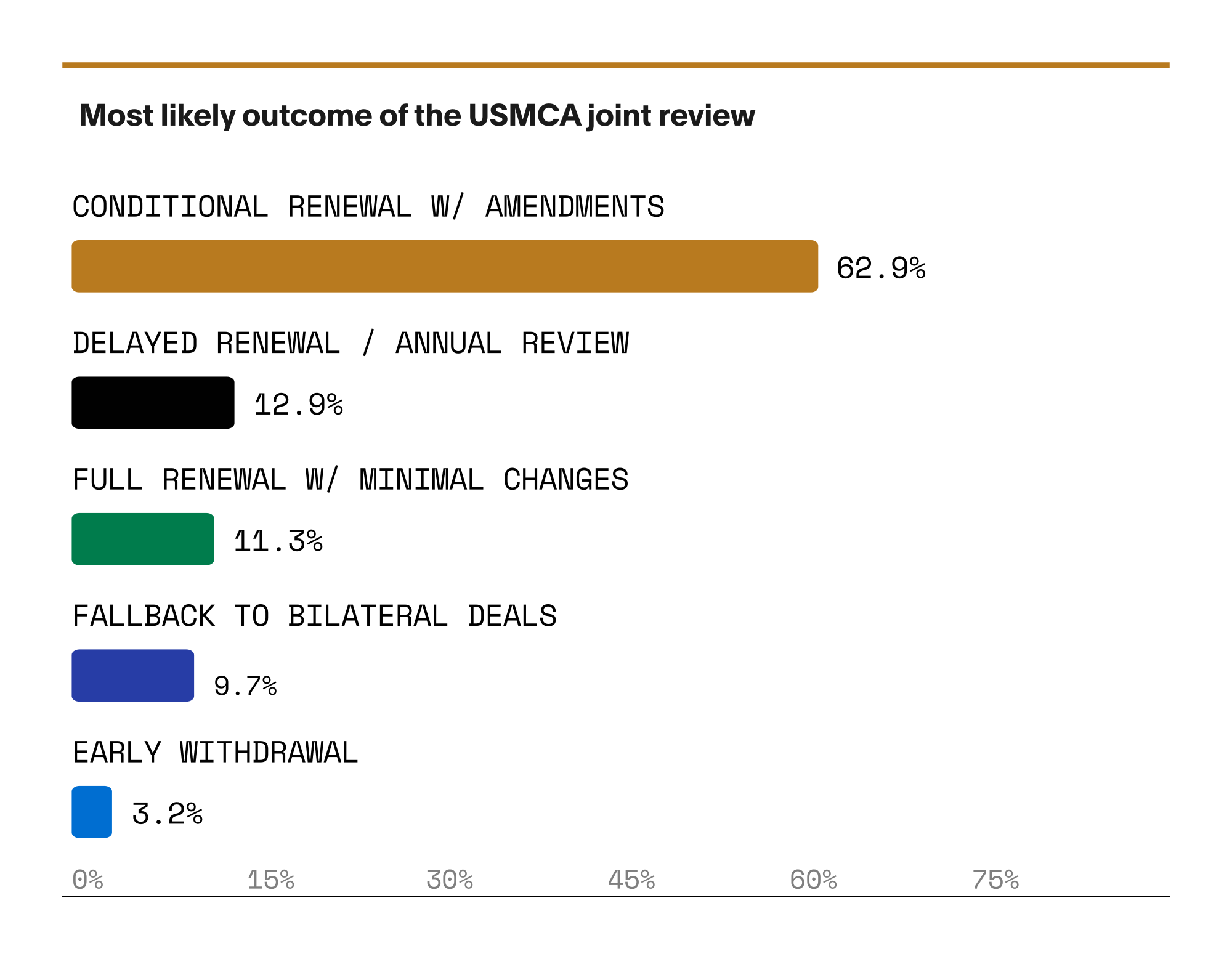
Conditional renewal, not a clean extension

Nearly two-thirds of trade leaders surveyed expect the USMCA joint review to result in conditional renewal with substantial amendments — not a straightforward extension. This signals an industry bracing for meaningful renegotiation of core provisions around rules of origin, China policy, and enforcement.
"
A rolling review process could discourage the multi-decade capital commitments required for true North American nearshoring.

Corporate Executive, North American Trade

KEY INSIGHT

While 74% of respondents expect a substantive resolution by the end of 2026, only 16% believe that will happen during the actual July review window itself. The implication: the formal review is less of a decision point and more of a starting gun — kicking off an intense negotiation cycle that will stretch through the rest of the year and potentially beyond. For businesses making long-term investment decisions, this extended uncertainty is itself a cost.

A shipping yard full of containers

Chinese transshipment is the #1 flashpoint heading into the review
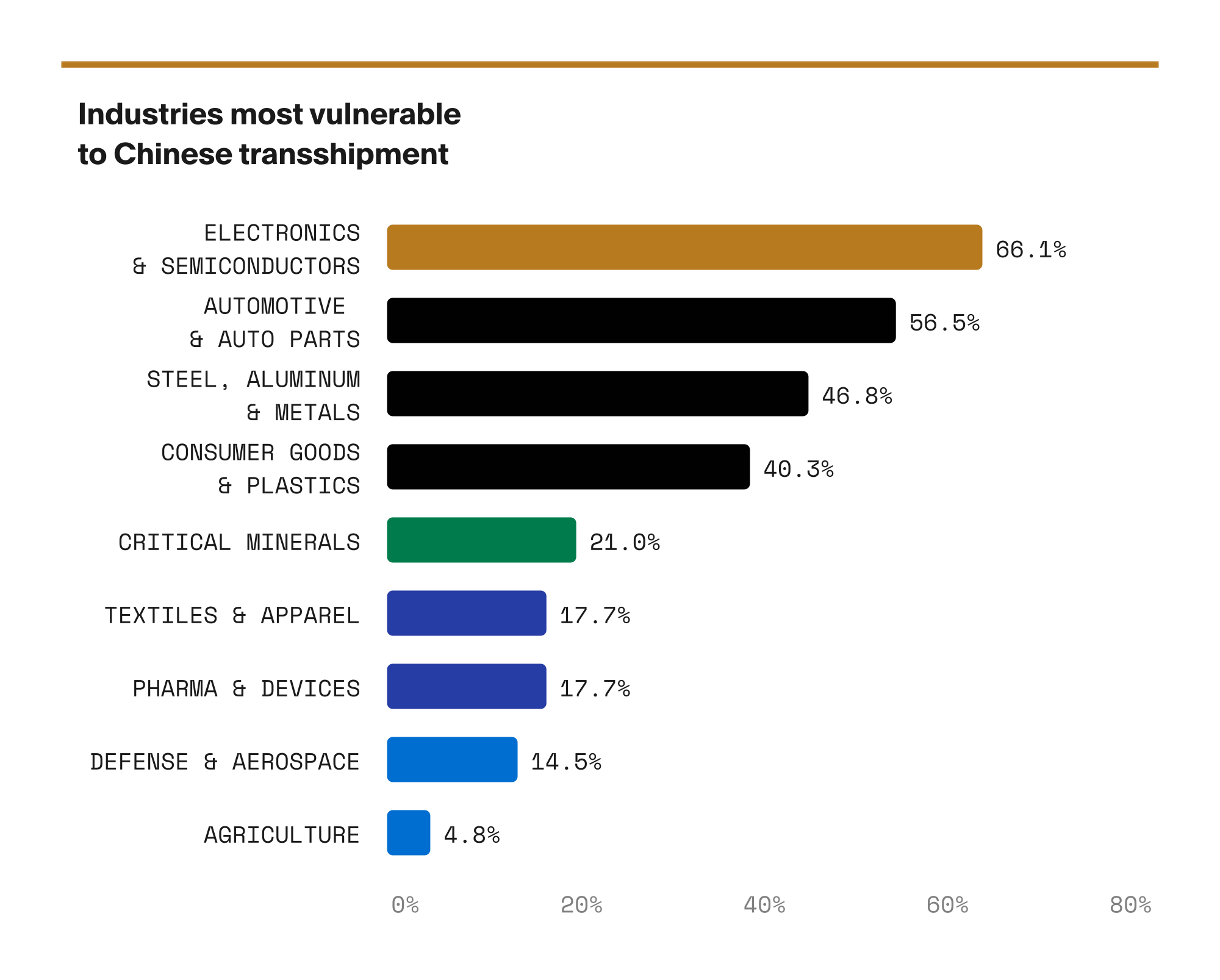
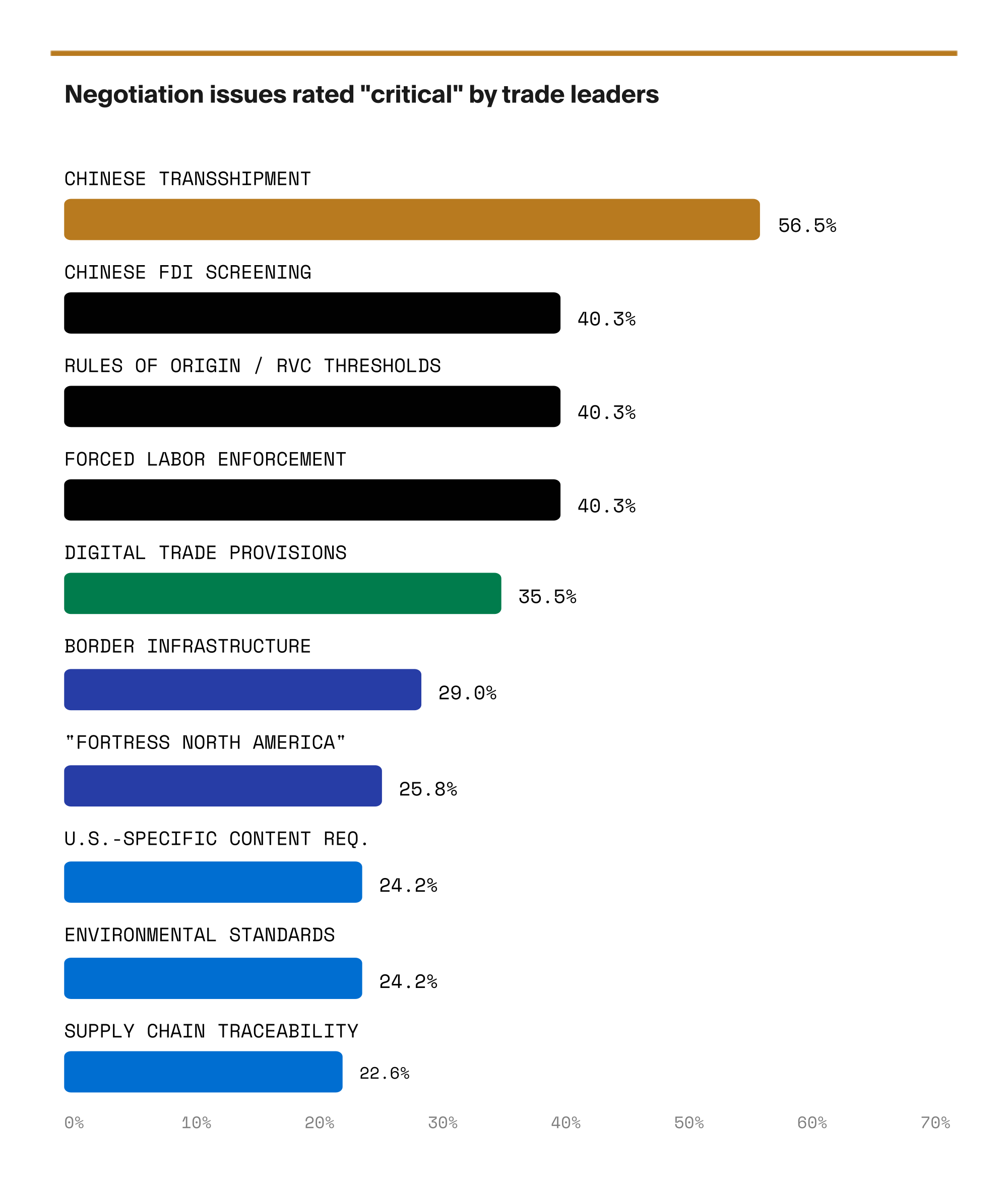
When asked to rate the importance of ten negotiation issues, addressing Chinese transshipment and non-transformation through Mexico and Canada emerged as the highest-priority “Critical” issue.
Nearly 57% of respondents rated it critical — far outpacing any other single issue. Combined with 89% agreement that transshipment is a “significant and growing problem,” China’s supply chain influence dominates the review agenda.
Bar chart of industries most vulnerable to Chinese transshipment, with electronics and semiconductors top at 66.1%
Bar chart of negotiation issues rated 'critical' by trade leaders, with Chinese transshipment top at 56.5%

89% Transshipment is a significant problem

87% Current rules can't prevent circumvention

87% Component-level visibility will dominate enforcement

KEY INSIGHT

The China question isn’t an abstract policy debate — it’s the central organizing issue of the review. With 86% of respondents agreeing that Chinese FDI in Mexico poses a national security risk, and electronics and semiconductors (66%) plus automotive (56%) identified as the most vulnerable sectors, trade leaders see a systemic challenge that the current USMCA framework was not designed to address. Notably, 69% believe the U.S. will successfully compel Mexico and Canada to adopt aligned China restrictions — but that still leaves significant skepticism about trilateral alignment.

"
The hidden vulnerability of North American supply chains to Chinese capital and intermediate goods — while policy focuses on final assembly, the real risk is deeper in the supply chain.

Financial Analyst / Risk Advisor

"
The most underreported issue is Mexico’s role as a conduit for Chinese goods and investment to circumvent U.S. tariffs.

Trade Compliance Professional

Component-level visibility is the next enforcement paradigm
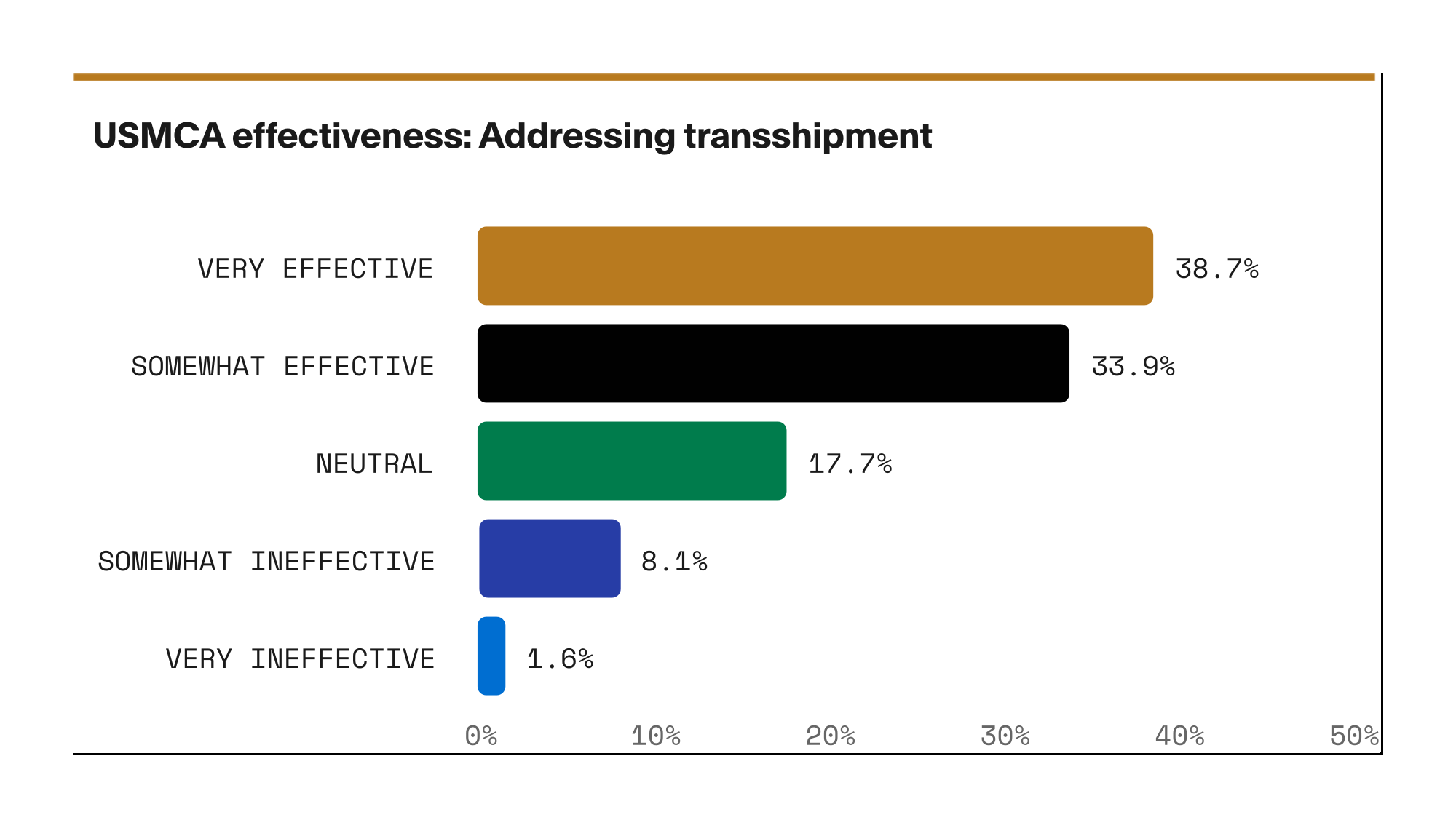
A striking 87% of trade leaders agree that component-level supply chain visibility — knowing what’s in a product, not just where it ships from — will become the dominant enforcement paradigm in trade agreements. This represents a fundamental shift from documentation-based compliance to data-driven transparency.
Bar chart of USMCA effectiveness at addressing transshipment
Bar chart showing component-level visibility as the next enforcement paradigm
Bar chart of importance of AI & technology in enforcement
"
There remains a significant opportunity to integrate and modernize the systems by which importers relay data to trade authorities. This includes CARM in Canada, and ACE in the US. Customs Authorities need to continue to find ways to use technology to make it easier for good actors to facilitate trade so that they can spend their financial resources detecting bad actors. Concepts like product passports and trusted traders must be part of the conversation to achieve this vision.

Regulatory and Government Affairs Leader, Fortune 500 Retailer

KEY INSIGHT

The enforcement gap is real: while 73% rate USMCA somewhat or very effective at addressing transshipment, 87% simultaneously agree that current rules of origin are insufficient to prevent circumvention. The reconciliation is clear — the framework has value but needs a new enforcement layer. With 58% rating AI and advanced technology as “Very Important” to the review outcome, the industry sees technology-enabled visibility as the bridge between today’s documentation-based system and tomorrow’s component-level reality.

Headshot of Diego Marroquín Bitar

"As supply chains have grown more complex, enforcement has grown more difficult. Production networks extend well beyond direct suppliers. Inputs cross multiple jurisdictions before final assembly. Excess capacity in non-market economies, indirect routing, and minor transformation practices have increased pressure on customs authorities to verify origin, tariff treatment, and regulatory compliance with limited upstream visibility. Economic security now depends on visibility."

Diego Marroquín Bitar,

Center for Strategic and International Studies

Headshot of Diego Marroquín Bitar

Diego Marroquín Bitar,

Center for Strategic and International Studies

"Supply chain traceability and enforcement gaps are being overlooked. Current discussions emphasize rules of origin and China restrictions, but the lack of component-level visibility across industries leaves loopholes for circumvention."

Corporate Executive

Corporate Executive

"Many discussions focus on thresholds and tariffs, but few address how companies can realistically verify and trace component origins at the subassembly level. Without stronger enforcement mechanisms and digital traceability, the rules themselves are just words on paper."

Trade Compliance Professional

Trade Compliance Professional

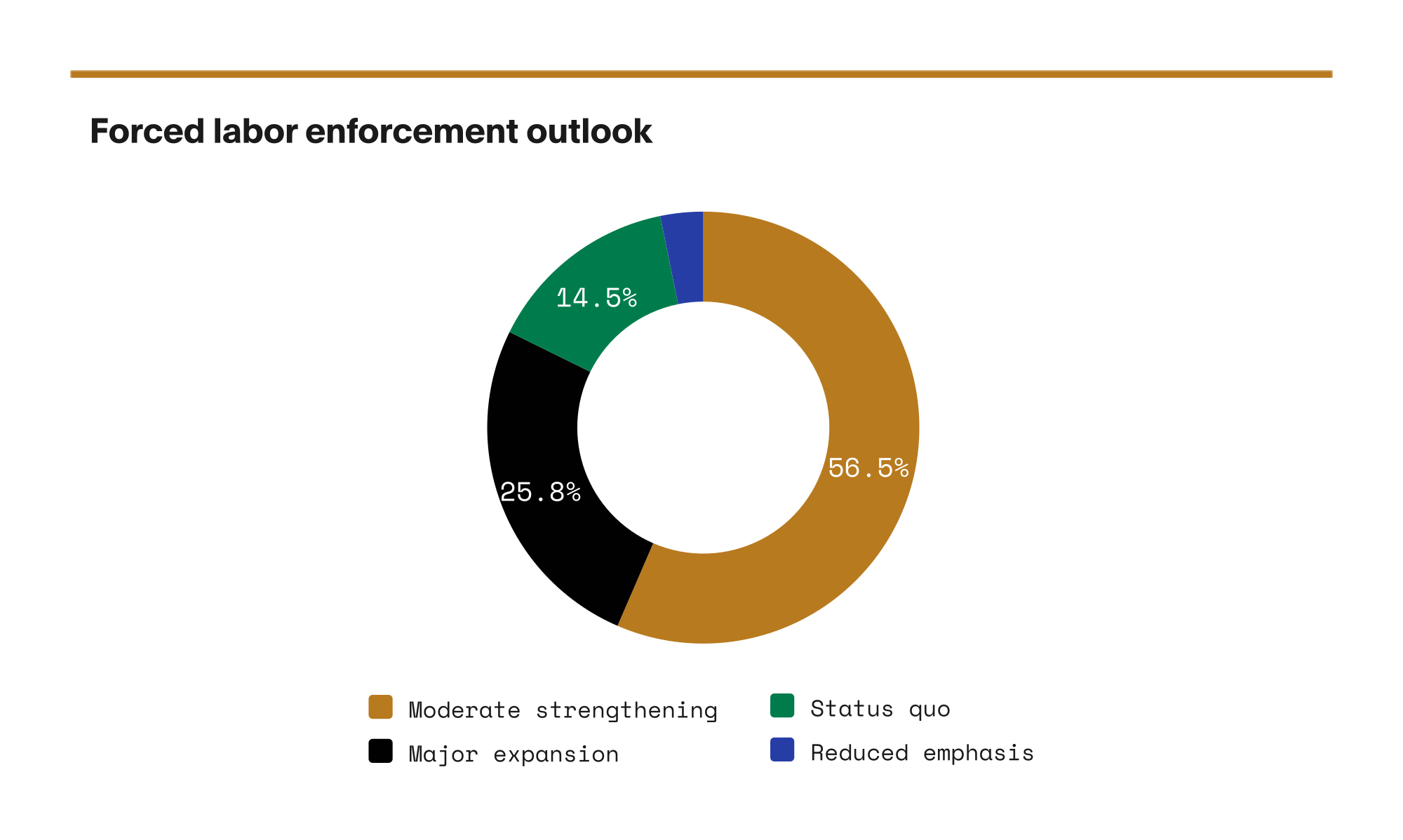
Experts suggest moderate strengthening and enforcement of existing rules

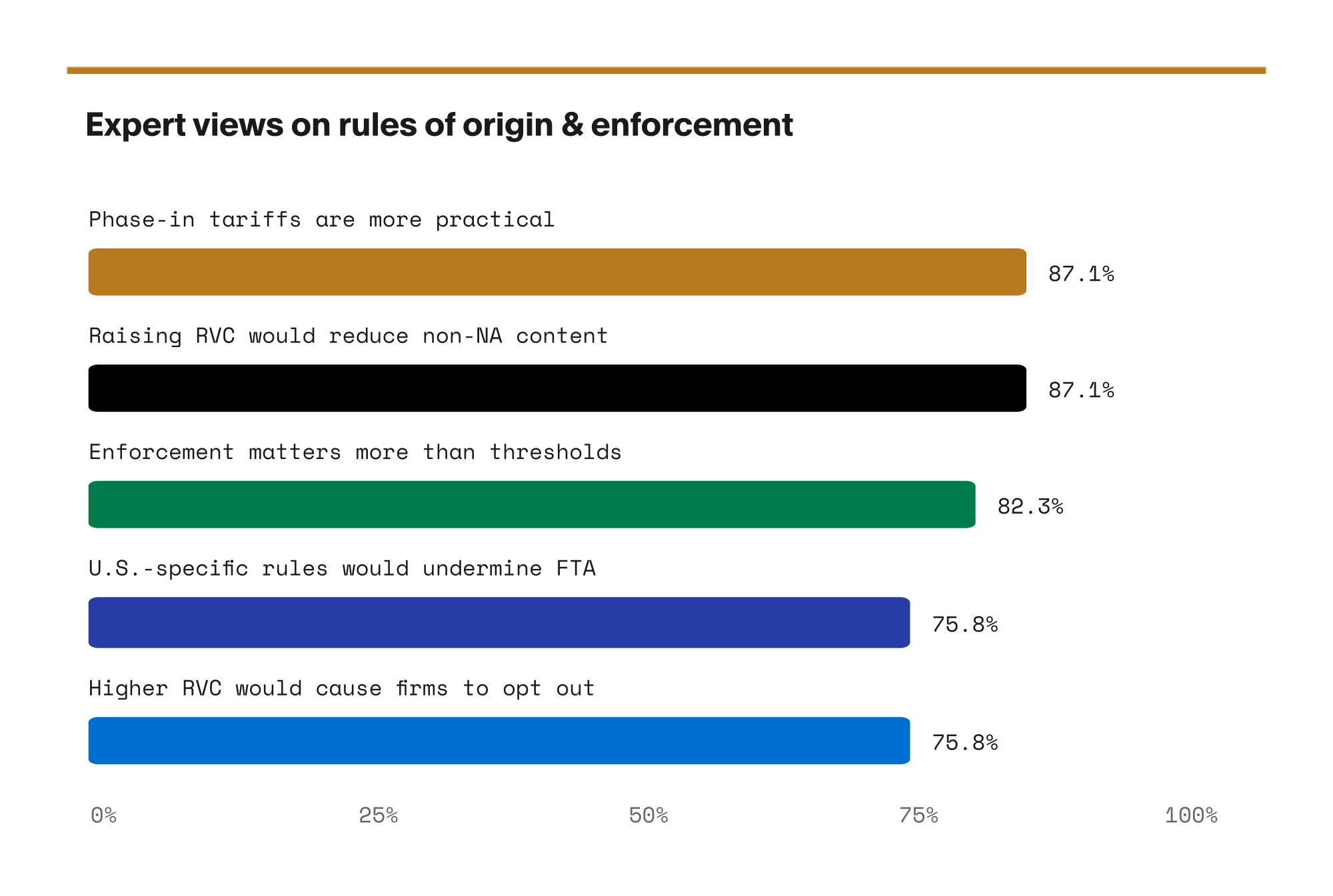
On the politically charged question of whether to raise regional value content (RVC) thresholds, trade leaders send a nuanced message: enforce what we have before piling on new requirements. 82% agree that enforcement of existing rules matters more than raising thresholds, even as 87% acknowledge higher thresholds could reduce non-North American content.

KEY INSIGHT

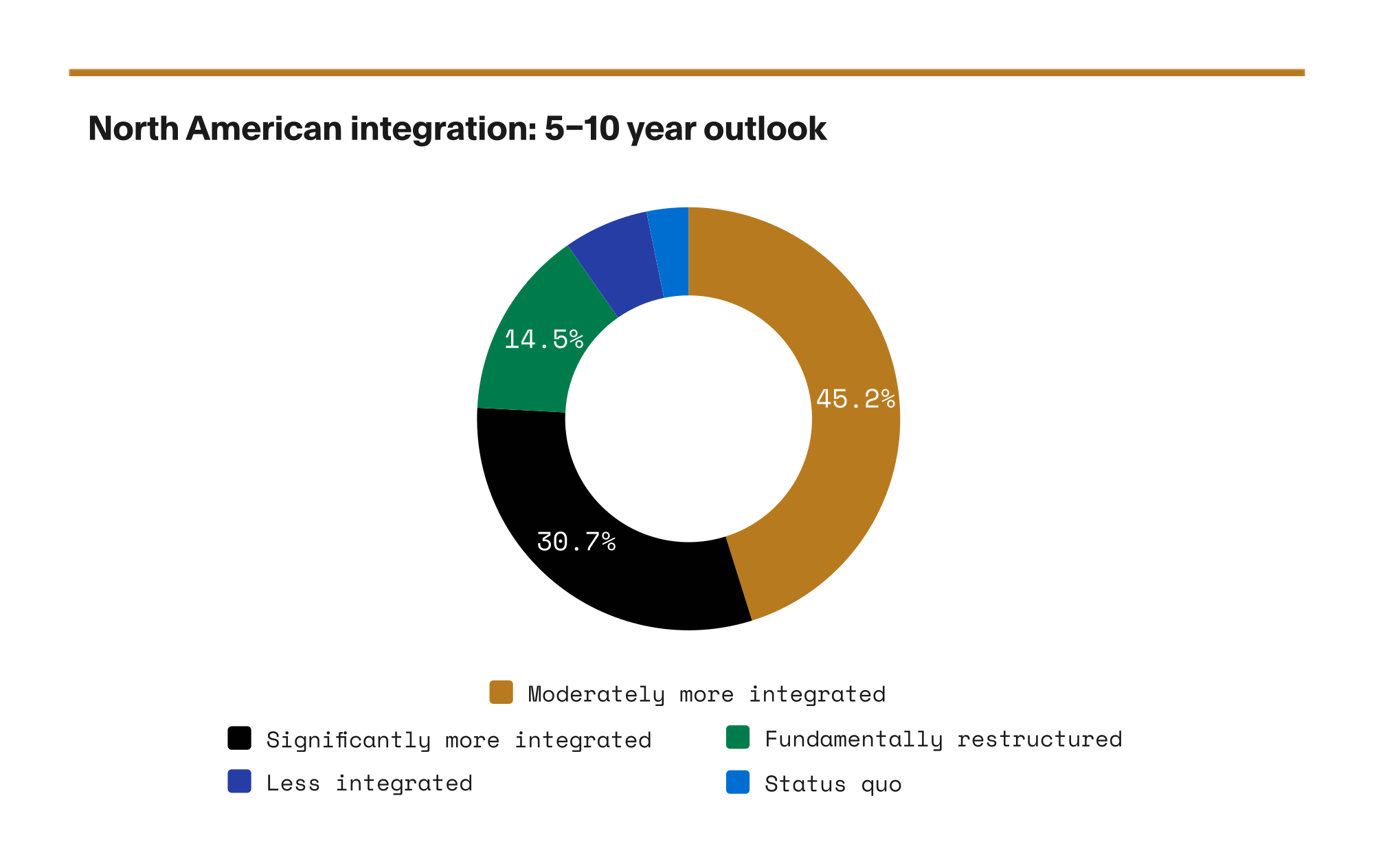
The trade community is hoping for evolution: better enforcement of existing rules, gradual phase-in approaches to content requirements, and deeper North American integration over the next decade. At the same time, the push for U.S.-specific content requirements signals that USMCA is no longer just an economic-growth trade agreement but also a geopolitical instrument. USMCA is no longer just an economic-growth trade agreement — it is increasingly a geopolitical instrument, and the 2026 review may be the moment that transformation becomes explicit.

"
The 2026 USMCA review is being redefined by non trade issues like border security, fentanyl trafficking, and Mexico’s judicial reforms, which the U.S. is now using as direct leverage for market access. Simultaneously, a quiet but aggressive tightening of rules of origin is transforming the pact into a geopolitical fortress.
Industry Association Leader

Bar chart of expert views on rules of origin and enforcement
Stacked bar chart of broader strategic factors shaping the review outcome
Donut chart of forced labor enforcement outlook
Donut chart of North American integration 5-10 year outlook

Methodology

This survey was conducted as part of Altana’s Future of Trade Forum series in Spring 2026. Respondents were screened for professional involvement in USMCA or North American trade operations and familiarity with the 2026 joint review process. The conversational survey format combined structured quantitative questions with open-ended qualitative prompts to capture both measurable consensus and nuanced expert perspectives.
respondent roles

91 Expert respondents

53% USMCA is primary focus for their role

81% Directly involved in USMCA trade operations

More research from Altana

  • Component-Based Tariffs Tax the Goods Within the Goods

    Insights

    Component-Based Tariffs Tax the Goods Within the Goods, Complicating Global Trade

  • De Minimis Rollback Reshapes Global Trading System

    Insights

    De Minimis Rollback Reshapes Global Trading System

  • illusion of origin: non-transformation of goods in u.s. trade lanes

    Insights

    Illusion of Origin: Non-Transformation of Goods Found in Major U.S.-Bound Trade Lanes

Subscribe to the Altana newsletter

Latest news, announcements and updates direct to your inbox

  • Privacy Policy
  • ©Altana 2025. All Rights Reserved.
  • Altana and the Altana logos are trademarks of Altana Technologies, Inc., in the United States and other countries.

Company Type

  • Platform
  • For Government
  • For Enterprises
  • For Suppliers
  • For Logistics

Use Case

  • Tariffs & Trade Compliance
  • Resilience
  • Counternarcotics

Resources

  • Resources
  • Cookie Preferences
  • Trust Center

About

  • About Us
  • Careers
  • Legal
Altana
  • Privacy Policy
  • ©Altana 2025. All Rights Reserved.
  • Altana and the Altana logos are trademarks of Altana Technologies, Inc., in the United States and other countries.