U.S. Customs selects Altana to modernize enforcement and border clearance

Learn more

Altana

September 2, 2025

Official Trade Guide

How Electronics Brands and Manufacturers Can Overcome Trade Shocks with AI

How Electronics Brands and Manufacturers Can Overcome Trade Shocks with AI

The current state of the electronics supply chain
It’s never been harder for electronics manufacturers to design resilient, compliant, cost-efficient supply chains.
China is restricting exports of critical minerals and permanent magnets, the U.S. is imposing component-based Section 232 national security tariffs on critical minerals, semiconductors, and polysilicon, and an emerging body of trade regulations hold manufacturers accountable for inputs far upstream in their product value chains.
But concurrent advances in artificial intelligence have knitted the world’s supply chain together into a unitary, collaborative network that gives manufacturers and importers the visibility and traceability they need to gain competitive advantage, remain compliant, and build supply chains that can withstand the tumult.
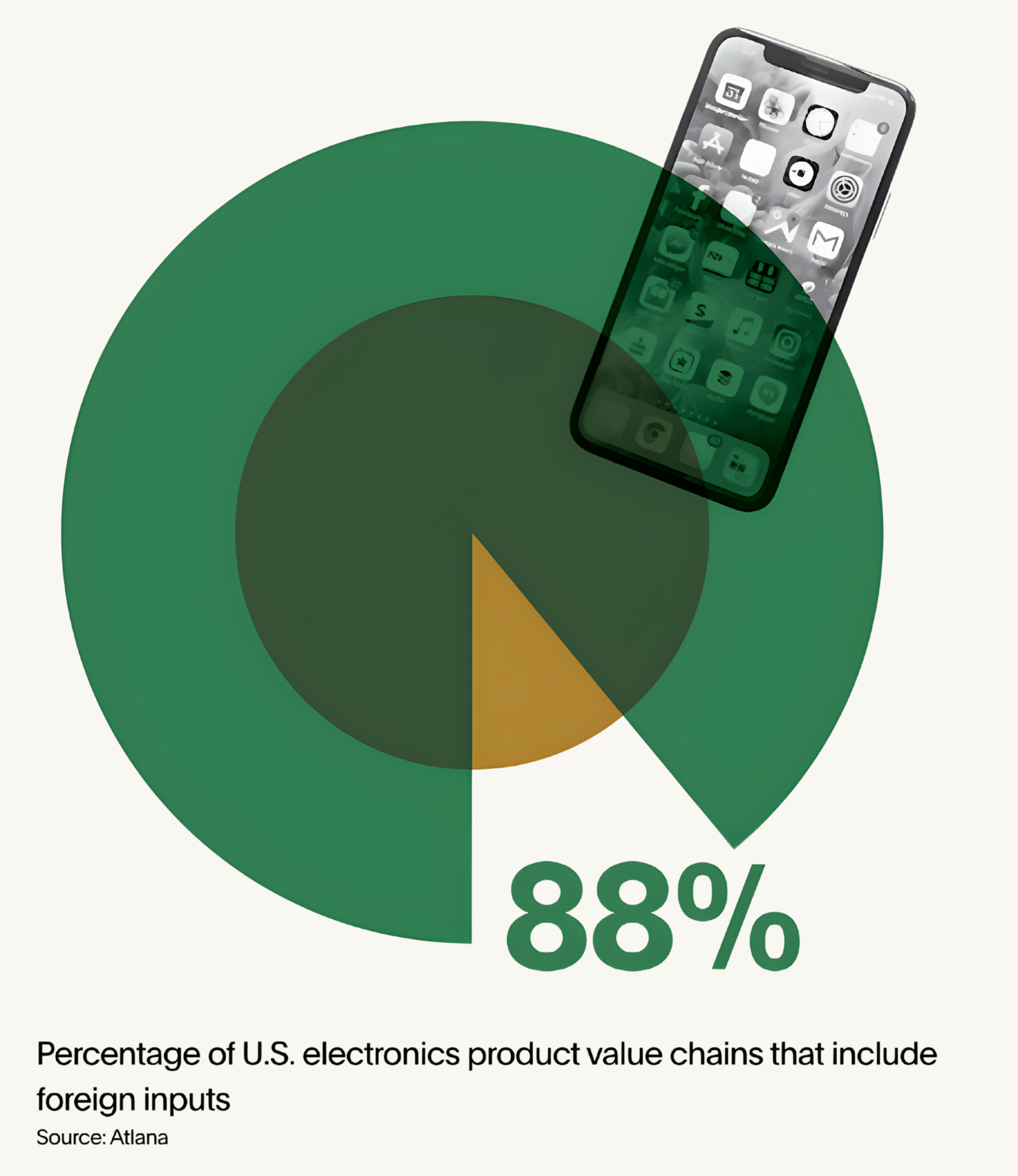
The challenge for enterprises stems from the global dispersion of electronics manufacturing: Roughly 88% of U.S. electronics product value chains include foreign inputs, according to an analysis of Altana’s Knowledge Graph. Most alarming is the significant sub-tier reliance on suppliers in China, according to the analysis. About one-quarter (24.4%) of electronics suppliers in Tiers 1, 2, 3, and beyond in U.S.-bound electronics product value chains are located in the U.S.’s primary competitor and adversary.
For electronics manufacturers, gaining competitive advantage during an era of trade disruption and fluctuating tariff policy requires knowing and managing a global network of suppliers. Read on for Altana’s analysis of the electronics supply chain and learn about the challenges facing manufacturers on the journey from silicon to solar panels, smartphones, and software-enabled automotives. You’ll also see how Altana’s network for trusted trade provides the visibility, traceability, and collaboration necessary to validate compliance, stress-test resilience, identify alternative suppliers, and design secure, profitable value chains.
electronics product value chains foreign inputs
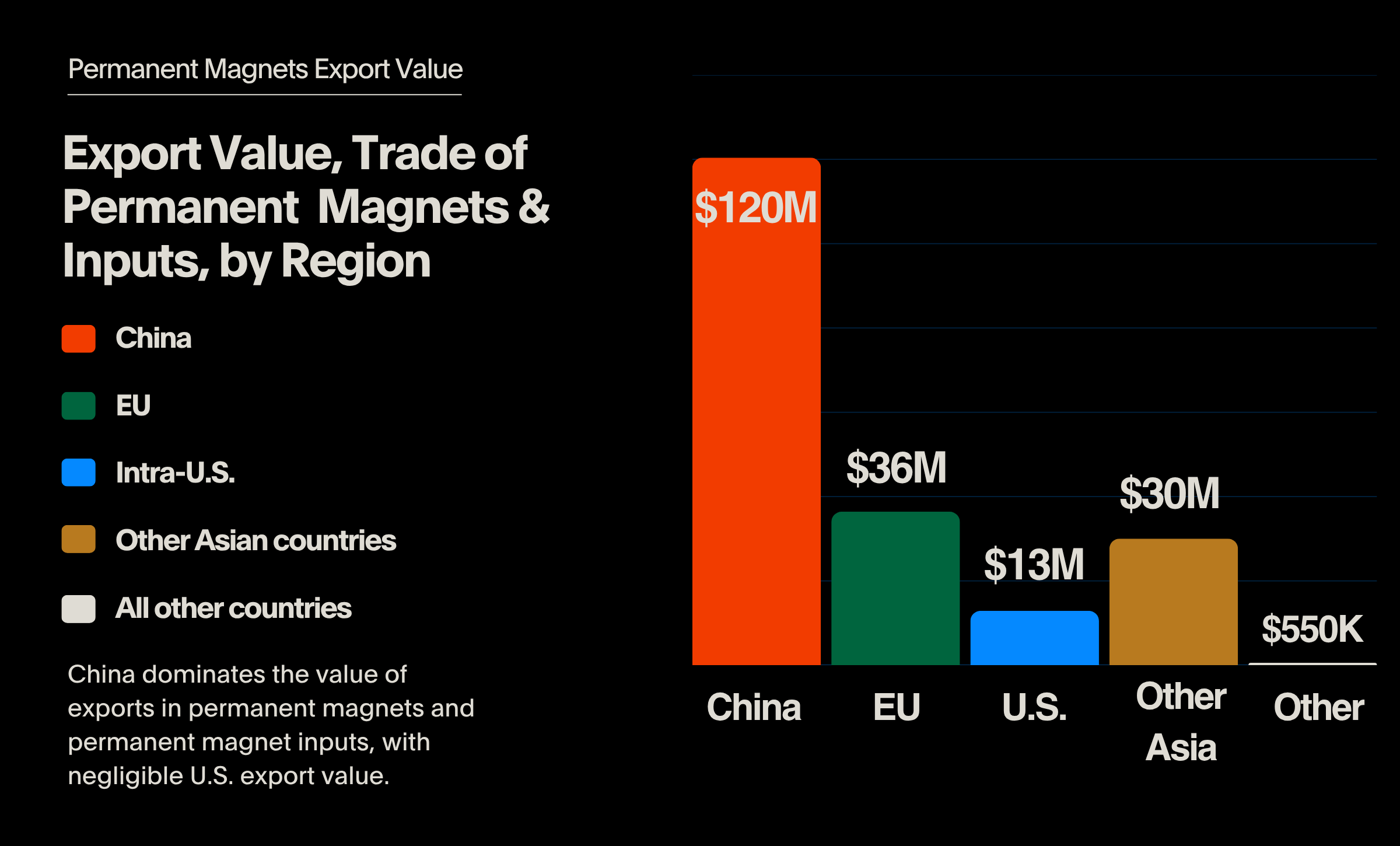
export value trade of permanent magnets and inputs by region

China places export controls on essential rare earths

China recently placed export controls on permanent magnets and a slew of rare earth elements and minerals, vital inputs for electronics products and applications across a range of industries.
Across industries, Altana’s analysis demonstrates that over the past decade, the preponderance of the value of permanent magnet trade has come from Chinese exports.
Terbium, dysprosium, and other minerals go into the production of permanent magnets, and permanent magnets themselves are now subject to China’s export controls.

Export-restricted rare earth elements and magnets, other key materials are vital to electronics manufacturing, consumer products

China’s dominance of rare earth elements and minerals refinement, and the restrictions on these exports, affect a range of electronics components and end products. Electronics products contain an intricate, complex web of components and specialized parts produced from rare earth elements and minerals and magnets.
Smartphones use export-restricted NdFeB permanent magnets for vibration, speakers, and microphones. Gallium, tantalum, dysprosium, lithium, and indium are vital for rechargeable batteries, touchscreens, power amplifiers, and other smartphone components. All are subject to Chinese export and licensing restrictions.
Electronics components and parts are also exposed to Chinese export restrictions:
  • Semiconductors and microchips use gallium and tantalum to provide high-frequency, high-power current and voltage.
  • Integrated circuits use the compound tungsten silicide to boost speed.
  • Capacitors use tantalum to regulate voltage as well as improve audio quality.
  • Solar panels rely on tellurium and indium.
  • Electric motors use permanent magnets with dysprosium to maintain magnetic properties at high temperatures.

Adding to the resiliency challenge: Polysilicon, not presently subject to Chinese export controls, is largely produced in China and is vital to the production of silicon wafers, integrated circuits and microchips, and thin-film transistors necessary for solar cells, screen-display consumer electronics, and the processors (CPUs), graphics cards (GPUs), memory, and modems that fuel the computing power found across modern electronics.
li-ion's share critical minerals report
The Li-Ion's Share: Vast Critical Minerals Exposure in U.S. Value Chains
Read the Report

Critical minerals, sub-components sourced from China are hidden upstream in electronics value chains
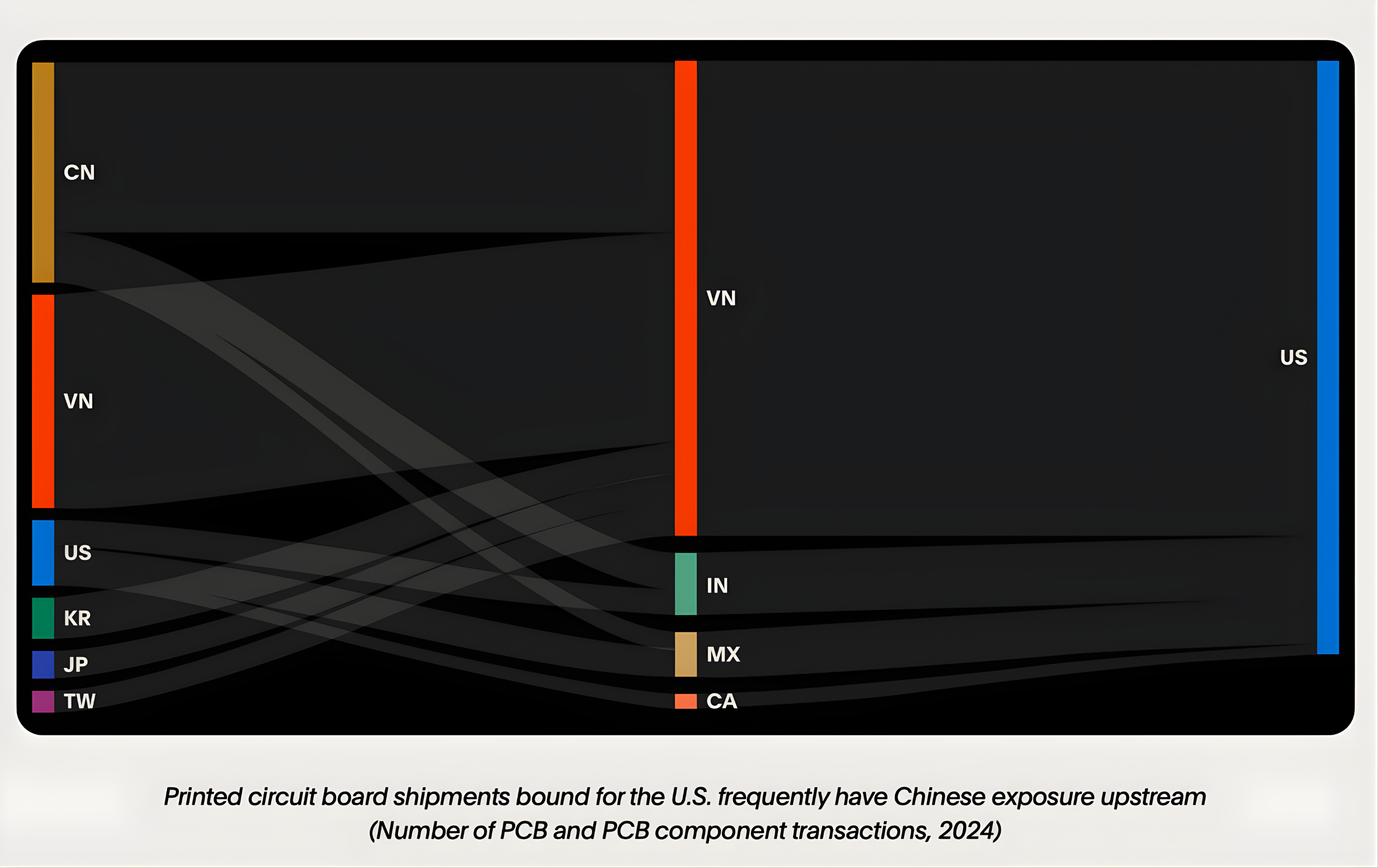

Electronics brands are well aware of their dependence on China’s manufacturing capacity. Less realized — and newly visible in multi-tier product value chains in Altana’s product network — is the vast resilience risk introduced by China’s dominance of electronics sub-componentry.
Printed circuit boards (PCBs) are essential parts of nearly all electronic goods, from consumer electronics and connected vehicles components to defense articles like radar, satellites, and unmanned aerial systems. Not only does China originate about two-thirds of global PCB exports, but a large portion of PCBs imported from friendlier nations contain sub-components made in China, Altana’s analysis reveals.
Altana’s analysis of UN Comtrade data shows that China originates about 67% of global PCB exports, while friendlier trading partners such as Vietnam and India send a significant amount of PCBs to the U.S.
In 2024, Vietnamese manufacturers consigned more than 7,000 shipments of PCBs to the U.S. valued at about $78 million, Altana’s analysis revealed. Roughly 20% of that trade included Chinese components from upstream in the supply chain.
India registers even more upstream reliance on China: In 2024, more than 61% of India’s roughly $23 million in U.S.-bound PCB shipments had Chinese sub-components upstream.
China was also the primary upstream supplier of sub-components for Mexican PCB manufacturers that supply the U.S. Across all PCB supply chains that lead to the U.S, China was the largest source by value of upstream components in 2024.
Lacking visibility beyond Tier 1 of their supply chains, electronics manufacturers in the West can’t gain a comprehensive accounting of their reliance on Chinese manufacturing. That leaves them exposed to supply shocks, component-based tariffs, and other supply chain disruptions.
sankey flow of goods
most common pcb assembly sub-components present upstream

Hidden China reliance upstream further imperils supply, threatens Section 232 tariffs for electronics manufacturers and brands

Reliance on the Chinese supply of PCBs and PCB components threatens the security of electronics supply chains and could introduce significant component-based tariffs for brands and manufacturers, Altana’s analysis shows.
Some of the most common PCB sub-components present in electronics are electronic integrated circuits; telecommunications apparatuses; transformers and inductors; diodes, transistors, and other semiconductor devices; and electrical capacitors.
And, as illuminated by Altana’s product network, each of these components are nestled in multi-tier, transnational value chains and therefore depend significantly on critical minerals that are subject to Chinese export controls and restrictions. For example, gallium and germanium are essential materials in electronic integrated circuits and diodes, transistors, and other semiconductor devices.
Even as electronics manufacturers identify alternative trade lanes and sourcing opportunities to bypass Chinese export restrictions, they face another challenge: the U.S. Department of Commerce’s Section 232 national security tariff investigations into critical minerals, semiconductors, polysilicon, and derivative items necessary for PCB production.
Section 232 tariffs in effect on steel and aluminum apply 50% levies on raw steel and aluminum, derivative components such as pipe fittings, and finished products such as dishwashing machines. For finished products, importers must pay a levy on the declared value of steel and aluminum content.
A similar levy for critical minerals, semiconductors, and polysilicon would cause tariffs for electronics imports to skyrocket. Compounding the uncertainty is the possibility that certain electronics brands or components could receive exemptions, as well as the challenges of quantifying and mitigating exposure to levies and export controls when exposure is concentrated in Tiers 2, 3, or further upstream.

Forced labor compliance vulnerabilities for electronics importers
The trade shocks rippling through the electronics supply chain as a result of U.S.-China Great Power competition extend beyond resilience challenges and into costly and complicated compliance demands.
The electronics industry is among the most financially exposed to global laws aimed at eradicating forced labor, data from U.S. Customs and Border Protection (CBP) shows.
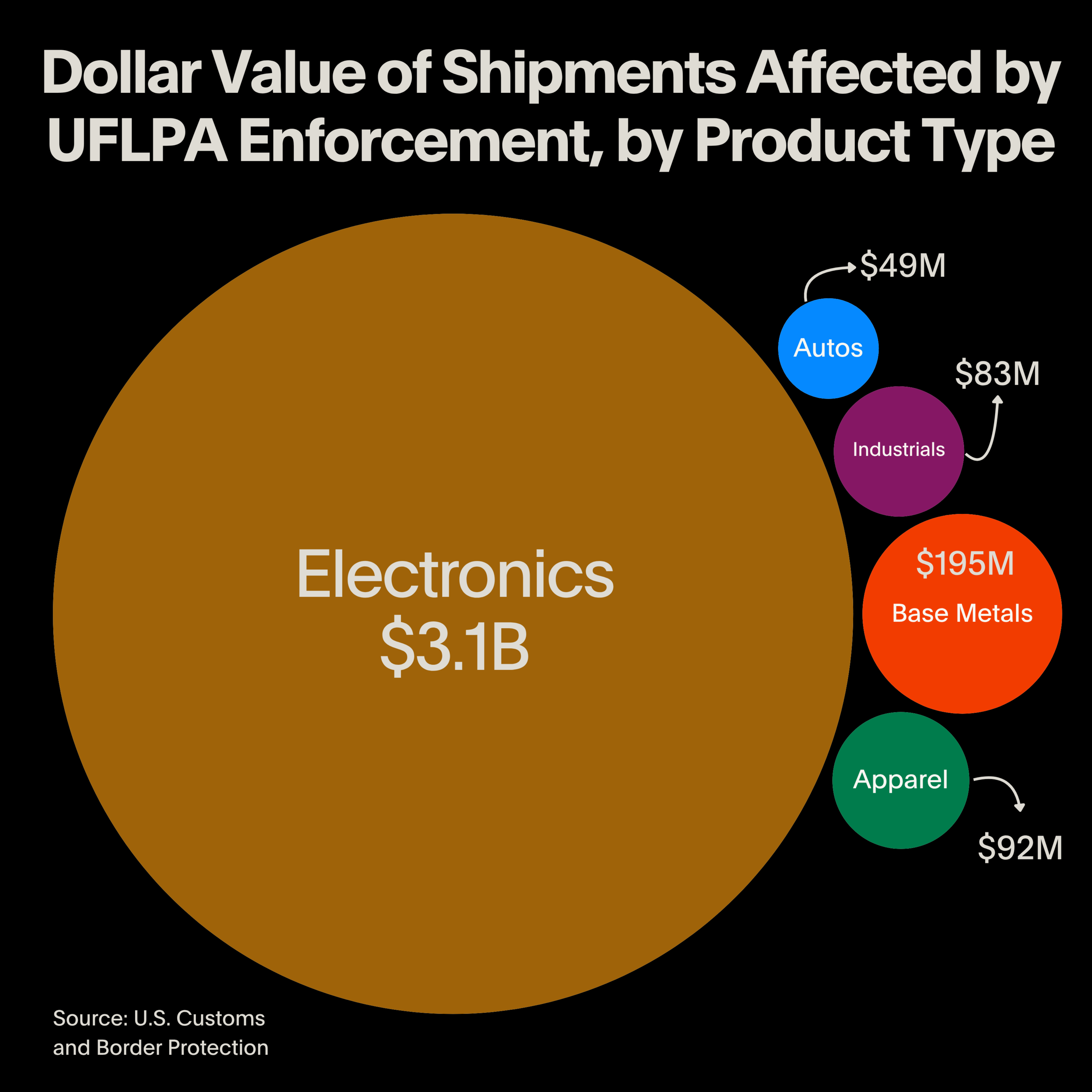
CBP detained $3.1 billion of electronics shipments from July 2022 to June 2025 under the Uyghur Forced Labor Prevention Act (UFLPA), the agency’s data shows. The UFLPA, which took effect in 2022, establishes a rebuttable presumption that all goods mined, produced, or manufactured in China’s Xinjiang province are produced by forced labor and are therefore barred from entering the U.S.
The presumption applies to goods’ inputs, holding manufacturers liable for forced labor far upstream in their supply chains.
The value of detained electronics shipments dwarfs that in other sectors: $195 million in base metals, $92 million in apparel, $83 million in industrial goods, and $49 million in automotive parts. The outsized dollar value of UFLPA detentions of electronics shipments is traced largely to polysilicon. Xinjiang produces close to half the world’s polysilicon production. Polysilicon is a vital component in semiconductors, photovoltaic cells, and integrated circuits and microchips that power industrial and consumer electronic products.
uflpa product type electronics
forced labor electronics upstream value

Electronics UFLPA violations lurking upstream in product value chains

For the electronics industry, ensuring, documenting and proving compliance with the UFLPA carries a challenge: Exposure to possible forced labor violations is hidden upstream in product value chains.
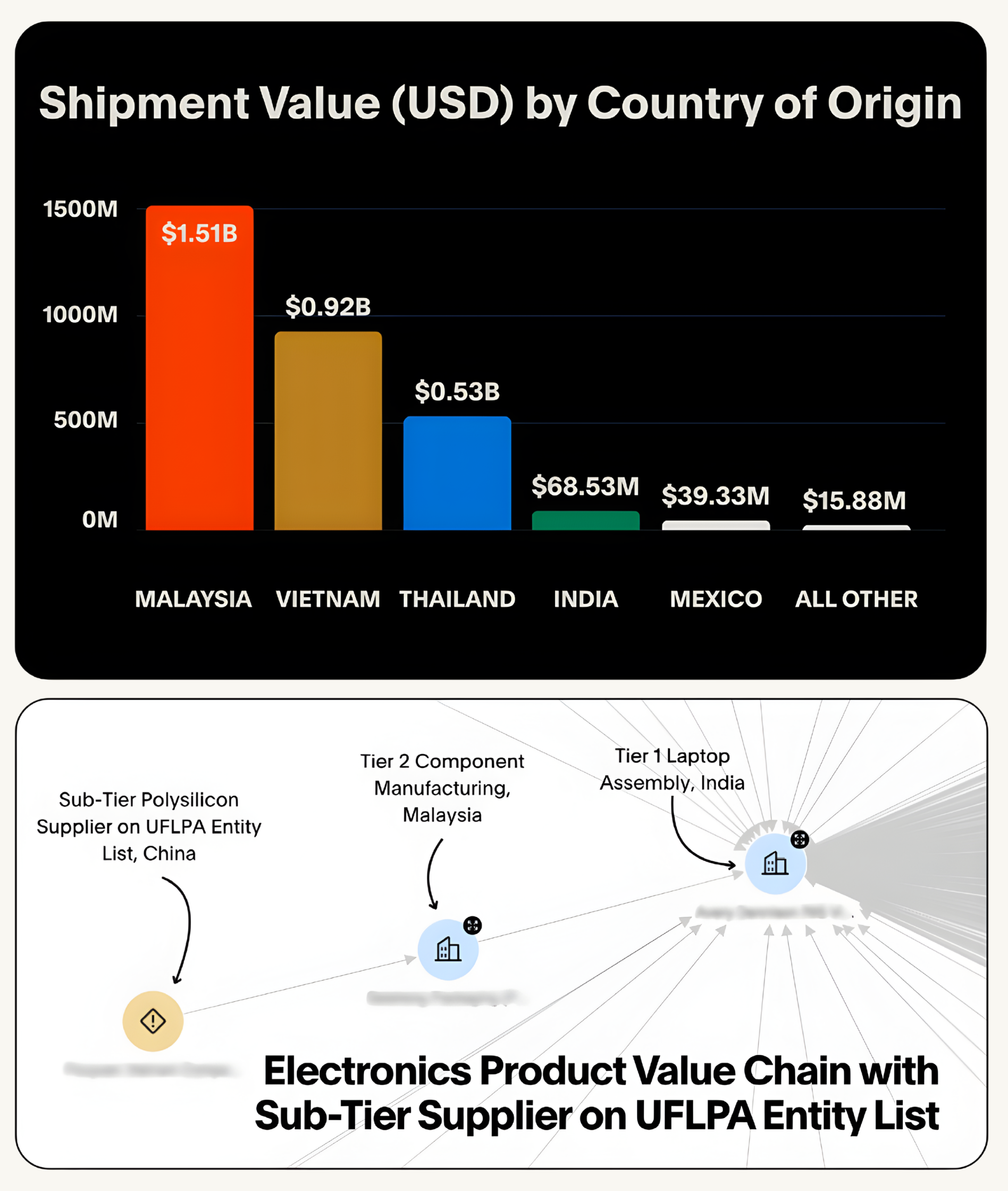
CBP data indicates that the most common countries of origin for electronics shipments detained under the UFLPA are Malaysia, Vietnam, and Thailand; none of the detained electronics shipments came from China.
The large volume of detained shipments from southeast Asia points to its status as a growing manufacturing hub for electronics. But raw goods and materials, like polysilicon, that are used to manufacture electronics components in southeast Asia often come from China, and specifically Xinjiang.
The result, visible within Altana’s product network, is that Chinese forced labor is obscured far upstream in multi-tier product value chains, unseen and unanalyzed.
An example: polysilicon from China goes to a Malaysian manufacturer of display panels. The Malaysian manufacturer sends the display panel component to India, which has a growing electronics assembly industry, to assemble into a completed laptop. The declared country of origin is India, the manufactured component comes from Malaysia, but sub-tier exposure to a Xinjiang mining operation on the UFLPA Entity List could flag the shipment for CBP detention.
CBP has visibility into these product value chains because it uses Altana’s product network, which gives enterprises an impetus to join the product network and collaborate directly with customs agents to ensure compliance before shipments reach U.S. ports.

Hidden electronics compliance risks are present for vital connected vehicle components

Large quantities of connected vehicle sub-components are sourced from China and Russia, analysis of Altana’s product network reveals, posing a hidden risk upstream in electronics manufacturers’ value chains.
The U.S. Department of Commerce’s connected vehicle security mandate bars Chinese and Russian-made components in Vehicle Connectivity Systems (VCS) and Automated Driving Systems (ADS), starting with Model Year 2027 vehicles. VCS and ADS systems are the hardware and software present in modern automotives that connect to the internet and other external systems.
VCS and ADS systems subject to restrictions — components for remote battery management and monitoring, diagnostics, radio frequency integrated circuits, external charging controls, internet-connected inverter control boards, telematics systems, and more — are produced by electronics manufacturers for major automakers.
More than 280,753 yearly U.S. import transactions include VCS and ADS components from China and Russia, Altana’s research shows. More than half of the affected transactions (55%) were in product value chains leading to electric vehicles (EVs).
Virtually all of the exposure exists upstream in product value chains. Less than 1% of component transactions are visible at Tier 1; 83.5% of the analyzed VCS/ADS exposure occurs at Tier 3 or beyond in product value chains.
The upshot: Major electronics manufacturers may unknowingly be introducing major compliance risk for the biggest North American automakers, imperiling future business.

Visibility, traceability, and collaboration with Altana’s product network

Traditional supply chain mapping solutions aren’t actionable. Other supply chain technology solutions demand burdensome manual mapping, risk screening tools, and supplier surveys that are incomplete and immediately become obsolete. Data scraped from online sources lack relevance to your specific product lines and creates noise that distracts from your compliance effort. Survey tools rely on suppliers to fill in details with no context or benefit to them.
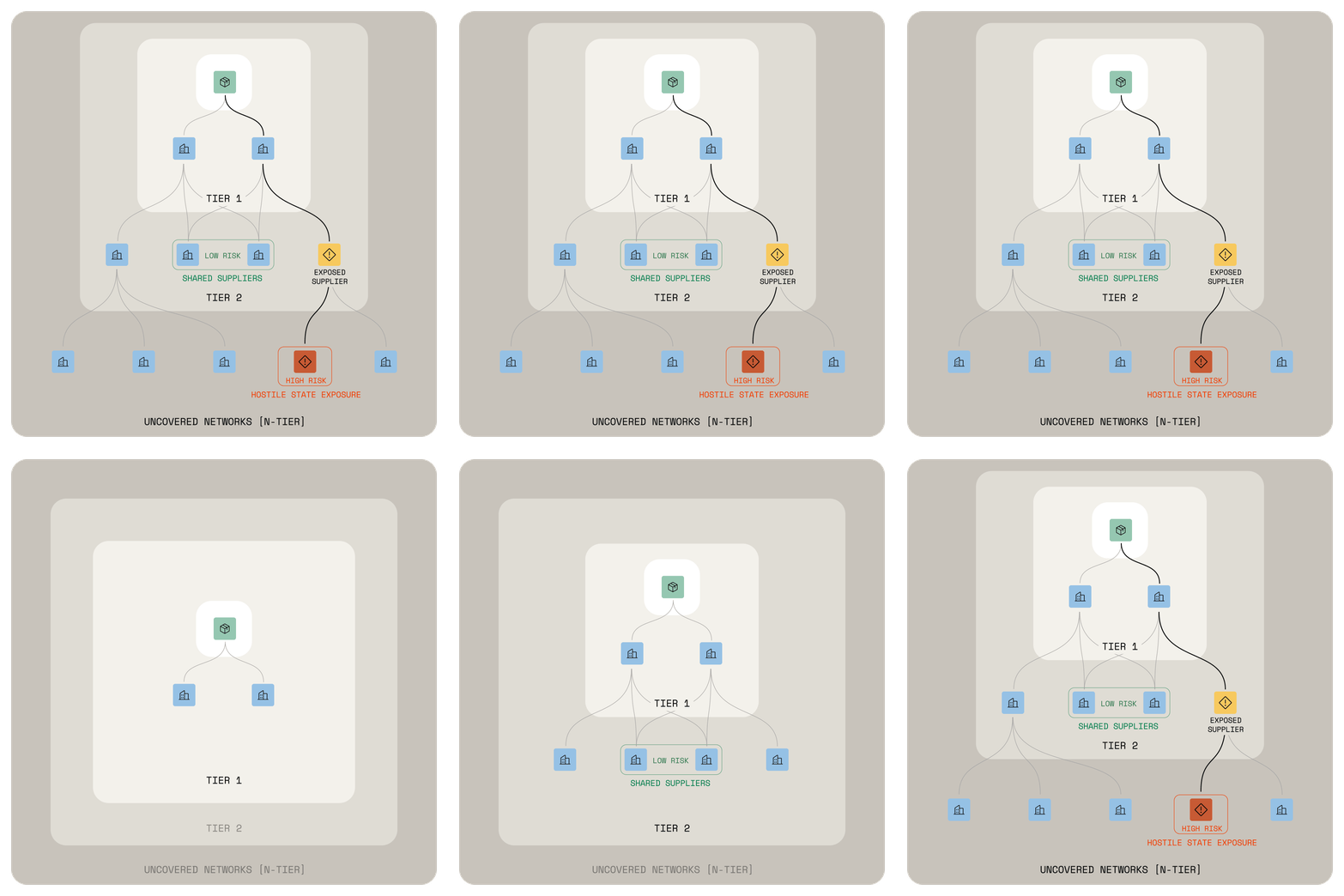
But Altana’s product network makes it possible for electronics brands and manufacturers to illuminate, design, and collaborate across product-level value chains, all based on the world’s largest dynamic body of supply chain data.
  • Visibility is an instant, dynamic map of N-tier relationships at a product level. AI reveals specific multi-tier product value chain connections and uncovers hidden relationships and risks, such as upstream exposure to suppliers on the UFLPA Entity List or specific components and materials subject to VCS/ADS regulations or Section 232 tariffs.
  • Traceability is detailed data and documentation on a product’s lifecycle, as verified by upstream suppliers.
  • Collaboration is closer relationships and more real-time communication with partners and regulators. Altana Product Passports verify information with upstream and downstream supply chain partners, and can be shared with regulators to prove compliance.
risk tiers exposure visibliity
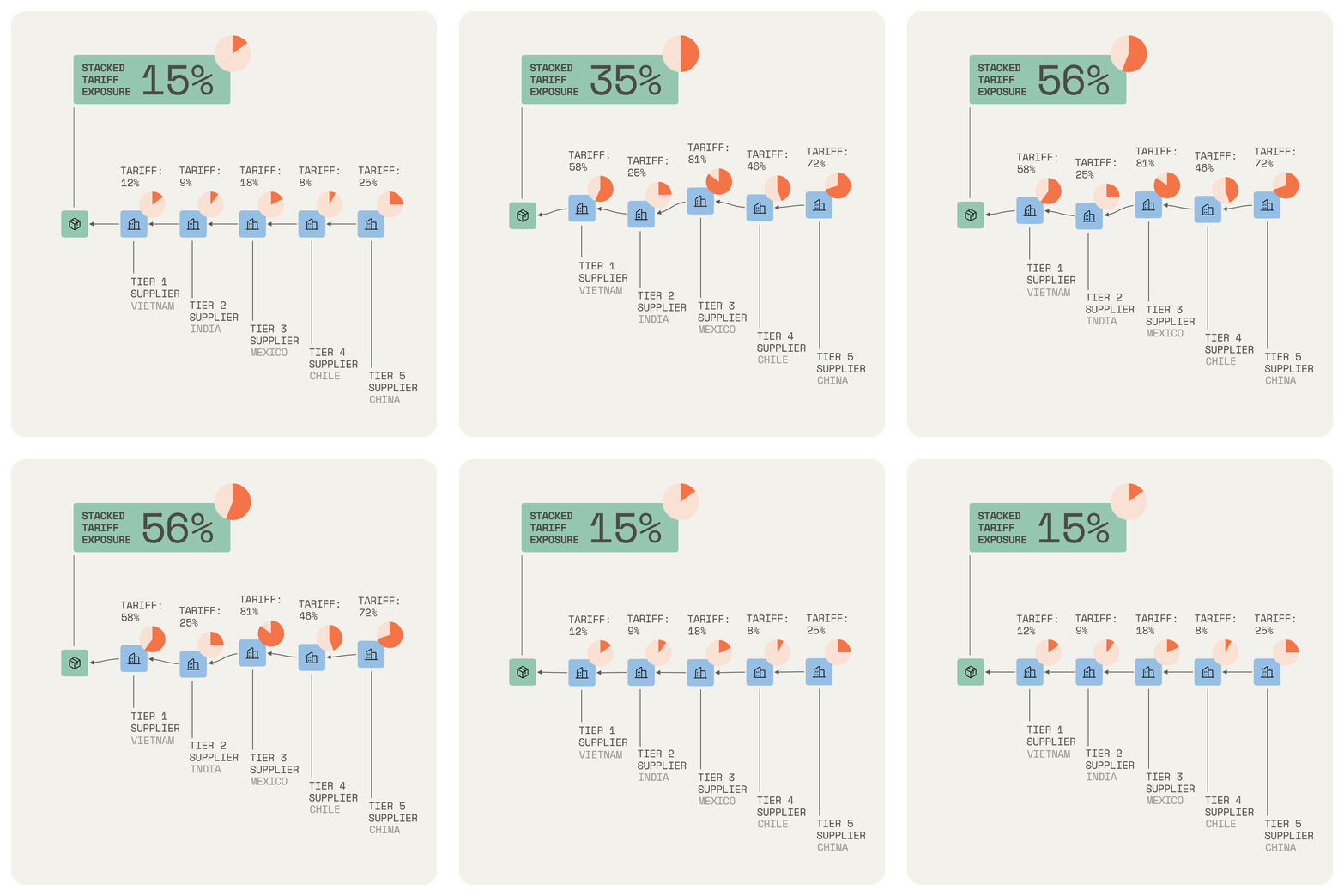
stacking tariffs electronics

How Altana’s network for trusted trade enables electronics brands and manufacturers to build compliant, resilient, cost-effective value chains

The visibility, traceability, and collaboration unlocked by Altana’s network for trusted trade enable electronics manufacturers to design product value chains that are compliant, resilient, and cost-efficient. With Altana’s product network, electronics brands can:
  • Demonstrate compliance with UFLPA and other regulations Identify compliance risks, including reliance on suppliers on the UFLPA Entity List, hidden upstream in product value chains. Manufacturers can remediate risks by collaborating with upstream suppliers to get documentation, or by sourcing alternate suppliers in the product network.
  • Future-proof product value chains by identifying single points of failure and potential bottlenecks — geopolitical, environmental, and otherwise — upstream in product value chains, then sourcing new suppliers that are less exposed to those risks.
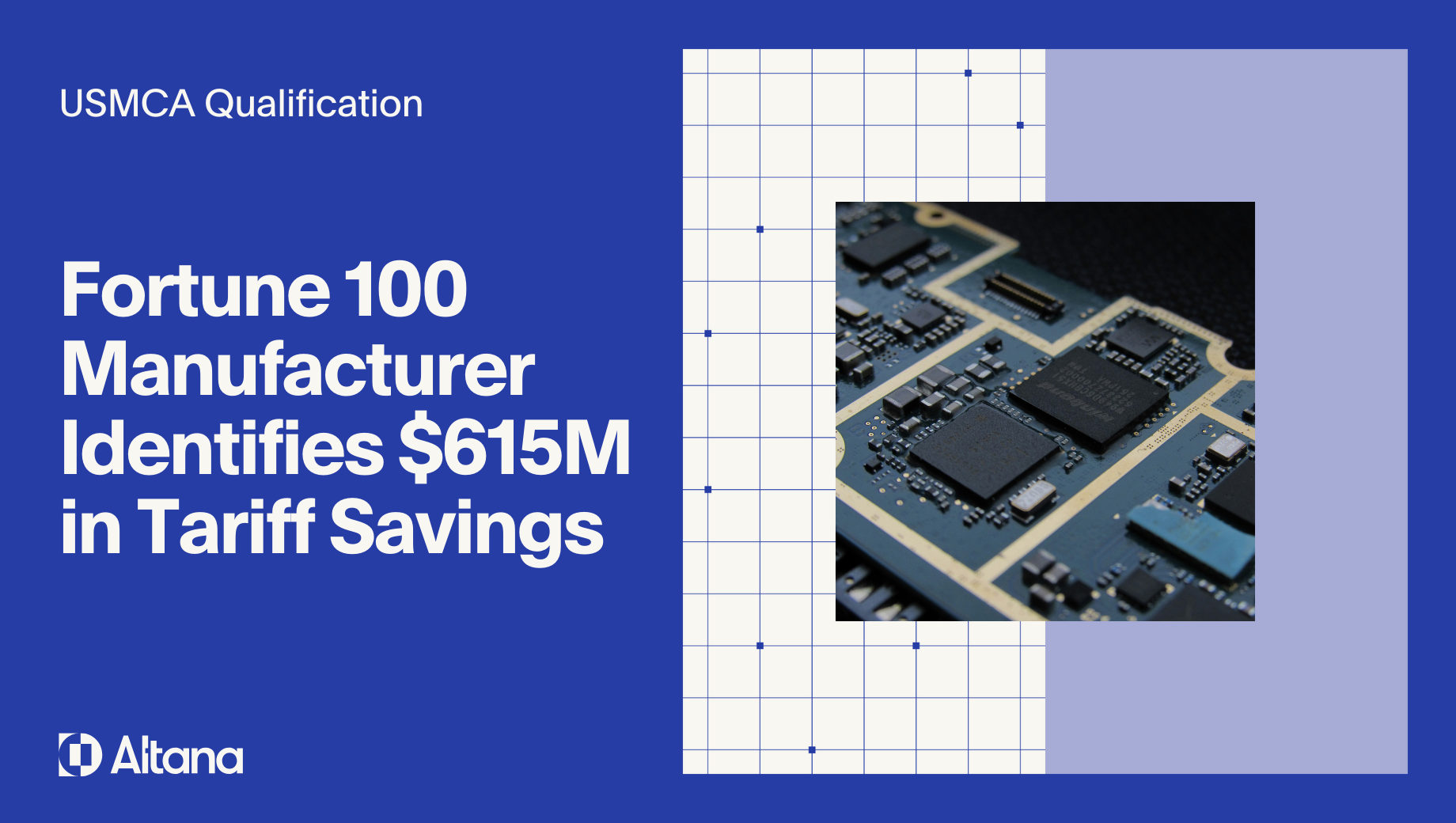
  • Assess tariff impacts and claim FTAs that lower import duties. Quantify cost increases from Section 232 tariffs and other levies hidden upstream in your value chains. You can also identify products eligible for USMCA and other free trade agreements based on value chains in Altana, qualifying your FTA claims in seconds with AI.
  • Clear the border quickly and efficiently by submitting Altana Product Passports to CBP, clearing electronics components and products for entry before shipments hit the border. Collaborating with CBP enables companies to proactively address concerns and minimize the costs associated with penalties, delays, and detentions.

Altana's network for trusted trade for electronics manufacturers

Compliant, resilient, cost-efficient value chains bring deep, structural business benefits. Electronics manufacturers that join Altana’s product network have clear, quantifiable success metrics, with guaranteed ability to:
Illuminate sub-tier value chains

Illuminate sub-tier value chains

Achieve 75%+ visibility into Tier 2 suppliers and 60%+ visibility into Tier 3+ suppliers for critical, global supply chains within 90 days

Perform fast, extensive entity resolution

Perform fast, extensive entity resolution

Normalize and enhance 95% of existing supplier data through entity resolution

Reduce risks and disruption

Reduce risks and disruption

Reduce time to identify multi-tier supply chain risks by 70%

See and act on new value chain insights

See and act on new value chain insights

Deliver initial value chain insights within 30 days of implementation

Identify business-critical risks

Identify business-critical risks

Identify previously unknown risk exposure in 5%+ of critical supply chains
Request a demo to see Altana’s product network in action.

  • Tariff Savings for an Electronics Manufacturer

    Case Studies

    Fortune 100 Electronics Manufacturer Identifies $615M in Savings Through AI-Powered USMCA Qualification

  • coo and fta determination with altana

    TradeNerds Academy

    Perform a Complex Country of Origin Determination and Claim FTA Qualification in Minutes With Altana

  • See the World's First Value Chain Management System

    TradeNerds Academy

    How Altana’s Product Network Gives Unprecedented Value Chain Visibility and Collaboration

Subscribe to the Altana newsletter

Latest news, announcements and updates direct to your inbox

  • Privacy Policy
  • ©Altana 2025. All Rights Reserved.
  • Altana and the Altana logos are trademarks of Altana Technologies, Inc., in the United States and other countries.

Company Type

  • Platform
  • For Government
  • For Enterprises
  • For Suppliers
  • For Logistics

Use Case

  • Tariffs & Trade Compliance
  • Resilience
  • Counternarcotics

Resources

  • Resources
  • Cookie Preferences
  • Trust Center

About

  • About Us
  • Careers
  • Legal
Altana
  • Privacy Policy
  • ©Altana 2025. All Rights Reserved.
  • Altana and the Altana logos are trademarks of Altana Technologies, Inc., in the United States and other countries.