Key takeaways
The elimination of de minimis exemptions in the U.S. and EU exposes billions of low-value parcels to full customs enforcement for the first time. The change reshapes global trade and adds tens of billions of dollars in yearly compliance costs that may reach consumers as higher prices.
- The U.S. suspended the Section 321 de minimis exemption for Chinese-origin imports in February 2025 and extended the suspension to all countries of origin in August 2025, ending duty-free treatment for packages valued under $800.
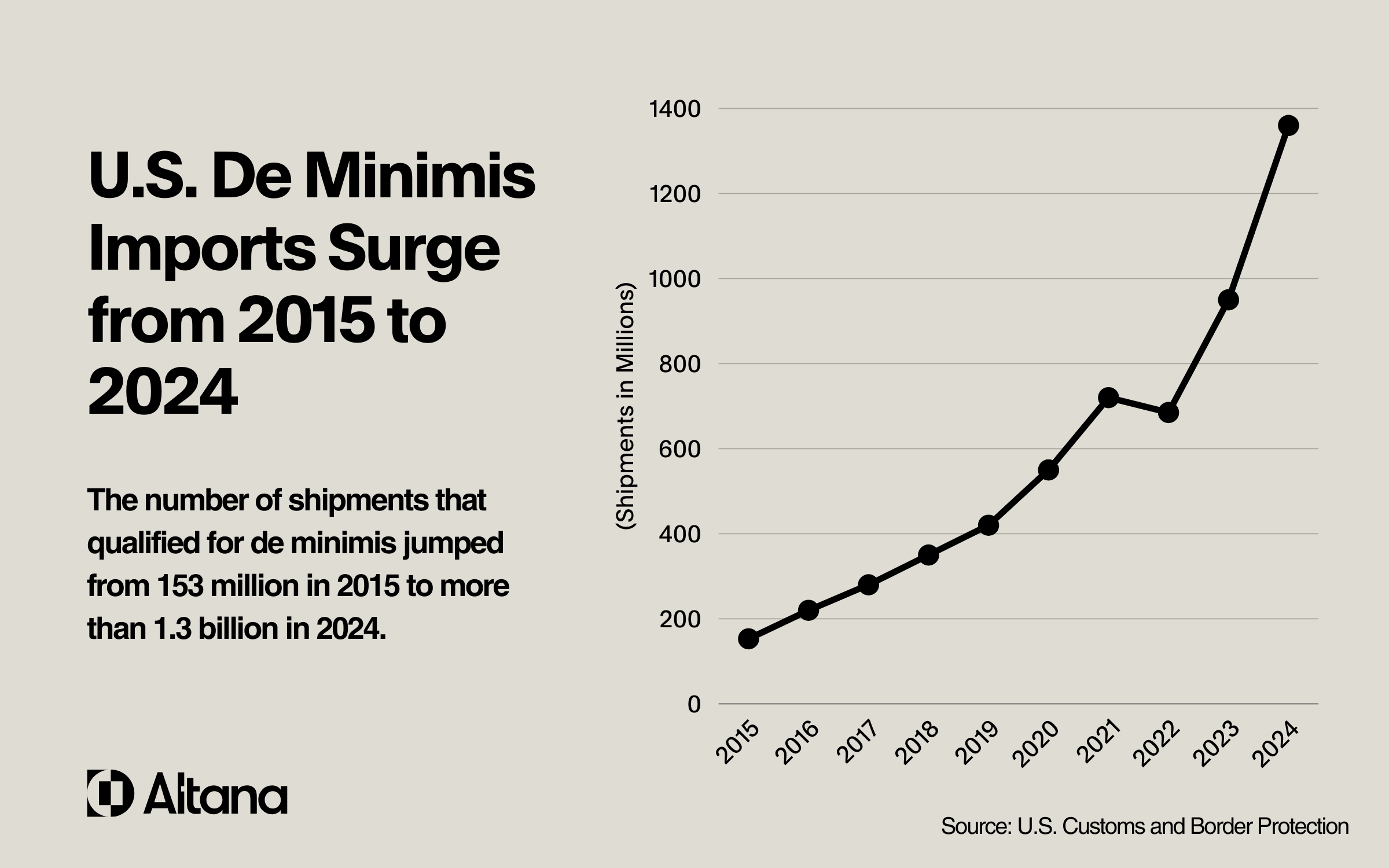
- By 2024, the more than 1.3 billion de minimis shipments accounted for 92% of all cargo entering the U.S., with 60% or more estimated to come from China.
- U.S. de minimis shipments accounted for 98% of narcotics seizures by case count in 2024, along with 97% of counterfeit goods seizures and 77% of health and safety seizures, according to U.S. Customs and Border Protection.
- U.S. Customs and Border Protection uses Altana to pre-clear shipments and detect misrepresentation of classification, Country of Origin, and forced labor exposure, doubling revenue collection without increasing enforcement resources.
Volume of small dollar parcel shipments explodes in the 2010s and 2020s, leaving most cargo spared from full compliance and enforcement work
De minimis shipments became a route to traffic narcotics, transship goods, and side-step tariffs and consumer protections
Counternarcotics and consumer safety
- 98% of narcotics seizures by case count
- 97% of counterfeit goods seizures — totaling over 31 million fake items
- 77% of health and safety seizures, including weapons parts and fentanyl precursors
On any given day, we could receive and process 750,000 to a million de minimis shipments. We have limited resources. We only have X number of staff. There is no physical way if I doubled or even tripled my staffing that I could manually look at a significant percentage of that. So due to the volume, it’s a very exploitable mode of entry into the U.S.

Andrew Renna, Assistant Port Director for Cargo Operations, JFK Airport
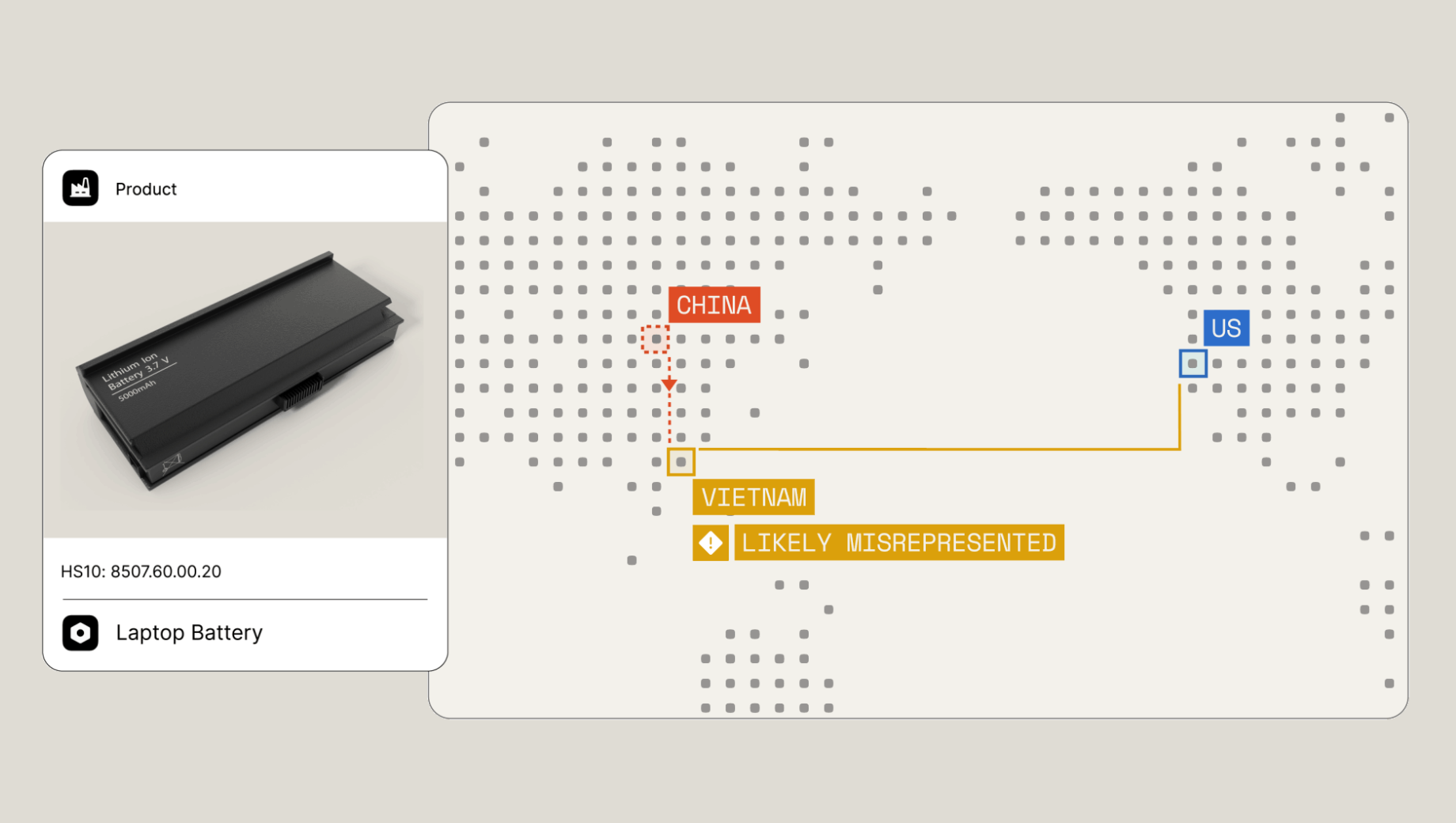
Transshipment and tariff avoidance
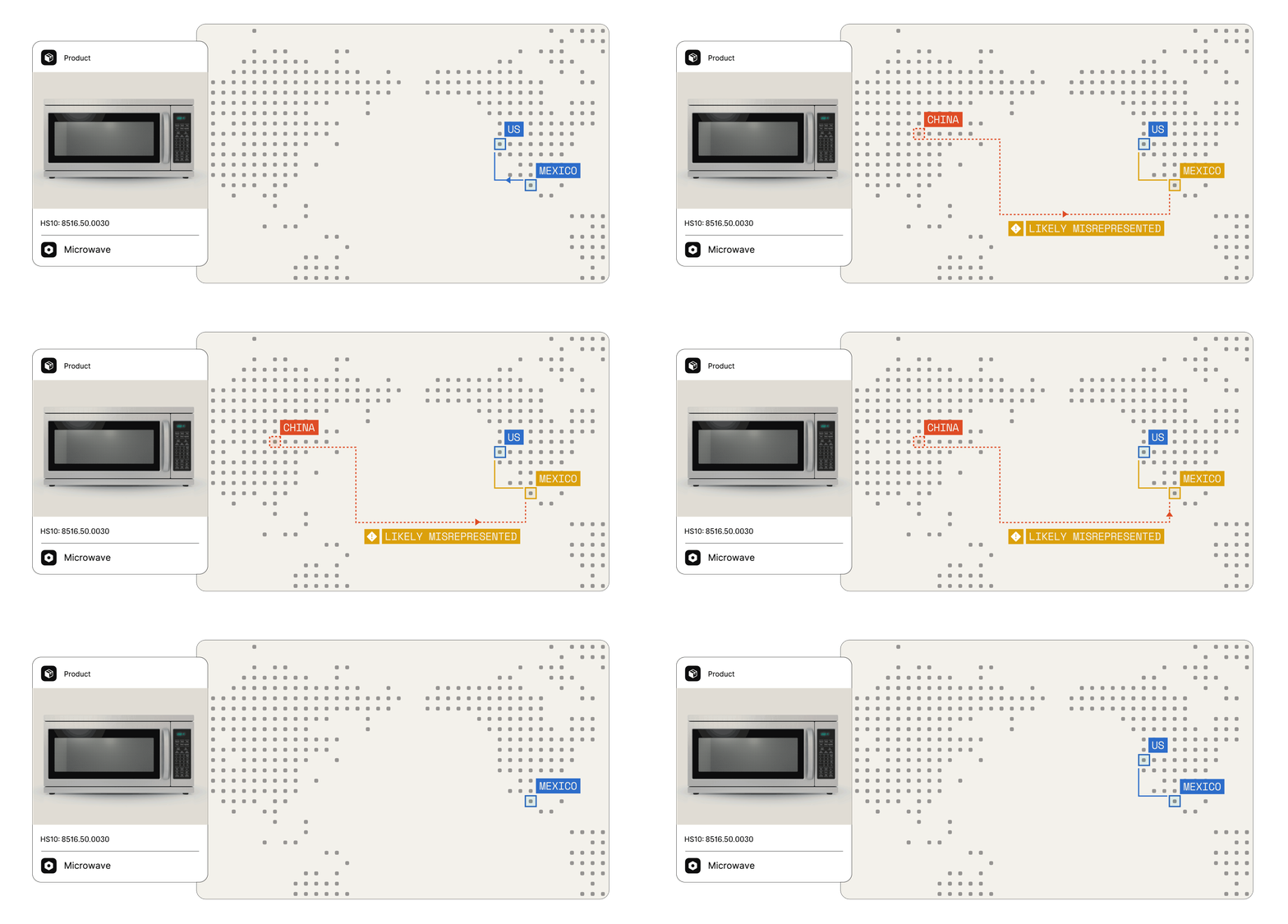
Market manipulation and consumer standards
As e-commerce is booming, we must step up efforts to prevent non-compliant products from entering the EU market and to ensure fair competition for both European and third-country operators. Our customs authorities are the first set of eyes at the border so we must equip them with the appropriate instruments to strengthen our enforcement capacities.

Maroš Šefčovič, EU Commissioner for Trade and Economic Security; Interinstitutional Relations and Transparency
The end of de minimis, and the new paradigm for trade compliance, enforcement, and facilitation
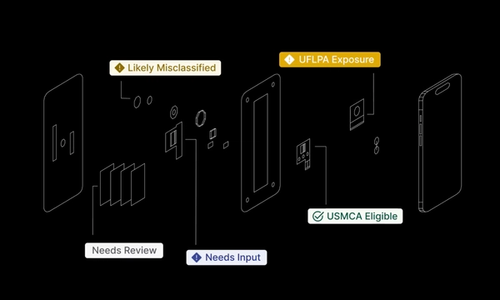
How Altana is Pioneering the New Architecture for Modern Trade Enforcement and Compliance
Learn More- A 500%+ margin increase through faster, more accurate compliance screening.
- 3 times faster product classification — cutting classification time per product from 15 minutes to less than 5.
- More than $1 billion in savings delivered for importer clients by flagging compliance risks and fast tracking customs clearance.
FAQs
The de minimis exemption allowed low-value shipments to clear customs without duties, taxes, or burdensome paperwork — set at $800 in the U.S. under Section 321 and €150 in the EU. It is being eliminated because the explosion of e-commerce turned these exemptions into a route for narcotics trafficking, illegal transshipment, tariff avoidance, and violations of consumer safety and market competition standards.
The U.S. suspended the Section 321 de minimis exemption for Chinese-origin imports in February 2025, then extended the suspension to all countries of origin in August 2025. The full elimination signaled that regulators would no longer pick and choose enforcement of small packages based on supposed country of origin.
Compliance actions for non-exempt shipments have historically cost between $1 and $5 per parcel, which adds up to tens of billions of dollars per year in additional transactional costs if e-commerce demand continues as expected. These costs may largely be passed to consumers as higher prices on goods.
By 2024, more than 1.3 billion de minimis shipments entered the U.S., accounting for 92% of all cargo, with U.S. Customs and Border Protection processing roughly 4 million per day in 2025. In the EU, low-value consignments rose from 1.4 billion in 2022 to 2.3 billion in 2023 to 4.6 billion in 2024.
Altana helps regulators and logistics providers navigate the end of de minimis by using Product Passports to pre-clear shipments and confirm trade agreement qualification, plus AI to detect misrepresentation of classification, country of origin, forced labor exposure, valuation, transshipment risk, and counternarcotics at scale. Logistics providers including Maersk and Scarbrough use Altana to deliver results such as 3 times faster product classification and more than $1 billion in savings for importer clients.