
Key takeaways
Altana's analysis of billions of shipment records found that more than 39,000 European companies directly imported products hit by the EU's new retaliatory tariffs on U.S. goods. About 150,000 more companies are exposed indirectly, deep within their product value chains, even though they never imported from the U.S. themselves.
- The European Union announced counter-measure tariffs of up to €26 billion on U.S. imports on March 11, 2025, matching the scope of new 25% U.S. tariffs on EU steel, aluminum and derivative products.
- Altana identified more than 39,000 European companies that directly imported affected products from the U.S. in 2023 and 2024, exposing them to the EU's retaliatory tariffs.
- About 150,000 additional European companies are exposed to the new tariffs indirectly because they buy from the 39,000 direct importers, who may pass tariff costs deeper down the value chain.
- The five EU member states most affected by the retaliatory tariffs are the Netherlands, Belgium, Germany, Italy, and Spain, according to Altana's analysis of UN Comtrade data.
The Integrated EU Supply Chain, and Deep Tariff Exposure
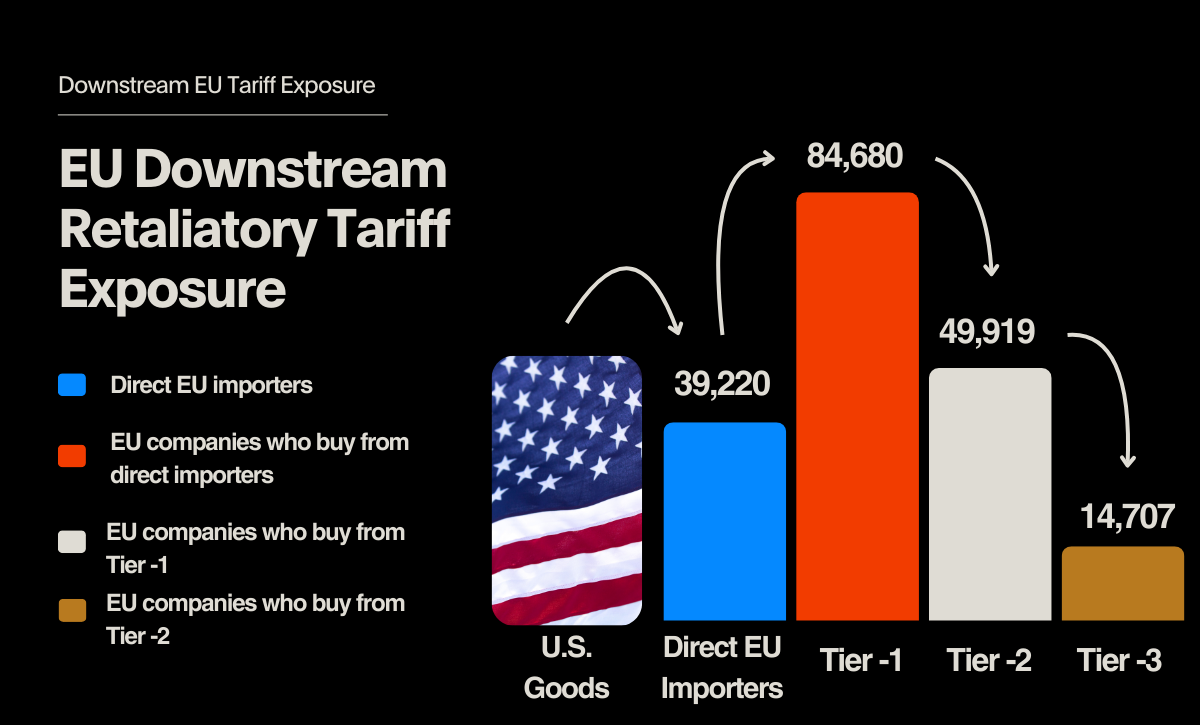
Indirect, Cascading Downstream Tariff Exposure in Practice

Mastering Tariffs With Altana's Tariff Scenario Planner
- Visualize and analyze your value chain connections, identifying hidden relationships and risks.
- Collaborate with partners across your value chains to build more resilient, compliant, and cost-effective product lines.
- Request, share, and link product information across your supplier network to build traceability upstream and downstream, saving time gathering product information, and resolving risk by adding proof of compliance.
- Pinpoint exposure: See the precise share of your product costs impacted by the new tariffs, down to the shipment level.
- Prioritize supplier relationships: Identify which suppliers pose the highest cost risk, so you can execute the right diversification strategy.
- Find alternative sources faster: Search for qualified suppliers outside of affected trade lanes to reduce risk and maintain supply continuity.
FAQs
More than 39,000 European companies imported products subject to the EU's new tariffs directly from the U.S. in 2023 and 2024. About 150,000 more companies are exposed indirectly because they buy from those direct importers. In total, the tariffs touch the value chains of over 100,000 companies across the bloc.
A company can face tariff costs indirectly when its suppliers import affected goods and pass those costs down the value chain. For example, a lumber supplier that imports U.S. sawn pine sells to lumber yards, who supply furniture makers, homebuilders, and flooring manufacturers. Each tier adds value and passes cost along, so companies far from the original import often have no visibility into where their exposure comes from.
The EU's counter-measures cover a wide range of U.S. goods, including petroleum and agricultural products, lawn mowers, and wines and spirits. According to Altana's analysis, the top categories subject to tariffs are spirits, wine, ethylene polymers, lumber and nuts. The measures are set to apply in mid-April 2025.
The EU supply chain is highly integrated, so tariff costs cascade from direct importers to customers several tiers deep. Companies closer to end consumers often cannot see the original source of their product components, which obscures the source of their exposure. Visibility into every tier lets a company quantify risk, forecast exposure, and prioritize the right supplier relationships.
Altana's Tariff Scenario Planner is built on a company's own product networks and reveals the precise share of product costs hit by new tariffs, down to the shipment level. It also helps companies identify which suppliers carry the highest cost risk and find qualified alternative suppliers outside affected trade lanes. This lets teams make faster, better-informed trade decisions while competitors scramble for answers.


