Trade compliance is now a strategic function. Here are the insights to become trade-ready.
Rising enforcement, tariff volatility, and forced labor rules have pushed trade compliance out of the back office. New research from Gartner® lays out five actions to transform the function into a source of profitable growth. Access your complimentary copy.
Gartner insights for transforming trade compliance.
According to Gartner, trade compliance failures increasingly expose organizations to financial penalties, supply chain disruption, and loss of market access. The old operating model was not built for this. Gartner research shows what companies are building instead.
What's inside the report
Why teams organized around individual activities like classification, screening, and filings struggle to support the speed of today's business decisions.
How companies formally integrate trade compliance into sourcing, market entry, network design, cost modeling, and tariff strategy.
Gartner coordinated action plan, including automating high-volume transactional tasks, plus success measures that span compliance effectiveness and business impact.
“Global trade compliance (GTC) organizations must evolve into the strategic advisors businesses need to drive profitable growth.”
Gartner, Accelerate Profitable Growth by Transforming Your Global Trade Compliance Function, Brian Whitlock, 9 June 2026.
The fourth recommended action by Gartner is to accelerate investment in technology and data capabilities by automating high-volume transactional tasks. In our view, Altana was built for today’s trade environment.
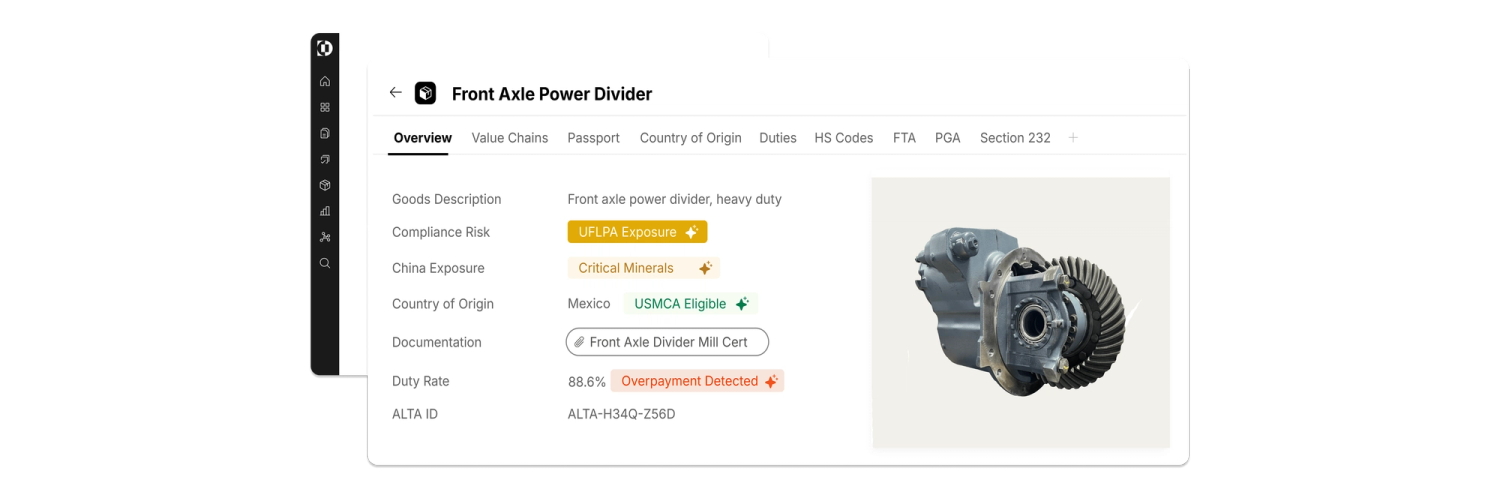
Altana’s AI trade-readiness workflows gets your products ready to cross the border and keep them ready as the rules change — so you prep entries faster, avoid detentions, never overpay or underpay duties, and qualify for every trade preference.
Once products are in the catalog, Altana’s trade-manager agent organizes everything you need for a product to cross the border — and keeps your products trade-ready as the rules change. The manual scramble across spreadsheets, brokers, and consultants becomes one fast, defensible workflow.
HS classification
Classifies to full national tariff depth, backed by rulings and clear reasoning.
Country of origin (COO)
Applies rules of origin against your real value chain, with audit-ready rationale.
Free-trade agreements (FTAs)
Evaluates qualification paths, tariff shifts and RVC, re-checking when inputs change to claim USMCA and other FTA qualification.
Duty calculation
Computes per-product net effective rate stacking every program, recalculating when schedules change.
Section 232 estimation
Records 232 exposure at material-composition level: steel, aluminum, and copper content with per-material rates and country of smelt/cast.
Forced labor remediation
Identify UFLPA exposure at the raw material level level. Collect supplier validations, respond to detentions, and identify compliant suppliers.
PGA / OGA requirements
Flags PGA obligations before filing, with the responsible agency on the record.
Comprehensive value-chain visibility and management
Screens your multi-tier value chain for risk; automated supplier outreach keeps records current.
Collaborate with your entire trade team
Network problems demand network solutions. Altana helps teams share documents with brokers and CBP so your products are always trade-ready.
1. Collaboration with your broker
Share documented records with brokers, then audit their filings against your catalog.
2. Collaboration with CBP
Pre-validate compliance with CBP before goods ship, ensuring smooth cross-border entry.
Audit and monitor — continuously
Build your Altana product catalog and automatically keep track of duty payments, new trade regulations, and refunds in real time.
1. Post-entry audit
Compares what you filed against what you owed, surfacing overpayments and underpayments.
2. Continuous audit
Checks classifications against current rules, flagging misclassifications and over/underpayments as rules change.
Altana organizes your product data into one collaborative catalog — where you and your suppliers illuminate the multi-tier sourcing paths behind every product.
An intelligent system of record for products & multi-tier value chains
Onboard
Upload and integrate product data. No more siloed spreadsheets.
Illuminate
Altana maps multi-tier product sourcing paths using AI and supplier data.
Collaborate
Suppliers manage their own catalog on Altana and link to yours to simplify multi-tier verification.
Verify
AI fills gaps, flags risk, and pre-validates with customs — all on Altana.
Altana was built for today’s trade environment
Legacy Global Trade Management software is breaking under geopolitics and constant regulatory change. Altana is the AI-native platform built for what global trade has become.
Classification, COO, FTA, duty, and more live on one product record and feed each other — not a point tool bolted onto spreadsheets and ERPs. Knowledge survives turnover; every decision carries an audit trail.
One connected system of record
Verified visibility into the value chain behind each product — the data layer that makes origin, forced-labor, and 232 work defensible instead of guesswork. No single-tier tool can reach it.
Multi-tier value-chain data
AI runs across the whole trade-readiness workflow and reasons over verified value-chain data, showing its work on every determination. You stay in control: it suggests, you decide.
AI that shows its work
Share a product’s trusted attribute set as a Product Passport, to brokers and to regulators, so entries are pre-validated before they reach the border. Like Global Entry, but for goods.
Network collaboration via Product Passports
One connected system of record
One connected system of record
Classification, COO, FTA, duty, and more live on one product record and feed each other — not a point tool bolted onto spreadsheets and ERPs. Knowledge survives turnover; every decision carries an audit trail.
Multi-tier value-chain data
Multi-tier value-chain data
Verified visibility into the value chain behind each product — the data layer that makes origin, forced-labor, and 232 work defensible instead of guesswork. No single-tier tool can reach it.
AI that shows its work
AI that shows its work
AI runs across the whole trade-readiness workflow and reasons over verified value-chain data, showing its work on every determination. You stay in control: it suggests, you decide.
Network collaboration via Product Passports
Network collaboration via Product Passports
Share a product’s trusted attribute set as a Product Passport, to brokers and to regulators, so entries are pre-validated before they reach the border. Like Global Entry, but for goods.
Altana AI
How our AI network works
Altana’s AI operates on Altana’s Supply Chain Graph — the world’s largest, most detailed view of how goods move across the globe, built from public trade data, commercial sources, and proprietary shipment data from the world’s leading logistics providers. That foundation enables AI-driven network collaboration on your products and shipments that you can actually trust — and which no generic, publicly trained AI can replicate.
Value-chain mapping
Share a bill of materials and supplier data, and Altana’s AI suggests which entities in the Supply Chain Graph are likely in your upstream value chains, completing the picture automatically and giving you the opportunity to verify.
Automated workflows to bake trade readiness into sourcing
Altana’s AI handles the work that’s always been manual, and bases its work on your actual product value chains: multi-tier supply chain mapping, simulating single-source risk identification, geographic concentration analysis, and screening value chains for violations, including forced labor.
Product information and attributes suggested by AI travel with the goods as a Product Passport. Logistics providers, CBP, and suppliers work from the Passport to verify information and remediate issues, so goods are cleared for entry before they reach the border.
Gartner, Accelerate Profitable Growth by Transforming Your Global Trade Compliance Function, Brian Whitlock, 9 June 2026. GARTNER is a registered trademark and service mark of Gartner, Inc. and/or its affiliates in the U.S. and internationally and is used herein with permission. All rights reserved.
Gartner does not endorse any vendor, product or service depicted in its research publications and does not advise technology users to select only those vendors with the highest ratings or other designation. Gartner research publications consist of the opinions of Gartner's Research & Advisory organization and should not be construed as statements of fact. Gartner disclaims all warranties, expressed or implied, with respect to this research, including any warranties of merchantability or fitness for a particular purpose.