
Key takeaways
Altana's analysis of Australia-bound trade reveals widespread, hidden forced labour exposure in the value chains of Australian companies. Nearly all of it sits deep upstream, where most importers cannot see and remediate challenges.
- Altana's analysis found that since the start of 2023, 631 Australian companies conducted 50,805 imports containing exposure to entities flagged under the U.S. Uyghur Forced Labor Prevention Act (UFLPA).
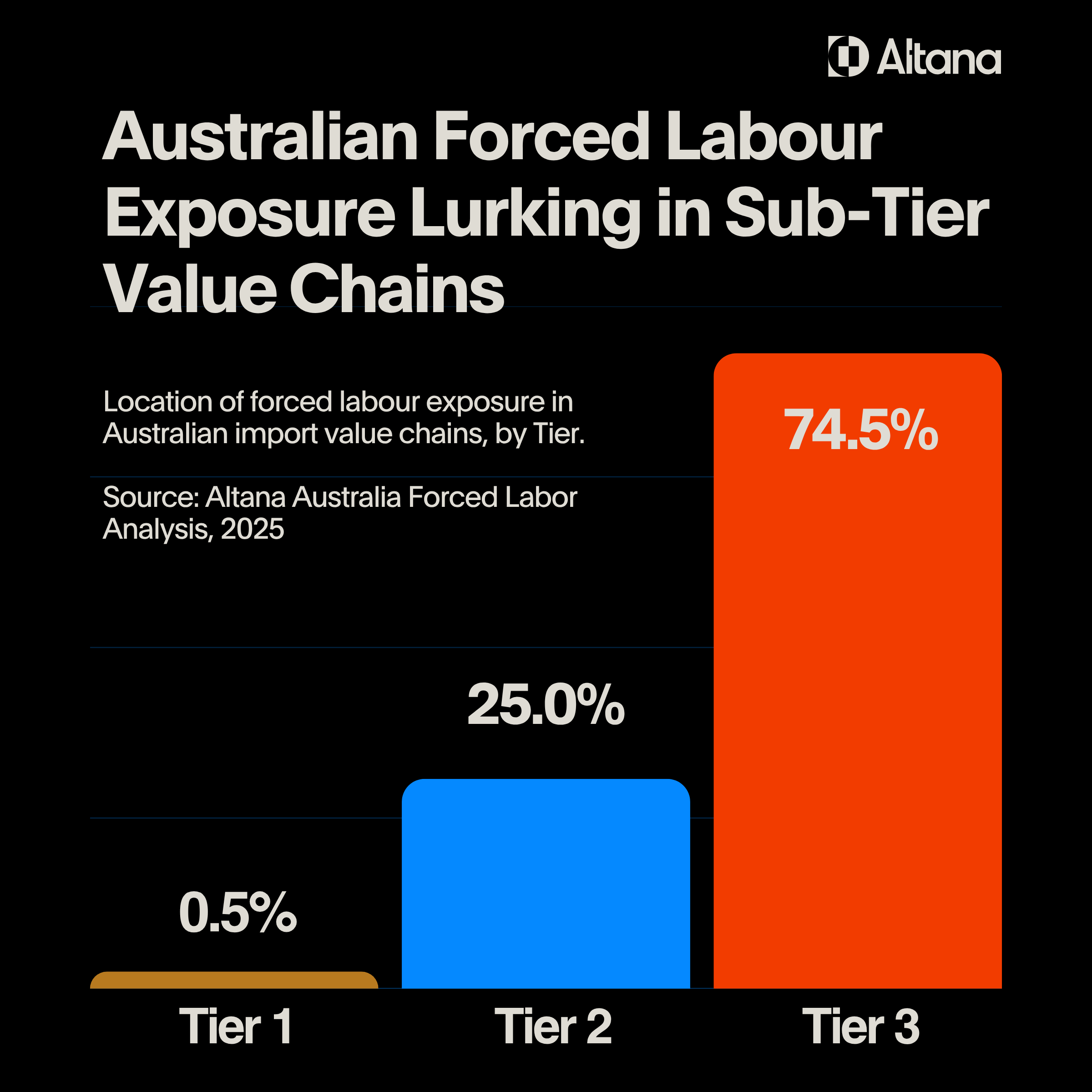
- A full 99.5% of forced labour exposure in Australian value chains occurs at Tier 2 or further upstream, with 74.5% sitting at Tier 3 or beyond — beyond the reach of standard supplier checks.
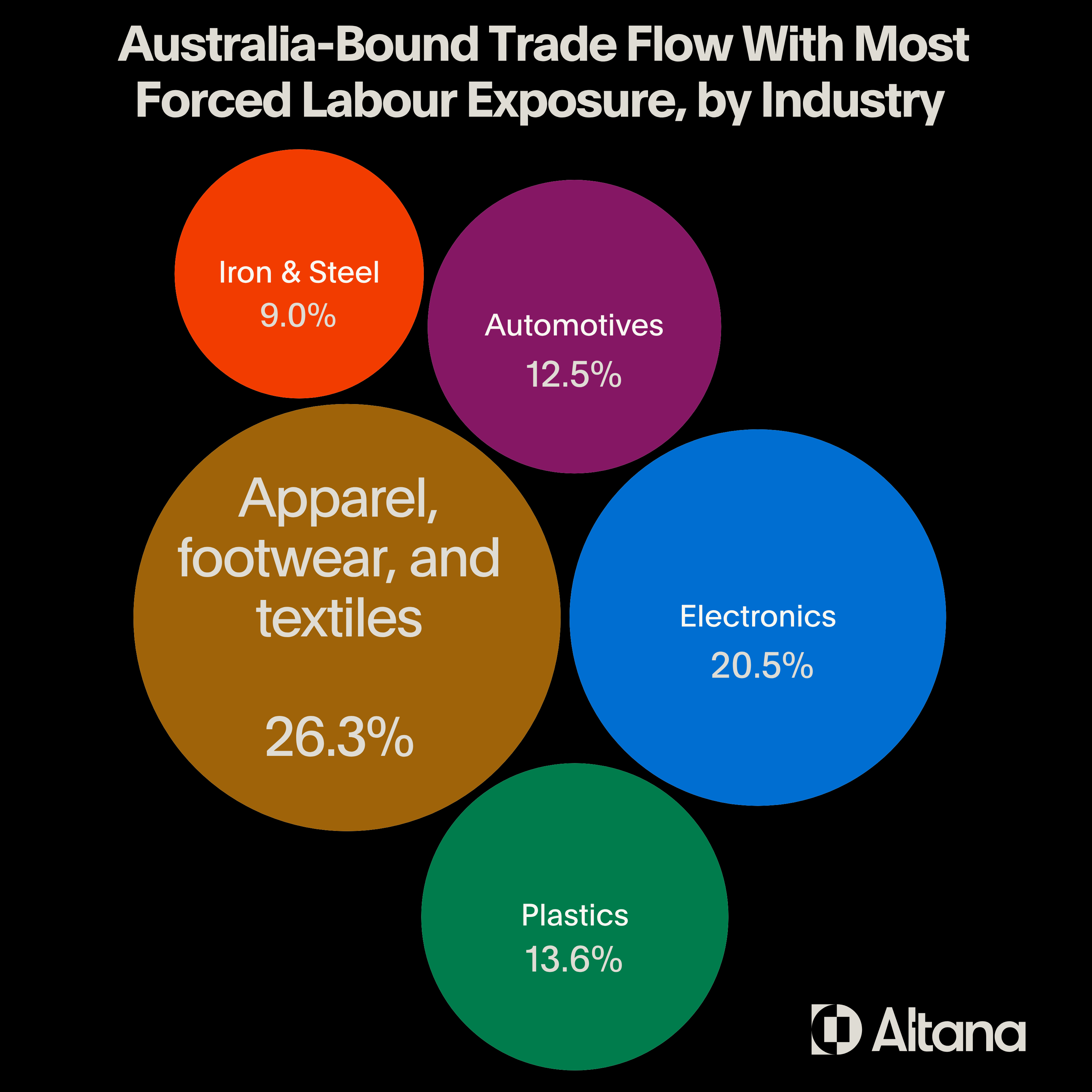
- Apparel and textiles account for the largest share of Australia's sub-tier forced labour exposure at 26.3% of affected trade flow, tied to Xinjiang's role as a major cotton producer.
- Altana's Product Network gives Australian enterprises and government agencies multi-tier visibility to identify, quantify, and remediate forced labour exposure from raw materials to finished goods.
Build Resilient, Forced Labour-Free Value Chains With Altana
Learn More"Australia needs to be prepared for an evidence-based discussion on the right mechanisms to ensure Australian businesses consistently identify, address and remediate modern slavery risks. I will consider if companies should be required to report on the presence of high risk products or suppliers in their supply chains…"
99.5% of Potential Australian Forced Labour Exposure is Present at Tier 2 or Further Upstream
Australian Companies’ Exposure to Forced Labour Spans Products, Industries
Expose and Combat Forced Labour Exposure With Altana’s Product Network
- Identify hidden forced labour risks with visibility, traceability, and fully-illuminated upstream value chains.
- Remediate forced labour risks by collaborating with upstream suppliers to collect documentation – or by identifying alternate suppliers.
- Identify both aggregate, economy-wide and individual, enterprise-specific forced labour exposure through access to a unified, continuously updating network.
- Conduct faster, more efficient forced labour and modern slavery investigations by searching and analyzing multi-tier trade flows in minutes.
- Perform proactive collaboration and coordinated action by sharing forced labour insights across agencies, allies, and industry to prevent trade disruptions, promote compliance, and inform policy.
About the Analysis
FAQs
Since the start of 2023, 631 Australian companies conducted 50,805 imports containing exposure to entities flagged under the U.S. Uyghur Forced Labor Prevention Act (UFLPA), according to Altana's analysis. The vast majority of this exposure sits at Tier 2 or further upstream in product value chains. Altana reviewed 12.3 million transactions across 2023, 2024, and part of 2025.
A full 99.5% of forced labour exposure in Australian value chains occurs at Tier 2 or further upstream, where companies typically have no visibility. Less than 1% of affected imports have the exposure at Tier 1, the direct supplier. Without visibility into deeper tiers, Australian businesses and the government cannot visualize, quantify, or fix the problem.
Apparel and textiles make up the largest share of Australia's sub-tier forced labour exposure at 26.3% of affected trade flow, driven by Xinjiang's status as a major cotton producer. Other heavily affected industries include electronics (20.5%), plastics (13.6%), automotive parts (12.5%), and iron and steel articles (9.0%).
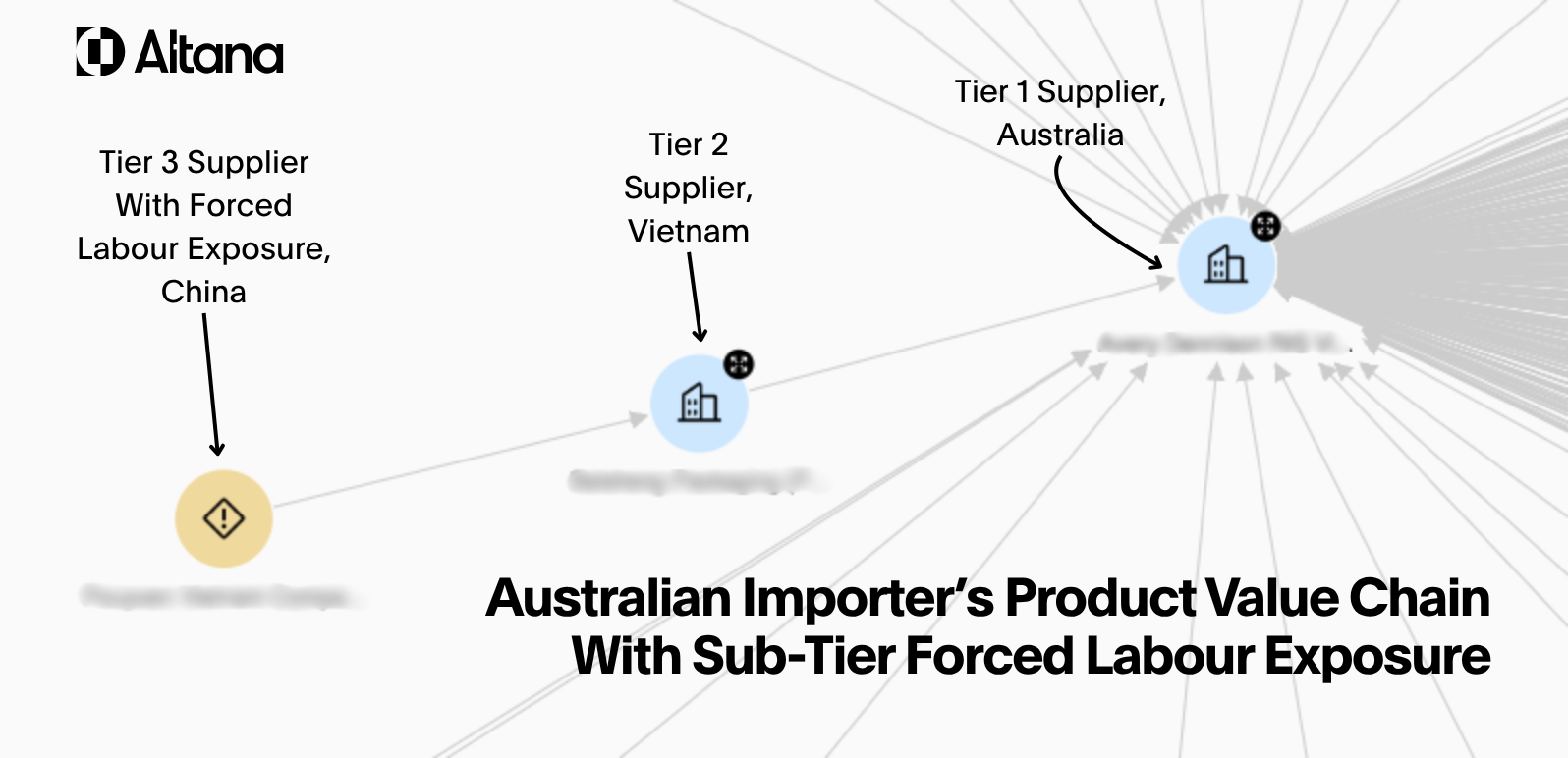
Exposure often enters through suppliers several tiers removed from the Australian buyer. In one example, an Australian company sourced a component domestically, but that supplier relied on a Vietnamese supplier, which in turn was supplied by a Tier 3 Chinese entity flagged for modern slavery violations. This pattern repeats across Australian value chains, creating broad, systemic exposure that hides upstream.
Altana's Product Network gives Australian enterprises and government agencies product-level visibility, traceability, and collaboration across every tier of the value chain. Companies can identify hidden forced labour risks and remediate them by collecting supplier documentation or finding alternate suppliers. Governments can run faster investigations, measure both economy-wide and company-specific exposure, and share insights across agencies and allies.


