U.S. Customs selects Altana to modernize enforcement and border clearance

Learn more

Altana

June 3, 2025

U.S. DIB Analysis

Secure Vital Supply Chains and Win the Trade War With AI

secure vital supply chains

The State of the DIB

lt’s never been harder – or more urgent – for U.S. government defense contractors to design compliant, resilient, secure supply chains.
China’s extraterritorial critical mineral export bans. Expansive NDAA import restrictions preventing the Department of Defense from contracting with entities that have upstream exposure to Chinese military companies operating in the U.S. An administration that is determined to decouple defense supply chains from adversaries and improve warfighting readiness – and willing to dislodge legacy contractors. The financial threat of compounding, stacking tariffs.
To overcome trade dislocation, defense contractors and sub- contractors need supply chain visibility and traceability – and the collaboration to prove compliance and find new suppliers.
Read on for Altana’s full, first-party analysis of tens of thousands of defense industrial base shipments to learn about the multi-pronged challenges faced by the DIB. You’ll also see how Altana’s network for trusted trade provides the visibility, traceability, and collaboration necessary to maintain production, win government contracts, and adapt to a new era of trade, foreign policy, and defense.
"
I will measure it as a success if in the next two years, one of the primes is no longer in business...

Dan Driscoll, U.S. Secretary of the Army

May 2025

China places extraterritorial export controls on essential rare earths critical for permanent magnets
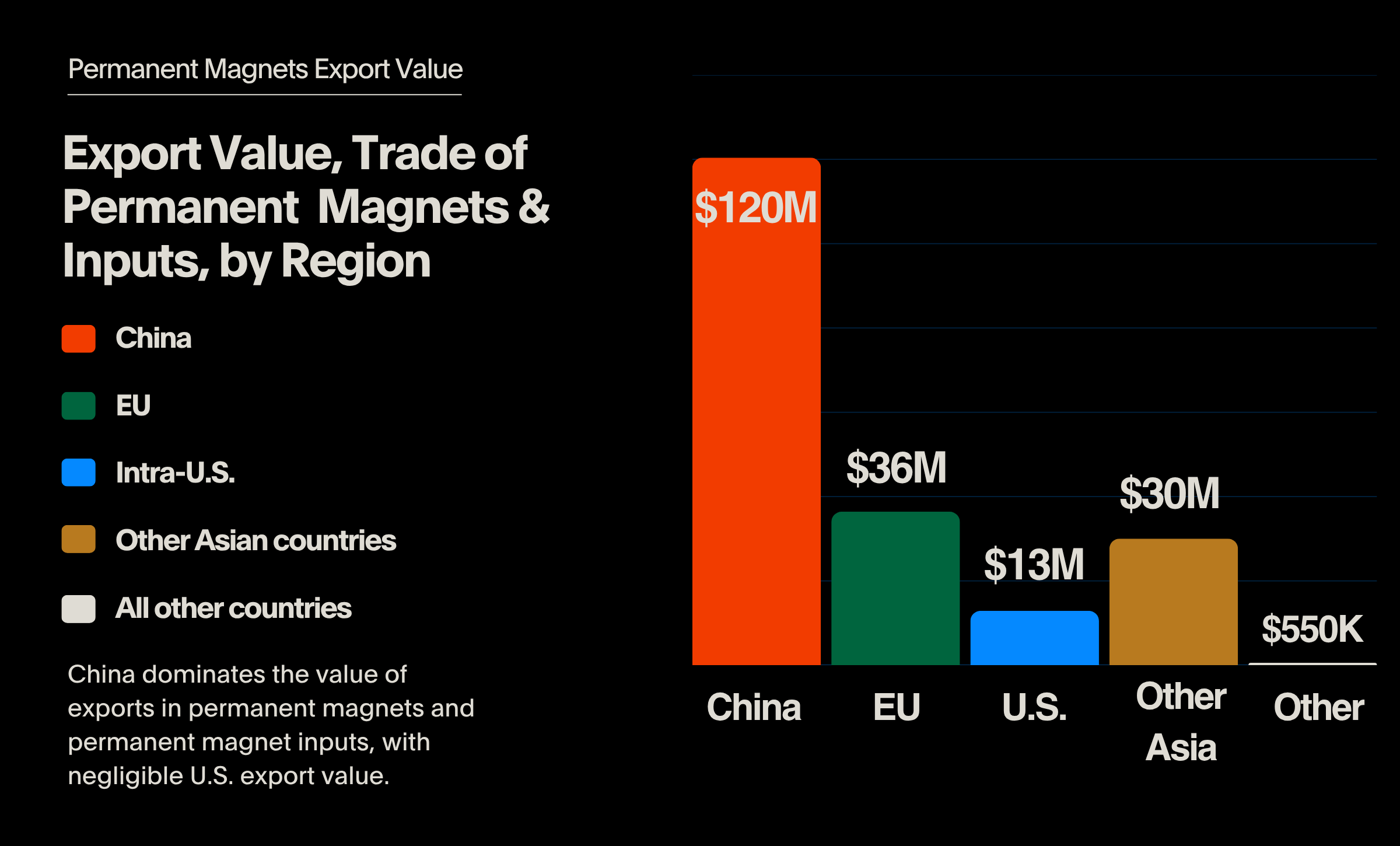
China recently placed extraterritorial export controls on seven rare earths and minerals, in addition to permanent magnets. These critical minerals are vital for products and applications for a range of industries.
Across trade tiers and industries, Altana’s analysis demonstrates that over the past decade, the preponderance of the value of permanent magnet trade comes from Chinese exports. Terbium and dysprosium go into the production of permanent magnets, and permanent magnets themselves are now subject to China’s export controls.
permanent magnets

Export-restricted rare earths and magnets are vital defense components
fighter jet
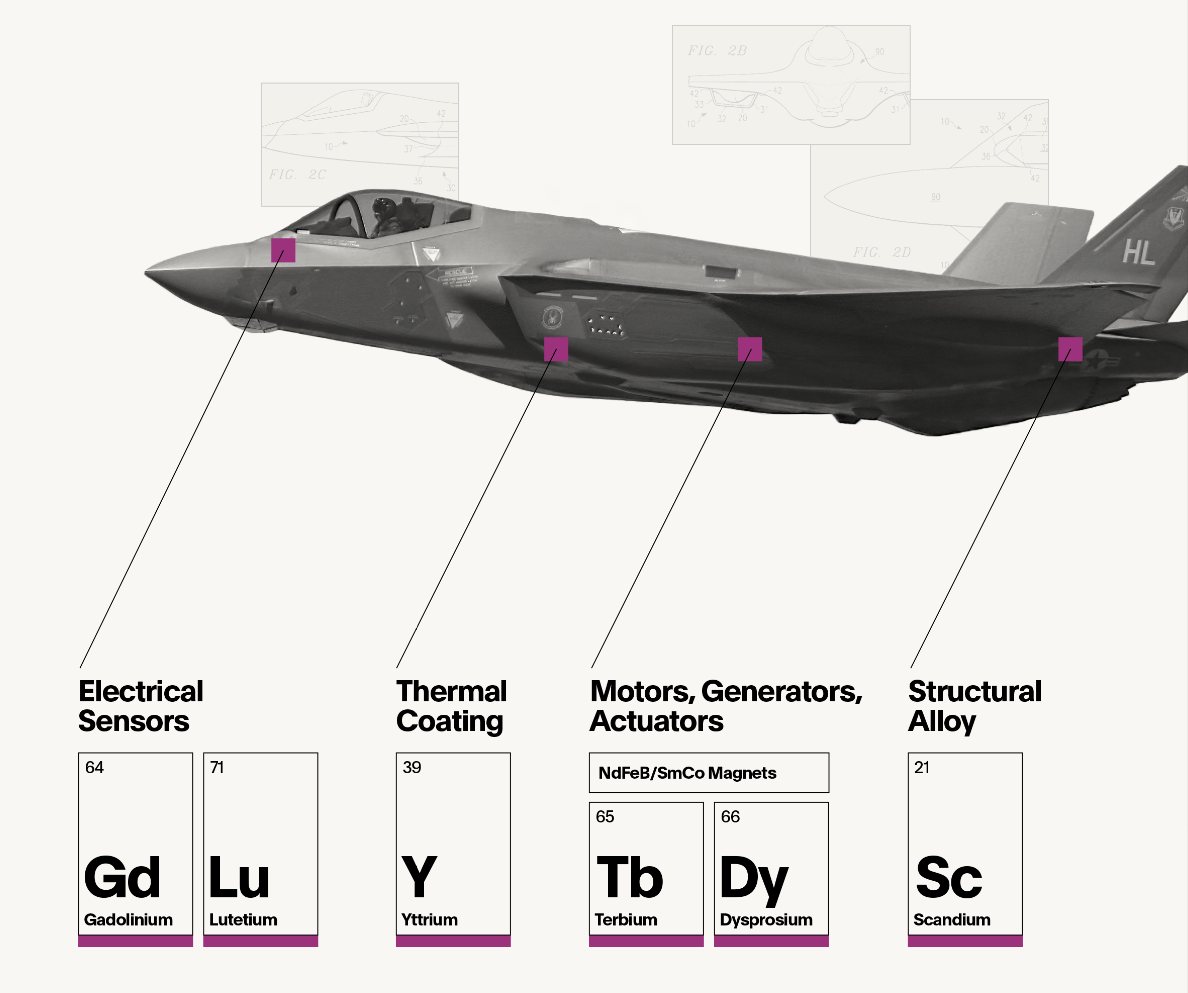
China’s domination of rare earths and minerals, and the extraterritorial restrictions recently placed on exports, affects a slew of vital products produced by DIB contractors. The complexity of DIB manufacturing means that in a single military application, many rare earths and magnets are needed for production.
Critical minerals and magnets subject to China export controls have a range of applications across the U.S. defense industrial base.
  • Fighter jets depend on a host of minerals and magnets for electrical sensors, thermal coating, motors, generators, actuators, and structural alloy.
  • Unmanned aerial vehicles (UAVs) – more simply, drones – rely on scandium for structural alloy.
  • Submarines use terbium for sonar systems.
  • Destroyers need gadolinium for sonar.
  • Precision-guided missiles have yttrium-aluminum-garnet (YAG) lasers.
  • Smart bombs need SmCo magnets for control actuators and guidance systems.
  • C4ISR systems rely on a host of critical minerals, including gadolinium for electronic displays.

Adversarial reliance on critical minerals, magnets, high-tech manufacturing present far upstream in U.S. DIB supply chains
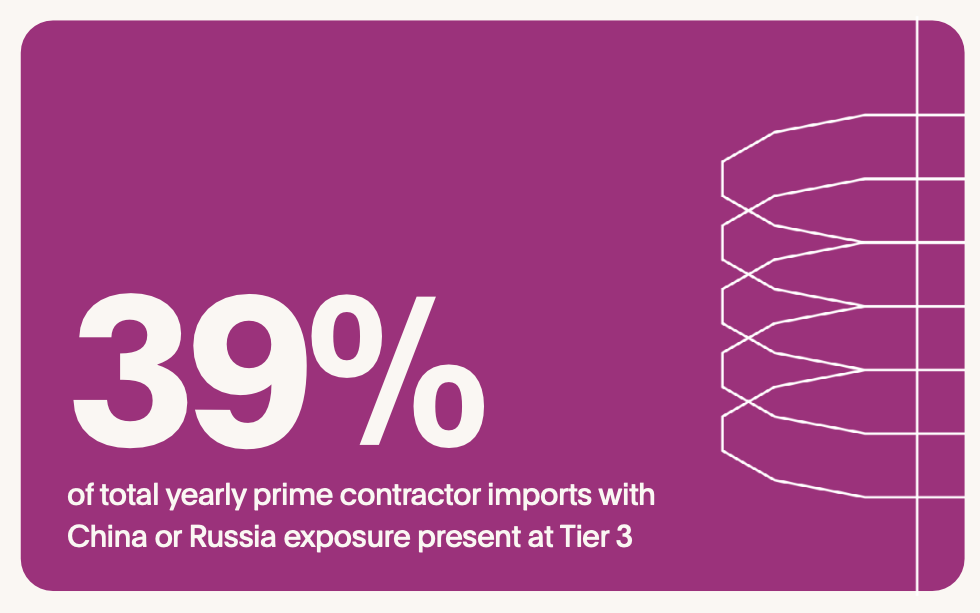
Global dependence on critical minerals from China is broadly reflected in the trading patterns and relationships of U.S. defense contractors and sub-contractors, for which upstream dependence on adversaries is endemic.
Altana analyzed millions of product and manufacturing component imports of 609 defense contractors and sub-contractors. In 2024 alone, this group had 272,911 transactions in which China or Russia exposure was present at Tier 3.
The affected components included the most sensitive parts of military applications, including electronic controllers for drones, vacuum insulated storage tanks for transporting gases that fuel rockets and missiles, dielectric spacers for radar systems, and large volumes of electronic components destined for command and control systems.
prime contractor imports china or russia exposure
ndaa exposure upstream

Vast, upstream Section 1260H China exposure present in DIB value chains

In the last five years, the National Defense Authorization Act (NDAA) has been burnished with a compounding set of provisions that prohibits the Department of Defense from engaging with entities linked to Chinese military companies.
A particular challenge for the defense industrial base: Section 1260H, first introduced in 2021, requires the Department of Defense to publish yearly a list of Chinese military companies operating directly or indirectly in the U.S.
Section 805 of the FY2024 NDAA prohibits the DoD from contracting with entities flagged under the 1260H provision. Starting on June 30, 2026, the DoD will be prohibited from entering into direct contracts on listed entities. One year later, the prohibition extends to indirect procurements, meaning defense contractors must ensure their supply chains are free from goods, services, and technology from these listed Chinese military companies – or they will lose government contracts.
Altana’s analysis indicates that in advance of 2027, defense contractors will struggle to comply with rules barring Chinese military suppliers in their upstream supply chains.
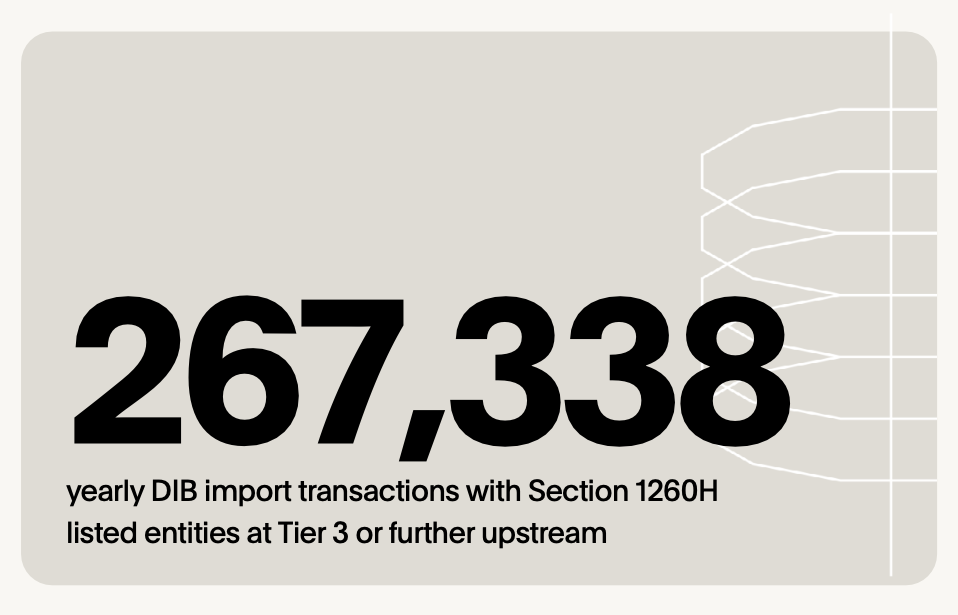
In 2024, the evaluated group of 609 contractors and sub-contractors had 267,338 import transactions in which Section 1260H listed entities were present in Tier 3 or further upstream. Given the Gartner finding that only 17% of Chief Procurement Officers have visibility into Tier 3 suppliers, it’s likely that many prime DIB contractors and their sub-contractors don’t presently have an honest accounting of their vast, business-critical Section 1260H exposure.

High-value upstream imports from Section 1260H listed suppliers reverberate across U.S. DIB supply chain
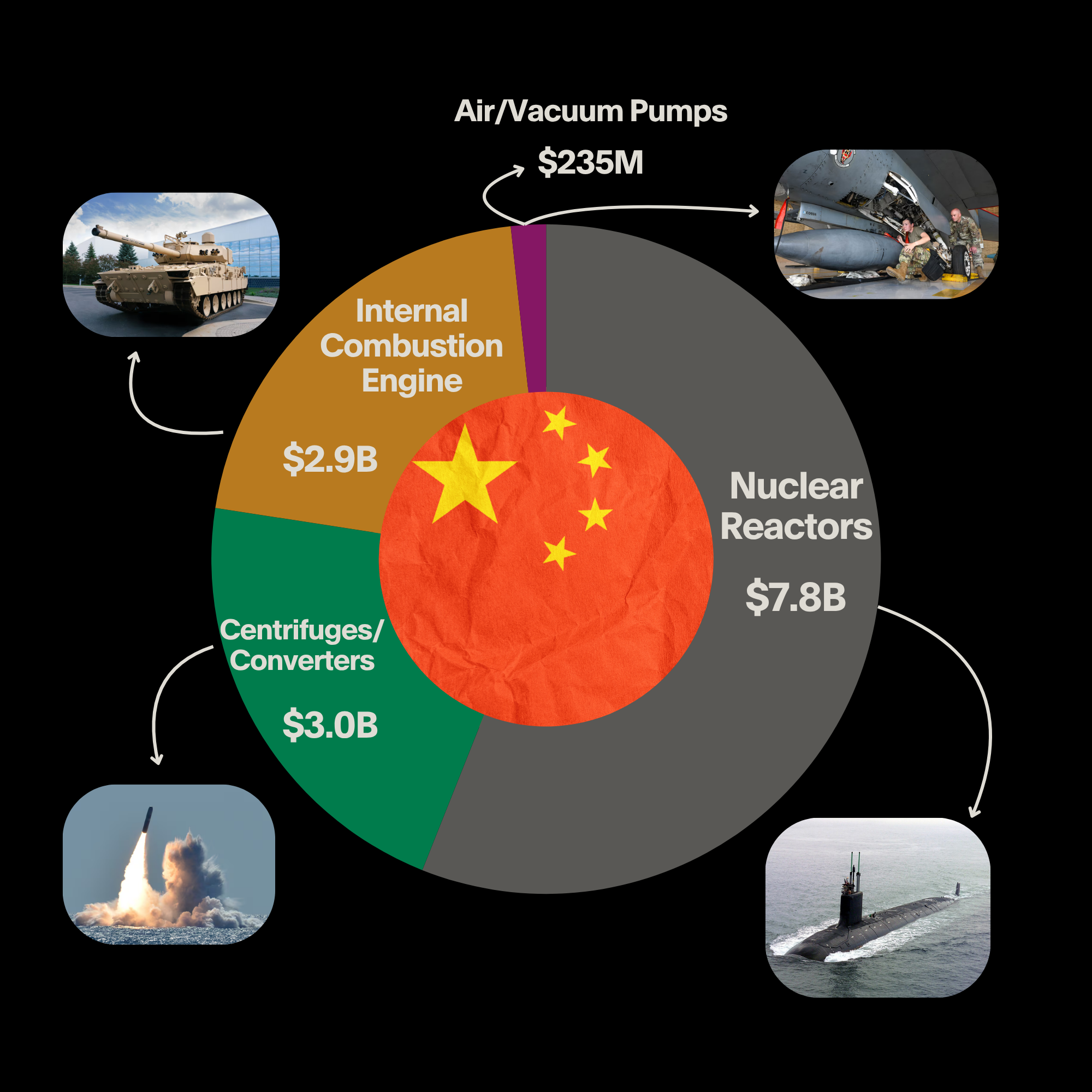
Altana’s analysis reveals that the upstream exposure to Chinese entities listed under Section 1260H of the NDAA affects billions of dollars of yearly imports to U.S. defense contractors.
$7.8 billion of shipment value flowing from nuclear reactors and nuclear reactor parts contains upstream exposure to Chinese military entities. Nuclear reactors are a vital component in ballistic submarines, the warships that transport and stage hypersonic weapons, and other applications. Listed Chinese entities also exist upstream in the high-value trade lanes of centrifuges and converters ($3 billion yearly); internal combustion engines ($2.9 billion yearly); and air-vaccum pumps ($235 million yearly). These parts are vital for producing missiles, tanks, automotives, pneumatic conveyers, service parts, and other specialized military equipment.
section 1260h applications

Broad trade disruption means compliance challenges, free trade qualification needs exist in the same DIB value chains

The broad, multi-faceted nature of trade disruption means that withinDIB value chains, compliance challenges exist side-by-side with tariff exposure and potential cost increases. A multi-lens analysis of a prime DIB contractors’ value chain for a large, mission-critical weapons system reveals a startling picture:
  • A Tier 1 sub-contractor in the U.S.
  • A Tier 2 manufacturer in Mexico
  • A Tier 3 SmCo magnet producer that appears on the Section 1260H List.
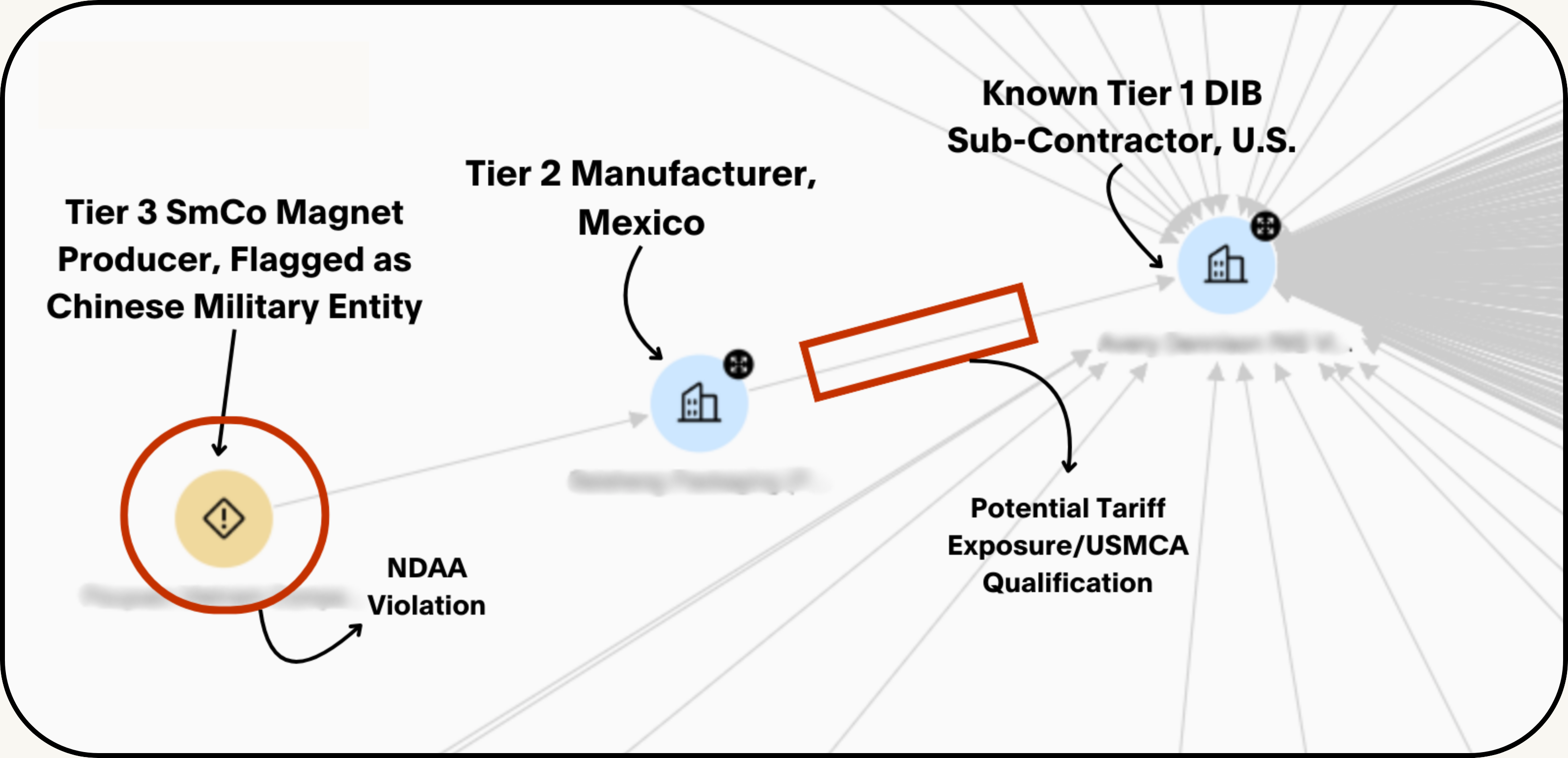
The result: On a single value chain, in which the prime is directly engaging with a U.S. sub-contractor, the prime is both potentially exposed to passed-on tariff costs and has Section 1260H exposure that, starting in 2027, would get them barred from DoD contracts.
entity multiple vulnerabilities

Get DIB value chain visibility, traceability, and collaboration with Altana’s Product Network

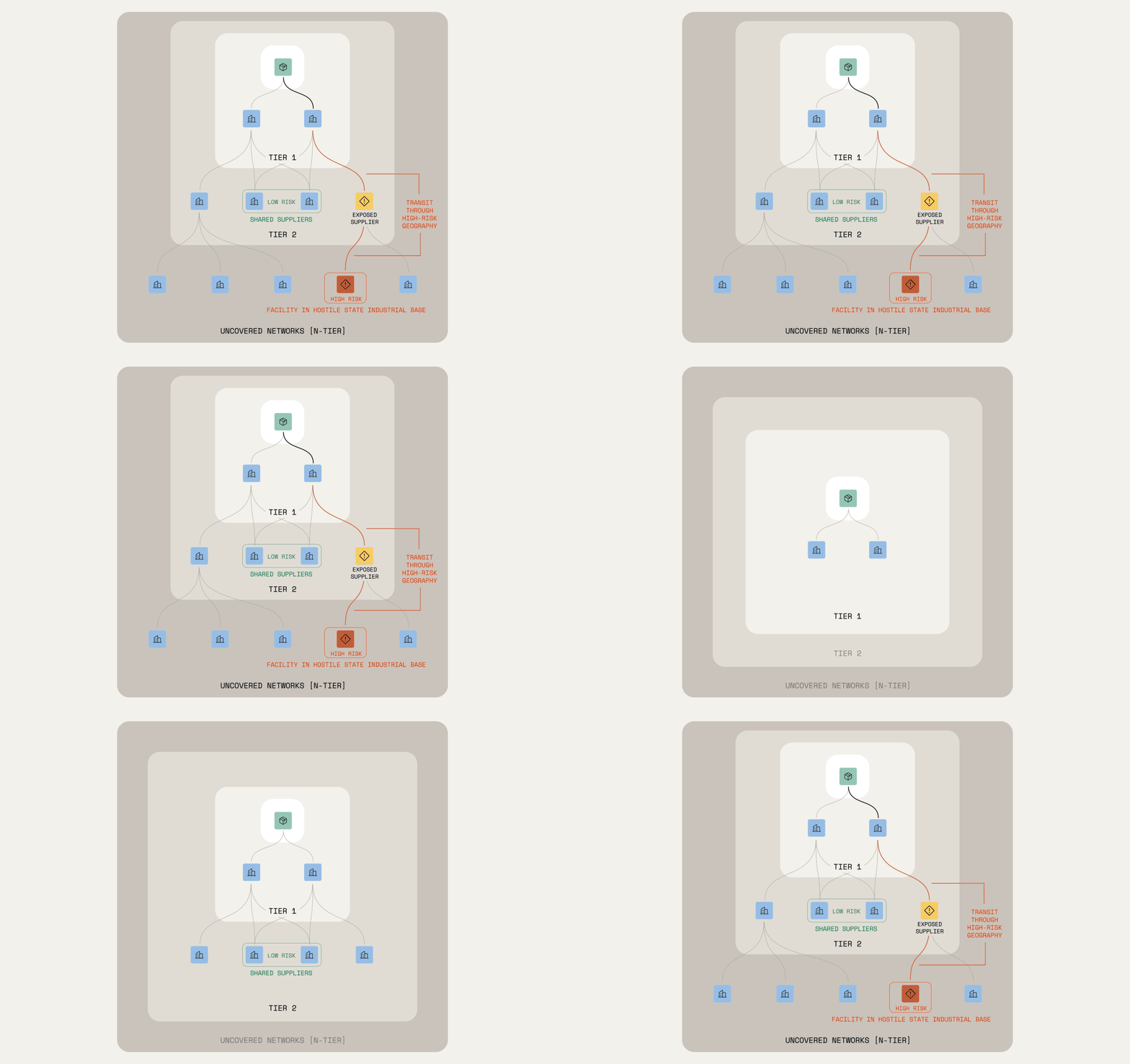
Unlike tired supply chain technology that requires burdensome and inaccurate manual mapping, risk screening tools, and supplier surveys, Altana’s Product Network makes it possible for DIB contractors and sub-contractors to illuminate, design and collaborate across product-level value chains.
  • Visibility means getting an instant, dynamic map of n-tier relationships at a product level. AI reveals specific multi-tier product value chain connections and uncovers hidden relationships and risks, such as upstream exposure to entities flagged on the Section 1260H list or specific suppliers subject to high, compounding tariffs.
  • Traceability means having detailed data and documentation on a product’s lifecycle, as verified by upstream suppliers.
  • Collaboration means closer relationships and more real-time communication with partners and regulators. Altana Product Passports can be used to collaborate with upstream and downstream supply chain partners, and can be shared with regulators to prove compliance
test
collaborate product passports

How Altana’s Product Network enables DIB companies to build compliant, resilient, cost-effective value chains

The visibility, traceability, and collaboration unlocked by Altana’s Product Network helps DIB contracts and sub-contractors design product value chains that are compliant, resilient, and cost-efficient.
  • Demonstrate compliance with NDAA and other restrictions: Identify compliance risks, including Section 1260H entities, hidden in upstream value chains. You can remediate risks by collaborating with upstream suppliers to get documentation, or by identifying alternate suppliers.
  • Future-proof product value chains by identifying single points of failure and potential bottlenecks – geopolitical, environmental, and otherwise – in upstream value chains. You can then source new suppliers that are less exposed to these risks to enhance resilience.
  • Assess tariff impacts and claim FTAs that lower import duties. Assess cost increases hidden in your upstream value chains resulting from input materials being subject to different tariff rates. You can identify products eligible for USMCA and other free trade agreements based on value chains in Altana, qualifying your FTA claims in seconds with AI.
  • Clear the border fast and efficiently by submitting Altana Product Passports to CBP to clear components for entry before shipments hit the border. Collaborating with CBP means you proactively address concerns and minimize the costs associated with penalties, delays, and detentions.

Business impact of the Altana Product Network for the DIB

Having compliant, resilient, cost-efficient value chains comes with deep, structural business benefits. DIB companies that join Altana’s Product Network have clear, quantifiable success metrics, with guaranteed ability to:
Illuminate sub-tier value chains

Illuminate sub-tier value chains

Achieve 75%+ visibility into Tier 2 suppliers and 60%+ visibility into Tier 3+ suppliers for critical, global supply chains within 90 days

Perform fast, extensive entity resolution

Perform fast, extensive entity resolution

Normalize and enhance 95% of existing supplier data through entity resolution

Reduce risks and disruption

Reduce risks and disruption

Reduce time to identify multi-tier supply chain risks by 70%

See and act on new value chain insights

See and act on new value chain insights

Deliver initial value chain insights within 30 days of implementation

Identify business-critical risks

Identify business-critical risks

Identify previously unknown risk exposure in 5%+ of critical supply chains

Request a demo to see Altana's network for trusted trade in action.
  • Defense Prime Supply Chains Riddled with NDAA Section 1260H Violations

    Insights

    Defense Prime Supply Chains Riddled with NDAA Section 1260H Violations

  • The Li-Ion's Share: Analyzing Vast China Critical Minerals Exposure in U.S. Value

    Guides & Research

    The Li-Ion's Share: Vast China Critical Minerals Exposure in U.S. Value Chains

  • Defense Prime Supply Chains Riddled with NDAA Section 1260H Violations

    Insights

    Reliance on Foreign Sources Imperils Defense Supply of Critical Minerals, Risks Tariff Costs

Subscribe to the Altana newsletter

Latest news, announcements and updates direct to your inbox

  • Privacy Policy
  • ©Altana 2025. All Rights Reserved.
  • Altana and the Altana logos are trademarks of Altana Technologies, Inc., in the United States and other countries.

Company Type

  • Platform
  • For Government
  • For Enterprises
  • For Suppliers
  • For Logistics

Use Case

  • Tariffs & Trade Compliance
  • Resilience
  • Counternarcotics

Resources

  • Resources
  • Cookie Preferences
  • Trust Center

About

  • About Us
  • Careers
  • Legal
Altana
  • Privacy Policy
  • ©Altana 2025. All Rights Reserved.
  • Altana and the Altana logos are trademarks of Altana Technologies, Inc., in the United States and other countries.